Infrastructure Engineering: Systems, Networking, Databases & the Internet
Network architecture, internet protocols, database and systems design, and the infrastructure engineering decisions that determine whether real production systems hold up under load.

Find MTU Between Two Hosts Using Ping Do-Not-Fragment
If you have ever tried to use jumbo packets, or trace a weird slowness on the network – one of the things that frequently comes up is packet fragmentation. This is basically where a source machine is sending bigger packets than can be consumed along its pathway to a destination machine. This means the packets […]
Read more →
Has Microsoft’s Moat Been Breached? What Is Left of the Enterprise Fortress?
1. Microsoft the company is doing perfectly well, and that is not the question I am asking Let me kill the easiest objection to this article before anyone reaches for it, because the objection is entirely reasonable and entirely beside the point. Microsoft 365 Commercial cloud revenue grew 14% in Microsoft’s latest reported quarter, paid […]
Read more →
pi2s3: An AMI for Your Raspberry Pi
If you have ever had a Raspberry Pi die on you, you know exactly what the recovery process looks like. You flash a new SD card or NVMe, reinstall your packages, rebuild your Docker stacks, reconnect your Cloudflare tunnel, reconfigure nginx, re-enter your credentials, clone your repos, tweak your cron jobs, and spend the better […]
Read more →Mac: Find Open Ports and IP Addresses with lsof & netstat
Below is a dump of examples of doing pretty much the same thing differently. I mostly use netstat and lsof, coupled with some bash scripts. You can argue that this is overkill, but below is a simple bash function that you can paste into terminal and call it whenever you want to see which application/process […]
Read more →Mac OS X: Find Which Network Interface Routes Traffic
If you have multiple connections on your device (and maybe you have a zero trust client installed); how do you find out which network interface on your device will be used to route the traffic? Below is a route get request for googles DNS service: If you have multiple interfaces enabled, then the first item […]
Read more →
QUIC: The Protocol That Breaks Your Site Without Warning
Why It Exists, What It Gets Wrong, and How to Diagnose and Fix It Andrew Baker · andrewbaker.ninja · 2 May 2026 1. Why TCP Was a Problem QUIC is a complete replacement for the TCP transport layer. To understand why that replacement was necessary, you need to understand what TCP does internally and where […]
Read more →How to Find and Set the MTU on Windows (Step-by-Step)
If you have just changed ISPs or moved house and your internet suddenly starts misbehaving the likelihood is your Maximum Transmission Unit (MTU) is set too high for your ISP. The default internet facing MTU is 1500 bytes, BUT depending on your setup, this often needs to be set much lower. Step 1: First check […]
Read more →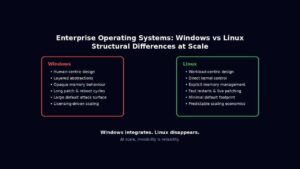
Windows Server vs Linux for Enterprises: 10 Key Differences
Enterprise operating systems for servers, are not chosen because they are liked. They are chosen because they survive stress. At scale, an operating system stops being a piece of software and becomes an amplifier of either discipline or entropy. Every abstraction, compatibility promise, and hidden convenience eventually expresses itself under load, during failure, or in […]
Read more →
How to Set Up a Cloudflare Tunnel on a Raspberry Pi (From Zero to Live)
Goal: Expose a service running on your Raspberry Pi to the public internet, securely, without port-forwarding or a static IP, using Cloudflare Tunnel. What You’ll End Up With Prerequisites Requirement Notes Raspberry Pi (any model) Running Raspberry Pi OS (64-bit recommended) A domain name e.g. yourdomain.com purchased anywhere (Namecheap, GoDaddy, etc.) SSH access to the […]
Read more →Model Context Protocol: Enterprise Implementation Guide
The Model Context Protocol (MCP) represents a fundamental shift in how we integrate Large Language Models (LLMs) with external data sources and tools. As enterprises increasingly adopt AI powered applications, understanding MCP’s architecture, operational characteristics, and practical implementation becomes critical for technical leaders building production systems. 1. What is Model Context Protocol? Model Context Protocol […]
Read more →
DNS Lookup with DIG: Query Records & Trace Resolution
DIG is an awesome command line utility to explore DNS. Below is a quick guide to get you started. Query Specific Name Server By default, if no name server is specified, dig will use the servers listed in /etc/resolv.conf file. To view the default server use: You can override the name server against which the query will be executed, […]
Read more →
Dublin Traceroute on macOS: Install & Usage Guide
Modern networks are far more complex than the simple point to point paths of the early internet. Equal Cost Multi Path (ECMP) routing, carrier grade NAT, and load balancing mean that packets from your machine to a destination might traverse entirely different network paths depending on flow hashing algorithms. Traditional traceroute tools simply cannot handle […]
Read more →