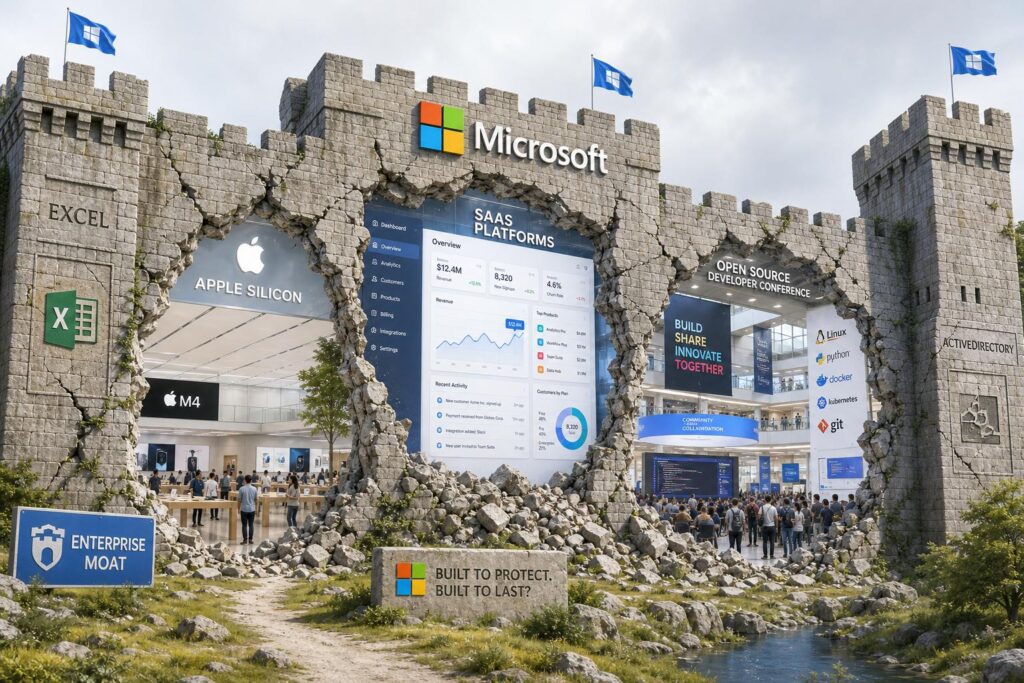
Has Microsoft’s Moat Been Breached? What Is Left of the Enterprise Fortress?

1. Microsoft the company is doing perfectly well, and that is not the question I am asking
Let me kill the easiest objection to this article before anyone reaches for it, because the objection is entirely reasonable and entirely beside the point. Microsoft 365 Commercial cloud revenue grew 14% in Microsoft’s latest reported quarter, paid commercial seats grew 6%, and Microsoft now says Microsoft 365 Copilot has passed 30 million paid seats, which means we are discussing an extraordinarily successful software business with one of the largest installed bases in commercial history. (Microsoft)
The question I actually care about is narrower and considerably more interesting, which is whether the Microsoft enterprise moat has been breached, because a moat and a company are not the same object and they do not fail at the same time.
For roughly thirty years, buying Microsoft was not a sequence of independent product decisions so much as a single decision that quietly made every subsequent decision for you. You bought Windows, which made Active Directory obvious, which made Office obvious, which made Exchange obvious, which eventually made Teams obvious, which made SharePoint tolerable, and before very long Microsoft could sell you an enterprise agreement containing products you actively wanted, products you vaguely suspected you needed, and products that nobody in the organisation could remember requesting. That was the moat, and it worked because the products reinforced one another so effectively that competing with Microsoft meant competing with the entire fortress rather than with one building inside it.
I am no longer convinced that fortress works the way it used to, and the reason has less to do with any single competitor than with the disappearance of the dependencies that used to hold the whole structure together.
2. Start with the device sitting in front of the employee
For most of corporate computing history the endpoint decision was barely a decision at all, because a company laptop meant Windows and the only remaining question was which model and how much memory. That assumption has weakened considerably, and while Windows still dominates enterprise computing and we should not pretend otherwise, the direction of travel is what deserves attention. Apple reached approximately 11% of the US enterprise PC market during 2025, up 2.4 percentage points in a year, with Mac shipments growing 11.2% against broader PC industry growth of 3.3%. (Computerworld)
Apple Silicon changed the economics as much as it changed the user experience, because current Macs advertise battery life of up to 24 hours while Apple has continued pushing secure boot, hardware backed encryption and the Secure Enclave directly into the platform. (Apple) None of that means a Mac cannot be compromised, since of course it can, and anyone selling you a fleet on the basis that it is inherently safe is selling you something other than security. What it does mean is that the old enterprise argument, in which Windows was the sensible corporate platform and Macs were expensive machines purchased for designers, has become very difficult to sustain in a procurement conversation with anyone paying attention.
The more important shift is that modern SaaS removed most of the reason the operating system mattered in the first place. Salesforce does not care what laptop you use, and neither does AWS, ServiceNow, Slack, Zoom, your browser or your AI assistant, which means that once applications stopped requiring Windows, Windows had to start competing as an endpoint rather than functioning as a prerequisite for everything else you had already bought. That is a profound change and it sits underneath almost everything else in this article.
3. So what is actually left of the Microsoft end user moat?
If I were decomposing a typical large enterprise Microsoft estate today and scoring each component honestly rather than diplomatically, I would arrive at something close to the following.
| Product | My view of the moat |
|---|---|
| Excel | 🏰🏰🏰🏰🏰 Extremely strong |
| Exchange and Outlook | 🏰🏰🏰🏰 Strong |
| Teams | 🏰🏰🏰 Strong, but substantially distribution driven |
| Power BI | 🏰🏰🏰 Strong |
| PowerPoint | 🏰🏰 AI is eroding it |
| Word | 🏰🏰 Increasingly a file format |
| OneDrive | 🏰🏰 Sticky plumbing |
| SharePoint | 🏰 Sticky plumbing with a user interface attached 🤣 |
| OneNote | 🏰 Surrounded by better modern alternatives |
| Visio | 🏰 Lucidchart, Figma and Miro happened |
| Project | 🏰 Jira, Linear, Asana, Monday and dozens more happened |
| Edge | 🪦 Chromium wearing a Microsoft jacket |
| Copilot | ❓ Important and growing, but fighting the most competitive software market on Earth |
| Active Directory | 🧱 Enormous legacy gravity, diminishing strategic importance |
| Windows Server | 🧱 Legacy gravity rather than future differentiation |
The table is deliberately provocative, but the architectural point underneath it is serious, which is that the Microsoft moat is no longer evenly distributed across Microsoft products. Some of these products remain genuinely exceptional and would win on merit in an open contest, some survive largely because of file compatibility, some survive because they are hidden underneath another Microsoft product that users are obliged to touch, and some survive principally because an enterprise agreement made removing them more effort than leaving them where they are. Those are four very different forms of customer loyalty and it is a mistake to price them as though they were one.
4. Excel may be the last great Office moat
If you forced me to name the single Microsoft application I would least like to remove from a large enterprise, it would not be Teams, Word or PowerPoint, because it would be Excel and it would not be close.
Excel stopped being a spreadsheet several decades ago and became something considerably stranger, which is an undocumented application platform that also functions as an accounting system, a pricing engine, a database, a reporting layer, a workflow tool and occasionally a small core banking system that somebody built in 2007 and everyone is now afraid to touch. Finance departments do not use Excel so much as live inside it, accountants exchange workbooks containing formulas, external references, macros, pivot tables and Power Query models, analysts know the keyboard shortcuts at a level that is close to subconscious, and files pass between companies with a shared expectation that the other side can open them and that every calculation will behave exactly as intended. That is a proper moat, built out of network effects and institutional muscle memory rather than out of licensing terms.
AI will eventually attack parts of Excel, because natural language interfaces can generate analysis, formulas and models without requiring the user to know how any of it works, but I suspect the first order effect actually strengthens Excel rather than weakening it, since AI removes much of the skill barrier to operating the tool while leaving the underlying workbook ecosystem completely intact. I would not bet against Excel.
5. Outlook is really Exchange wearing a user interface
Outlook is a more interesting case, partly because people complain about it incessantly and largely with justification, and partly because Microsoft has managed to produce so many concurrent Outlook experiences that “which Outlook?” became a legitimate opening question in a support call. I have written previously about the absurdity of having two Outlooks and neither of them working properly.
Replacing Outlook, though, is not really an Outlook question at all. The deeper moat is Exchange Online, which carries corporate email, calendars, shared mailboxes, distribution groups, retention policies, compliance, discovery and several decades of business processes that were quietly built around the assumption that an email address and a calendar entry are stable organisational primitives. The client is replaceable and always was, whereas the organisational dependency underneath it is a great deal harder to remove.
Google Workspace is the obvious credible alternative and plenty of modern companies start there rather than with Microsoft, which is a real signal about greenfield preference. For a mature enterprise already embedded in Exchange, however, migrating email remains one of those programmes where the PowerPoint describing the migration invariably looks substantially easier than the migration itself, so Outlook survives partly because Outlook is Outlook, but mostly because Exchange is sitting underneath it.
6. Teams is strong, but how strong would it be without the bundle?
Teams is Microsoft’s most fascinating modern moat precisely because it demonstrates both the strength of the old model and the weakness inside it. There is no question about the scale, since Microsoft still cites more than 320 million monthly active users, and no amount of scepticism about distribution makes a number like that unimportant. (Microsoft Learn)
The awkward counterfactual has always been how much of that adoption came from users choosing Teams on its merits and how much came from CIOs discovering that they already effectively owned it, because Teams competed against Slack and Zoom while sitting inside one of the most powerful software distribution machines ever constructed. The European Commission eventually took an interest in exactly this question, and in September 2025 it accepted commitments from Microsoft requiring the company to offer Office 365 and Microsoft 365 suites without Teams at lower prices and to improve interoperability with competing collaboration products. (European Commission)
None of that makes Teams a bad product, and I want to be clear that it is not. It does make the next phase considerably more interesting, because once customers can price Teams separately from the rest of Microsoft 365 we finally get a reasonable test of what Teams is worth on its own terms.
7. Word has a new problem, which is that people may stop writing documents at all
Word is where AI begins doing something much more destructive to the traditional Office moat than any competing word processor ever managed. The old competition was Microsoft Word against another word processor, and that was a contest Microsoft could reliably win because document compatibility, corporate templates, Track Changes, macros and twenty years of muscle memory produced switching costs that no feature list could overcome.
The question now is what happens when the competition stops being another word processor. I increasingly do not begin a document by opening a blank document, because I begin with AI instead. I explain what I want, the model produces a first draft, I argue with it, rewrite sections, add evidence, restructure the whole thing and eventually export the result into whatever format the recipient expects to receive. At that point Word is not the authoring environment in any meaningful sense, since it has become the renderer, and if Word is principally the application that opens a DOCX after the interesting work has already happened elsewhere then its strategic value has changed dramatically even though its installed base has not moved at all.
For ordinary business documents, it is worth asking whether LibreOffice could handle the final ten percent, or Google Docs, or a browser based editor, or whether the AI platform could simply produce the DOCX itself. For a growing proportion of users I suspect the answer to all of those is yes, which suggests the file format will outlive the strategic importance of the application that created it.
8. PowerPoint has exactly the same problem, only more so
PowerPoint is arguably more exposed than Word, because the traditional workflow was so painfully manual that anything capable of removing it was always going to be adopted enthusiastically. You began with a blank slide, added a title, hunted for an image, moved boxes around, fought with alignment, discovered that somebody had changed the corporate template while you were away, and then spent twenty minutes moving everything three pixels to the left.
AI changes the unit of work rather than the efficiency of the work, which is a much larger shift. The instruction becomes something closer to “create twelve slides explaining this strategy to an executive committee, use these financials, include these three risks, keep the diagrams simple and generate speaker notes”, and whether that instruction is issued in ChatGPT, Claude, Gemini, Gamma, Canva, Microsoft Copilot or something that has not been invented yet is almost secondary to the fact that the model, not the editor, is now where the presentation is conceived.
PowerPoint will remain, because PPTX is thoroughly embedded in corporate life and because presentations always need last mile editing before they meet an audience. That is a considerably weaker position than being the application through which presentations are actually imagined and assembled, and once again the format looks likely to have more longevity than the product.
9. Then we reach the strange furniture Microsoft accumulated around Office
Edge is a competent browser and I have no interest in pretending otherwise, but browsers became commodities, Edge is built on Chromium anyway, and its most visible competitive advantage is sometimes the extraordinary determination with which Windows reminds you that Microsoft Edge exists. Corporate browser controls have real value, browser security has real value, and managed browsing has real value, yet I struggle to picture the CIO who opens a Microsoft renewal negotiation by insisting that whatever else happens, the organisation must retain Edge. 🤣
SharePoint may be the finest example in enterprise software of a product that survived by quietly becoming infrastructure. Ask users whether they love SharePoint and watch their faces, then ask the infrastructure team whether it can be removed and observe an entirely different expression, because SharePoint sits underneath document libraries, Teams content, permissions, intranets, workflows and a substantial portion of Microsoft 365 content management, and Microsoft is now integrating Copilot even more deeply into it. (Microsoft Learn) SharePoint therefore does not disappear, it simply becomes something that fewer and fewer people consciously choose to visit, which is not a user experience moat so much as archaeological sediment.
OneNote once occupied an unusually valuable position, because everybody needs somewhere to put notes and Microsoft was already on the desktop. Then Notion, Obsidian, Apple Notes, Google Keep and an entire army of knowledge tools arrived, and now AI itself increasingly remembers, summarises and retrieves information on the user’s behalf. The category is not disappearing at all, but the reason it has to be OneNote certainly is.
Diagramming used to mean Visio, whereas today it might mean Lucidchart, Miro, Figma, Mermaid, draw.io or simply asking an AI system to generate the diagram and iterating on it in a chat window. The diagram remains important and Visio has become optional, which is a bad place for a product to sit inside a bundle that is being priced more aggressively every year.
Project management experienced the same decomposition, since Jira became close to universal in software development, Linear made issue tracking pleasant enough that people volunteer to use it, and Asana, Monday.com, Smartsheet and others attacked the adjacent workflows. Microsoft Project still exists, and that sentence may currently be its strongest marketing campaign.
10. And then there is Copilot 🤣
Copilot deserves more nuance than the rest of the furniture, because laughing at it is easy while declaring it unsuccessful would be factually wrong. Microsoft says paid Microsoft 365 Copilot seats exceeded 30 million in its latest quarter, and Copilot alongside the E5 and emerging E7 tiers is helping Microsoft push revenue per user upward, which is significant adoption by any standard. (Microsoft)
Copilot nonetheless has a strategic problem that Office never faced. When Microsoft constructed the Office moat there was no equivalent of a Word from OpenAI appearing out of nowhere and becoming globally relevant within two years, whereas AI is a brutally competitive market in which distribution advantages decay quickly. Okta’s 2026 Enterprise AI Index shows AI native companies including OpenAI, Anthropic and Cursor multiplying their enterprise customer bases rapidly, while established products such as Microsoft 365, Google Workspace, Slack, Adobe, Notion and Figma respond by adding AI of their own, and the striking finding is that enterprises are not choosing a camp at all, since they are installing both. (Okta) That is difficult terrain on which to construct a traditional Microsoft moat.
Microsoft 365 Copilot currently lists at $30 per user per month for enterprise customers and requires a qualifying Microsoft 365 subscription, which forces a question quite unlike the old Office decision. (Microsoft) Is Copilot the best AI assistant for this particular employee doing this particular job, or are we buying it because the procurement path is convenient and the invoice already exists? Those are not the same question and they should not produce the same answer by default.
11. Active Directory is already telling us where this goes
The erosion of the traditional Microsoft architecture is most visible in identity, which I covered separately in “Microsoft moved on from Active Directory. Should you?”. Microsoft has not discontinued Active Directory and that is not the argument being made here. The argument is that AD is no longer the strategic centre of modern Microsoft identity, because the new thinking is happening around Entra, conditional access, passwordless authentication, workload identity and cloud services, while AD remains enormously important for the simple reason that enterprises accumulated twenty years of Kerberos, LDAP, Group Policy, service accounts and domain dependencies around it.
That accumulation is installed base gravity and it is genuinely powerful, but it is not the same thing as strategic momentum and it should not be mistaken for it during a renewal. Once your Macs no longer need a Windows domain, your SaaS applications authenticate using modern identity protocols, your AWS workloads assume IAM roles and your applications stop binding to LDAP, another substantial section of the old Microsoft dependency graph quietly disappears without anyone announcing a migration.
12. Windows Server has the same smell
I recently made a similar argument about Windows Server, which is not disappearing tomorrow and will not disappear for years, because there are enormous estates running SQL Server, .NET Framework applications, vendor software and domain infrastructure that will continue operating for as long as the business depends on them.
Microsoft’s own financial results nonetheless tell us where the movement is happening, since on premises server revenue was essentially flat in the latest quarter while Azure grew 43%, and Microsoft itself expects continued customer movement from server products towards cloud offerings. (Microsoft) This is not death, it is a change in the strategic centre of gravity, and the distinction matters because future workloads increasingly run in containers, managed services, serverless platforms and cloud databases where the operating system is either Linux or somebody else’s implementation detail. Windows Server increasingly survives because something in the estate still needs Windows, and that is not how anyone describes a growth platform.
13. Which brings us to the $60 question
Microsoft 365 E5 now carries a US list price of $60 per user per month following Microsoft’s July 2026 pricing changes, with the version excluding Teams at $51.45, and full Microsoft 365 Copilot for enterprise sitting a further $30 per user per month on top of that. (Microsoft) Those numbers produce a procurement conversation quite unlike the one CIOs were having a decade ago.
Historically the Microsoft pitch worked because the marginal cost of accepting one more Microsoft product felt close to zero, which is why the questions were always shaped as “why would we buy Zoom when Teams is already in the bundle” or “why would we buy another endpoint product, another identity service, another collaboration platform”. The bundle weaponised procurement simplicity and it did so extremely effectively. At $60 for E5 with premium AI potentially layered above it, the question inverts, moving from “why would we not just use the Microsoft product” to “which of these products would we actually buy if each one arrived with its own purchase order and its own business case”.
That is the question every CIO should be asking, and the exercise is worth doing deliberately rather than rhetorically. Take the bundle apart conceptually and ask whether you would separately buy Teams, Word, PowerPoint, SharePoint, Edge, OneNote, Microsoft Project, every individual security component and Copilot. If the answer is no to enough of those line items, then the bundle discount is not functioning as a discount at all, since you are simply buying a large number of products you would never otherwise have purchased and congratulating yourself on the unit price.
14. Ironically, security may now be the strongest argument for E5
There is a genuine twist here that deserves more attention than it usually gets, which is that the future E5 argument may have very little to do with Office. Microsoft’s 2026 E5 packaging adds and combines increasingly substantial capabilities across Defender, Intune, Entra, Purview, Security Copilot, endpoint privilege management and cloud PKI, and Microsoft is clearly positioning the higher tiers around security, identity and device control at least as much as around Word and Excel. (Microsoft)
That changes what is actually being sold. The old proposition was essentially to buy the Microsoft productivity environment and accept the enterprise bundled around it, whereas the emerging proposition is closer to letting Microsoft become the control plane around your users, devices, identities, data and security. For some organisations that is an excellent proposition and I would defend it, but it needs to be evaluated as a control plane decision rather than inherited as a productivity decision. If your strategic identity platform is Okta, your endpoint fleet increasingly includes Macs, your collaboration platform is Slack, your meetings happen in Zoom, your AI platform is ChatGPT or Claude and your workloads live in AWS, then buying an entire Microsoft control plane because everybody still needs Excel begins to look like a decision nobody consciously made.
15. The enterprise stack is becoming composable
This is the wider trend that I think matters more than any individual product argument above, which is that enterprises used to select platforms and are increasingly selecting capabilities instead. The endpoint might be Apple, identity might be Okta, productivity might be Google Workspace, chat might be Slack, meetings might be Zoom, documents might be produced in ChatGPT or Claude, design might happen in Figma, knowledge might sit in Notion, workloads might run in AWS, security might come from several specialist vendors, and Excel might still sit immovably in the middle of the finance department because nobody is reckless enough to remove it.
None of this is hypothetical behaviour. Even several years ago Okta found substantial overlap between supposedly competing suites, with 48% of its Microsoft 365 customers also using Zoom and 42% also deploying Google Workspace, which tells you that the winner takes all framing was already wrong before AI arrived. (Okta) The modern enterprise stack is increasingly a matter of the best tool winning a specific job rather than a single vendor winning the account.
AI accelerates this considerably, because AI acts as an abstraction layer sitting above the applications themselves. If an agent can read a DOCX, create a PPTX, query a calendar, analyse a spreadsheet, search Slack, pull a document from Google Drive and file an issue into Jira, then the historical value of having everything inside one vendor’s user interface declines sharply, because the integration layer has moved upward and away from the suite. That may be the most important threat to the Microsoft moat of all, and it is the one Microsoft has the least ability to price against.
16. The moat has been breached, but the fortress has not fallen
So has Microsoft’s moat been breached? Yes, and I think the evidence is fairly clear. That is a very different claim from saying Microsoft is collapsing, and the financial numbers show the opposite, since Microsoft 365 is still growing, E5 is still selling, Copilot is adding millions of paid seats, Teams remains enormous and Excel remains almost absurdly entrenched. (Microsoft)
What has changed is the nature of the dependency rather than the scale of the estate. Twenty years ago, leaving Microsoft meant dismantling the corporate computing platform in a single terrifying programme, whereas today the pieces come apart individually. You can deploy Macs without abandoning Office, move identity without replacing Excel, replace Teams without replacing Exchange, create PowerPoint files without opening PowerPoint, create Word documents without writing them in Word, run a company without Windows Server and run AWS without Active Directory, and you can increasingly place an AI layer above all of it so that employees care much less about which application produced the artifact underneath.
That is what a breached moat looks like in practice. The castle is still enormous, still highly profitable and still contains some of the best enterprise software ever written, but the drawbridge is down, there are boats crossing the water, and the people inside have discovered that they can leave individual buildings without moving the entire company. For Microsoft that is the strategic problem, and for CIOs it is the opportunity.
Perhaps the most dangerous sentence in enterprise technology is no longer that nobody ever got fired for buying Microsoft. Perhaps it is that we already own it in E5, because that is not an architecture decision at all, it is procurement inertia wearing the vocabulary of one, and in 2026 I am no longer convinced procurement inertia is sufficient to hold the fortress together.