The Leadership Handoff: How Learned Helplessness And Management Bottlenecks Are Slowing AI Era Organizations

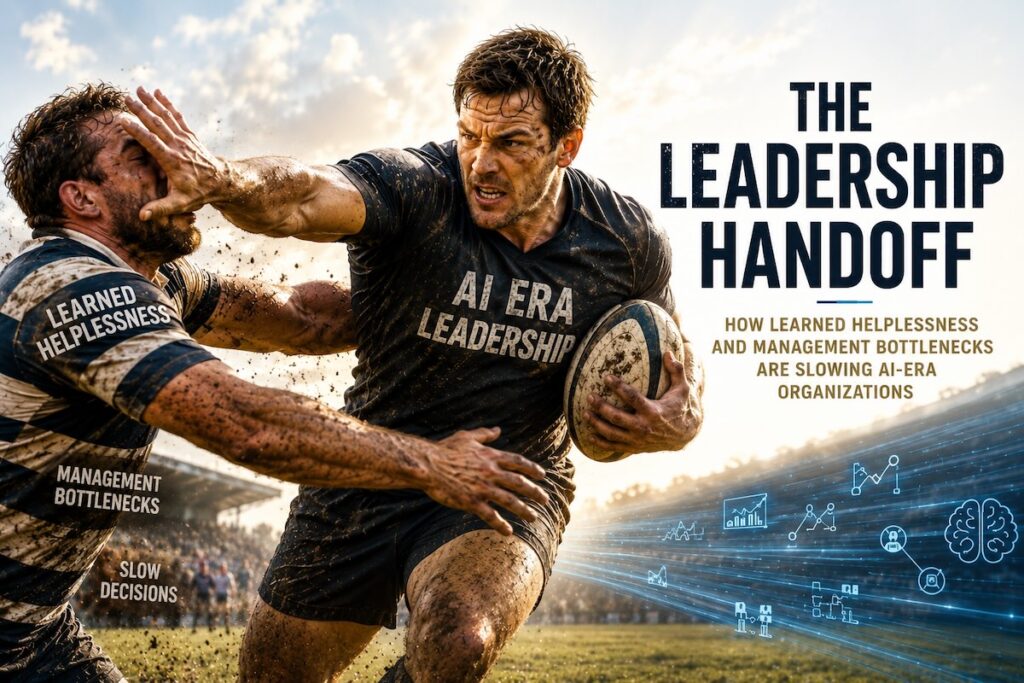
Learned helplessness and management bottlenecks slow AI era organizations when leaders fail to delegate decision making authority, creating dependency cultures where teams wait for approval rather than act. Like a poorly executed rugby tackle, overcentralized management exposes structural weakness, wastes momentum, and prevents organizations from scaling effectively in environments where speed and autonomous problem solving are decisive competitive advantages.
The Leadership Handoff: How Learned Helplessness And Management Bottlenecks Are Slowing AI Era OrganizationsAndrew Baker's Technology Blog Posts, 14/May/2026
https://andrewbaker.ninja/2026/05/14/the-leadership-handoff-how-learned-helplessness-and-management-bottlenecks-are-slowing-ai-era-organizations-v2/
1. The Rugby Lesson Most People Learn the Hard Way
If you have ever played rugby, you learn very quickly what a handoff is. You approach a player too high, too upright, or too casually, and suddenly there is a massive palm in your face while your dignity disappears backwards across the grass. The handoff is not subtle and it is not negotiable. It is an immediate correction mechanism that teaches you there is a right way to engage and a wrong way to engage, and the wrong way gets punished instantly.
After enough failed tackles, players stop approaching high because high tackles do not scale. They are structurally weak, they expose you, and they waste energy. Eventually you learn discipline, positioning, accountability, and how to solve the problem correctly yourself instead of hoping momentum and good intentions will save you.
Leadership works exactly the same way, except most organizations accidentally train people to tackle high every single day.
2. How Leaders Become Human Routing Layers
I am the CIO of a bank, and one of the most common patterns I see inside large organizations is people routing questions upward through leadership that they could easily solve themselves. This morning somebody sent me a WhatsApp asking about another business area and what functions that area performs. The interesting part was not the question itself. The interesting part was that the person asking already knows the executive who runs that business area and could have simply messaged them directly, but instead chose to route the traffic through me because leadership had become the path of least resistance.
At first this feels harmless. Leaders often interpret these interactions as collaboration, accessibility, or healthy communication. In reality, something much more dangerous is happening beneath the surface because the organization is slowly conditioning itself to use leadership as a navigational layer instead of building direct working relationships and self solving capability.
The questions almost always sound small and reasonable. Somebody wants to know who owns a system, which team supports a process, where a business function sits, or whether another area has already solved a similar problem. The leader answers because answering feels efficient and polite. The problem is that every unnecessary answer reinforces dependency, and once you become the person who reliably routes traffic, people stop solving navigation problems themselves.
The first question is never the real cost because the real cost is the behavioural pattern that follows afterwards. Once somebody learns they can route through leadership, they continue routing through leadership. The second message arrives asking for clarification, then comes additional context, more interpretation, political nuance, and eventually a debate or meeting that should never have existed in the first place. Thirty minutes disappears into an interaction that added almost no organizational value because the original problem never required executive involvement.
3. The Hidden Psychology Of Organizational Learned Helplessness
What makes this particularly dangerous is that the behaviour starts looking normal over time. Organizations become so accustomed to escalation and managerial routing that they stop recognizing the underlying pathology developing beneath the surface.
Psychologists refer to a similar phenomenon as learned helplessness, a concept pioneered by psychologist Martin Seligman. The theory demonstrated that when individuals repeatedly experience environments where initiative, control, or independent action are suppressed, they eventually stop attempting to solve problems themselves even when the freedom to act later becomes available.
The dangerous thing is that organizations unintentionally create the same conditioning mechanisms every day.
When employees repeatedly learn that the safest, fastest, or most rewarded path is escalating upward, they slowly stop building the instinct to navigate ambiguity independently. They stop asking direct peers. They stop building cross functional relationships. They stop exploring documentation, internal systems, historical decisions, or even modern AI tools capable of answering the question instantly. Instead, they wait for somebody higher in the hierarchy to interpret reality for them.
Eventually organizations begin producing highly capable people who behave helplessly inside operational systems.
Modern organizational research increasingly supports this pattern. Research into self managing organizations has shown that prolonged exposure to hierarchical environments creates what researchers describe as “cognitive, motivational, and emotional residues” that persist even after autonomy becomes available. Employees become psychologically conditioned to defer upward because escalation has been reinforced for years as the safest organizational behaviour.
The result is an organization filled with people waiting for answers instead of solving problems.
4. Why The Hub And Spoke Leadership Model Eventually Fails
Many companies unconsciously create hub and spoke operating models where information, relationships, and decisions continuously flow upward through a small number of senior people. Initially this can feel highly efficient because the leaders appear informed, connected, and responsive. Over time, however, the model becomes structurally catastrophic because the hub slowly collapses under the weight of accumulated coordination overhead.
No human being can sustainably operate as the routing layer for hundreds or thousands of micro interactions. Leaders who spend their days redirecting organizational traffic eventually lose the cognitive space required for strategic thinking, architecture, deep problem solving, mentoring, and long term planning. Instead of leading, they become human API gateways for organizational uncertainty.
This creates a vicious cycle because the more leadership acts as the routing layer, the less the organization develops independent navigation capability. Teams stop forming direct connective tissue with one another because hierarchy becomes the preferred communication protocol.
The organization slowly teaches itself dependency.
5. The Cost Of Waiting On Answers
One of the least understood scaling failures in large organizations is the hidden cost of waiting. Every unnecessary escalation introduces latency into the system. Work pauses while somebody waits for a response, interpretation, validation, or routing decision from leadership.
At small scale this appears manageable. At enterprise scale it becomes devastating.
The queue around leaders grows continuously because everybody learns that upward escalation is the safest path. Leaders become saturated with interruption traffic while employees spend increasing amounts of time blocked on answers they could often have solved independently.
This creates several cascading organizational failures simultaneously. Decision latency increases, context switching destroys leadership cognitive depth, and employees gradually lose confidence navigating ambiguity without managerial involvement. Over time, initiative declines because escalation becomes culturally safer than autonomy.
Research into workplace learned helplessness has shown measurable negative relationships between helplessness and work involvement, initiative, and proactive behaviour. Employees who become conditioned to dependency participate less actively and engage less deeply because the organization itself has taught them that independent action carries risk while escalation carries safety.
This is one of the reasons large organizations often feel slower than the intelligence level of the people inside them would suggest. The bottleneck is not lack of talent. The bottleneck is coordination gravity.
6. Why AI Makes This Problem Impossible To Ignore
This problem becomes dramatically more important in the AI era because information scarcity is no longer the primary organizational constraint.
Modern AI systems from OpenAI and Anthropic can already explain concepts, summarize documentation, analyze systems, answer operational questions, and accelerate problem solving in seconds. Internal search systems, collaboration platforms, architecture diagrams, chat histories, and organizational knowledge bases provide employees with more accessible information than companies have ever had before.
Yet many organizations still behave as though every answer must travel upward through management hierarchy before work can continue.
That operating model cannot survive AI scale.
As individual productivity increases through agentic tooling, the bottleneck shifts toward interruption management, coordination overhead, and organizational dependency. When one engineer can now produce what previously required entire teams, unnecessary human routing becomes existentially expensive.
The organizations that scale successfully over the next decade will not necessarily be the ones with the smartest leaders. They will be the organizations that most effectively eliminate unnecessary dependency patterns and build cultures of self solving behaviour.
7. The Leadership Handoff
In rugby, the handoff teaches the tackler to correct their technique. Leadership requires an equivalent correction mechanism because organizations must learn how to solve problems through direct engagement rather than hierarchy driven routing.
Sometimes the most important thing a leader can do is not answer.
This is not arrogance, indifference, or disengagement. It is structural discipline. When leaders refuse to become the routing layer for unnecessary traffic, people begin building healthier organizational instincts. They start asking the person who actually owns the problem. They develop direct relationships across teams. They use documentation, AI tooling, internal systems, and existing context to solve straightforward problems independently.
Healthy organizations are not defined by how frequently leadership gets involved. They are defined by how effectively people solve problems without needing leadership involvement in the first place.
That requires leaders to consistently reinforce direct ownership, direct communication, and self resolution behaviours even when answering immediately would feel socially easier. Over time, organizations begin building stronger connective tissue because people stop relying on hierarchy as the default coordination mechanism.
Individuals develop confidence navigating ambiguity independently while teams learn ownership boundaries more clearly. Relationships become more direct and less political, and decision making accelerates because communication paths flatten naturally instead of constantly escalating upward through management chains.
Eventually leadership stops functioning as a switchboard and returns to its actual purpose, which is creating strategic clarity, designing scalable systems, mentoring deeply, and shaping the long term direction of the organization.
The rugby handoff feels brutal when you first experience it, but it teaches an important lesson about structure, discipline, and positioning. Leadership handoffs serve exactly the same purpose because sometimes the correct response to an unnecessary question is silence, redirection, or a simple instruction to ask the relevant person directly. That is not leadership becoming inaccessible. It is leadership teaching the organization how to scale without collapsing under the weight of its own dependency patterns.
Additional Reading