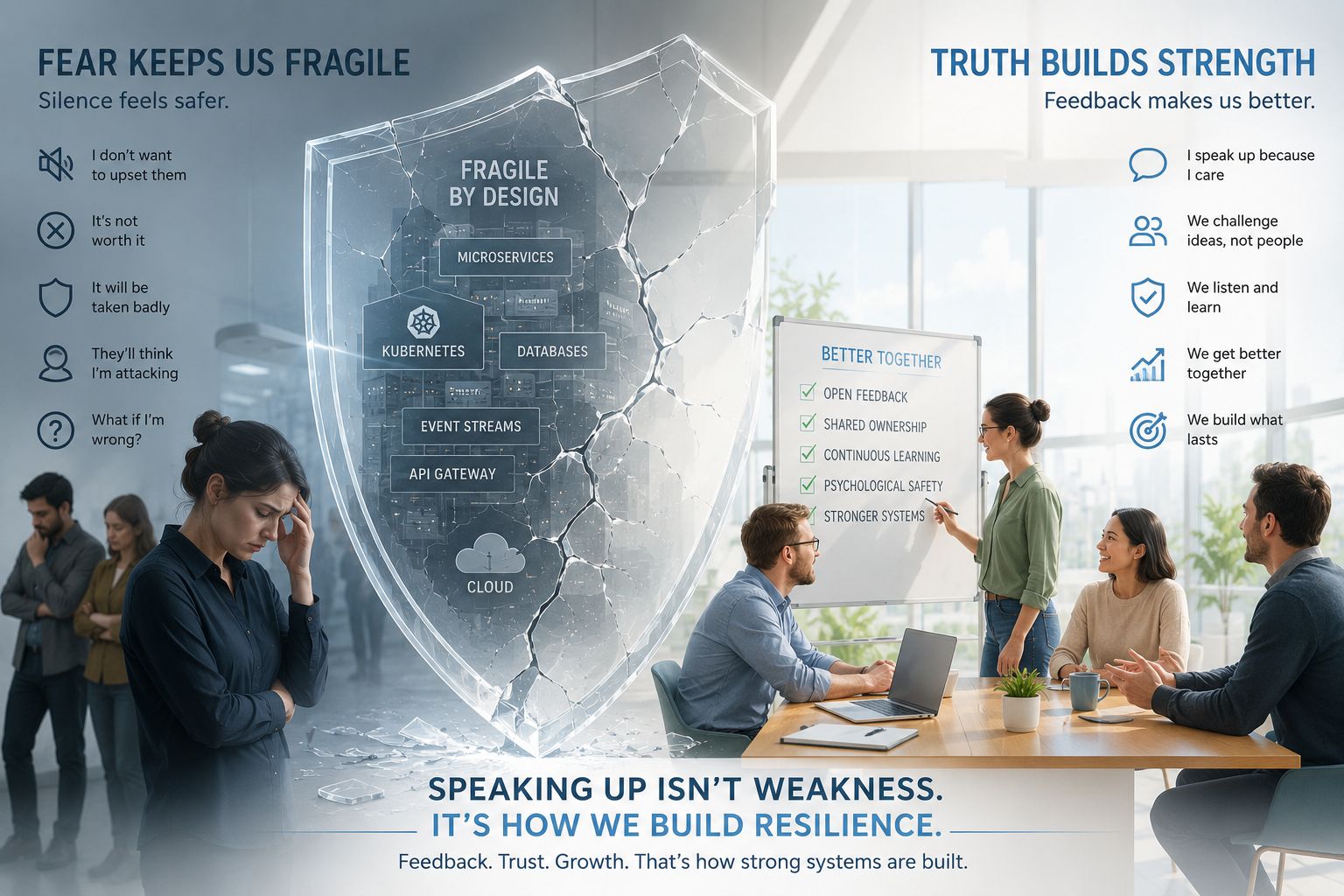
Anti-Fragile: Why Protecting People from Hard Feedback Makes Them Weaker

Genuine discomfort from honest feedback is not the same as cruelty. Conflating the two allows fragility to function as a social veto, silencing accountability and eroding performance standards. Organizations that protect people from difficult truths don't build psychological safety they build learned helplessness, which ultimately causes far greater harm than any candid conversation ever could.
Anti-Fragile: Why Protecting People from Hard Feedback Makes Them WeakerAndrew Baker's Technology Blog Posts, 08/May/2026
https://andrewbaker.ninja/2026/05/08/why-protecting-people-from-hard-feedback-makes-them-weaker/
Leadership · Culture · Strategy | Andrew Baker | May 2026 | 14 min read
There is a distinction that almost nobody in corporate life is willing to draw clearly, and the evasion of it costs organisations more than most technology failures ever will. The distinction is between unkind and cruel, and the confusion between them has become the primary mechanism through which feedback cultures collapse, performance bars erode, and entire organisations quietly train themselves to be weaker than they were the year before.
The confusion is not accidental. It serves a purpose. When cruelty and unkindness are treated as synonymous, any feedback that causes discomfort can be labelled cruel, and the person who delivers it can be held responsible for the receiver’s response to reality. This is enormously convenient for people who have decided, consciously or not, that their fragility is a legitimate reason to be insulated from honest assessment. It is also, in the most precise and literal sense available, a mechanism for manufacturing weakness.
1. The difference between unkind and cruel
Cruelty is directional. It is aimed at a person. Its purpose, whether acknowledged or not, is to diminish, to establish dominance, to punish, or to perform authority at someone else’s expense. Seneca, writing two thousand years before any management consultant was born, identified its root with characteristic precision: all cruelty springs from weakness. The cruel leader is not someone who has too much honesty. The cruel leader is someone who has too little courage to separate their own discomfort from the message they are delivering, and so the message arrives contaminated with contempt.
Unkindness, in the sense that matters for this argument, is something entirely different. It is the refusal to insulate someone from a truth they need to hear. It causes discomfort. It is not comfortable to receive, and it is not always comfortable to deliver. But its orientation is toward the person receiving it, not against them. The feedback is aimed at the gap between where someone is and where they could be, and the reason it is unkind rather than kind is simply that closing that gap requires acknowledging it first, and acknowledgment is temporarily disruptive.
Kim Scott’s framework in Radical Candor draws this boundary with some precision. What she calls obnoxious aggression is feedback that may be accurate but is delivered without care for its impact. That is the failure mode adjacent to genuine candour, and it is what most people mean when they invoke cruelty as a reason to soften or withhold feedback. But the more common failure mode in large organisations is ruinous empathy: feedback withheld or diluted in the name of kindness, which denies the person the information they need to grow while leaving the manager feeling virtuous. The manager’s discomfort has been resolved. The person’s development has been arrested. This is consistently misunderstood as compassion and is in fact its opposite.
The test for unkind versus cruel is intent, combined with orientation. Is the feedback aimed at helping someone close a gap, even at the cost of temporary disruption? Or is it aimed at the person as a target, for reasons that have more to do with the giver’s needs than the receiver’s growth? Unkind feedback respects the person enough to tell them the truth. Cruel feedback uses truth, or its approximation, as a weapon. The two are not on a spectrum. They are categorically different acts.
2. Fragility is manufactured, not inherited
This is the harder argument, and it is the one that corporate culture is most aggressively structured to prevent anyone from making. The received wisdom in most large organisations is that psychological safety requires protecting people from experiences that feel threatening, including feedback that challenges their self assessment, and that the responsible leader calibrates their honesty to what the receiver can tolerate.
This received wisdom produces weaker people. Not metaphorically. Literally.
Greg Lukianoff and Jonathan Haidt developed the argument most rigorously in the context of universities, but its application to enterprise organisations is direct. Their central analogy is exact: a university that removes intellectual challenge in the name of student welfare is like a gym that removes the weights. The student who trains in the weightless gym has not been protected from injury. They have been denied the mechanism by which strength is built. When they encounter resistance in the world outside the institution, they encounter it without having developed the capacity to process it. The protection is the damage.
The human mind, as Lukianoff and Haidt argue, is antifragile in the technical sense that Nassim Nicholas Taleb established in his 2012 work. Fragile systems break under stress. Resilient systems absorb stress and return to their prior state. Antifragile systems do something different: they improve under stress. The immune system is the clearest biological example. Expose it to a managed challenge and it does not merely survive the encounter. It builds a more capable response architecture for the next one. Expose it to nothing and it atrophies, or worse, it misdirects its activity against the organism itself.
This is not a metaphor. It is a description of exactly what happens in organisations that systematically withhold feedback in deference to perceived fragility. The people who are protected from honest assessment do not develop greater resilience over time. They develop greater sensitivity to feedback, because the baseline they are operating from has been kept artificially comfortable. Each act of protection raises the floor of what feels threatening, and lowers the capacity to process challenge productively. The organisation that believes it is being kind is in fact running a continuous programme of capability degradation.
3. The psychological safety misreading
Psychological safety is not a bad concept. The original research from Amy Edmondson at Harvard identified it as the single most predictive factor for high performing teams, and the finding is robust. But the misreading of what psychological safety actually requires has done substantial damage to the corporate cultures that claim to implement it.
Genuine psychological safety is the condition under which people feel able to speak honestly, challenge assumptions, surface problems, and give and receive difficult feedback without fear of punishment or humiliation. It is the precondition for honest information to travel through an organisation. A team with real psychological safety is one where a junior engineer will tell the programme director that the architecture is wrong, where a risk analyst will push back on a board narrative, where a peer will tell a colleague that their presentation is not ready.
What has been implemented in most large organisations under the label of psychological safety is something closer to what has been described as performative safety: a culture in which people are encouraged to share how they feel but not to challenge what is not working. This is not psychological safety. It is its institutional impersonation. And its practical effect is that feedback flows down, if it flows at all, but rarely up and very rarely sideways, because sideways challenge is the most direct threat to the social equilibrium that the culture has been designed to preserve.
The confusion matters because it means that fragility, the demonstrated or anticipated sensitivity of a particular person to feedback, gets treated as a property of the environment rather than a property of the individual. The environment is then adjusted to accommodate the fragility. The adjustment produces more fragility. The next adjustment is therefore more extensive. This is a compounding cycle, and it terminates in an organisation where honest assessment has been so thoroughly routed around that it exists only in private conversations, in the car on the way home, in the exit interview that nobody reads.
4. Durability is a construction project
The antidote is not to be harsh. The antidote is to be deliberate about stress as a development tool, to treat honest feedback not as a threat to be managed but as the primary raw material from which capable people are built.
Taleb’s concept of hormetic stress is precise here. Short term, manageable stressors produce adaptation. The key word is manageable, not absent. Progressive overload in physical training works because the stress is calibrated to be above current capacity without being beyond recovery range. The muscle tears, rebuilds, and rebuilds stronger. Remove the overload and the muscle does not maintain its current state. It declines. The absence of stress is not neutral. It is degenerative.
Applied to people and organisations, this means that the leader who consistently delivers honest feedback is not creating a hostile environment. They are running a calibrated development programme. The feedback is the load. The growth is the adaptation. The person who has been receiving honest assessment for years is not someone who has been treated harshly. They are someone who has been taken seriously. They have been given the raw material from which genuine confidence, the kind that does not shatter when tested, is actually constructed.
This is the distinction between confidence and fragility that most performance management frameworks misidentify. Fragility in this context is not a deficit of self esteem. It is a deficit of tested experience. The person who has been protected from honest feedback has not built the internal architecture to process it when it arrives. The person who has received it consistently, in the service of their development, has a very different relationship with challenge. They can disaggregate the discomfort of hearing something hard from the threat of being diminished by it, because experience has demonstrated that the discomfort is temporary and the growth is real.
Obsessive bar raising is not, therefore, an aggressive or punitive management philosophy. It is the only mechanism available for building genuine capability. The bar must move because a fixed bar becomes, over time, maintenance. The person who cleared last year’s standard comfortably is not growing against last year’s standard. They are coasting against it. The leader who raises the bar and supports the person in meeting it is doing something the leader who holds the bar constant, in the name of stability or kindness, is not: they are building someone.
5. What fragility as excuse actually protects
It is worth being specific about what is actually being protected when fragility is used as a reason to withhold or soften feedback, because it is rarely what the framing suggests.
The most common stated rationale is that the person receiving feedback is not in a state to hear it, that they are under stress, that the timing is wrong, that the relationship needs to be maintained, that the culture needs to be considered. Some of these are occasionally legitimate. Timing matters. Relationship matters. Method matters. But in most cases where these considerations are invoked to defer or dilute feedback, the honest account is simpler: the person giving the feedback is uncomfortable, and the receiver’s fragility is the most socially acceptable reason available to explain the deferral.
This is worth naming plainly because the cost is misattributed. When feedback is deferred in deference to fragility, the cost is typically described as a temporary delay in development. The actual cost is substantially larger. The person continues operating with a blind spot that is now tacitly endorsed by the absence of challenge. The organisation’s ability to course correct is degraded. And the fragility itself, having been accommodated rather than addressed, deepens. The next conversation is now harder, because the implicit social contract has been established that this area is protected territory.
Netflix’s original culture deck, published by Reed Hastings in 2009 and still the most honest public document any large organisation has produced about what a genuine performance culture requires, drew this line without apology. Adequate performance gets a generous severance package. Not because the organisation is indifferent to the people who work in it, but because the alternative, retaining adequate performance out of deference to comfort or relational inertia, degrades the environment for everyone. The deck was deliberately uncomfortable. That discomfort was the point. The 2025 update softened many of those lines, and was widely noted for doing so. The institutional retreat from uncomfortable honesty is almost always described as maturity. It is almost always decline.
6. The receiver’s responsibility
Most of the writing on feedback culture assigns the entire moral weight of the exchange to the giver. The giver must be skilled, careful, timely, specific, and compassionate. The receiver is positioned as the subject of an act, someone to whom something is being done, whose response is a natural and uncontrollable consequence of the feedback’s delivery.
This framing is incomplete, and its incompleteness is doing significant damage to the cultures that have adopted it wholesale.
The receiver of feedback has responsibilities that are just as demanding as the giver’s, and a culture that does not name them explicitly is one that has decided, whether consciously or not, that the receiver bears no accountability for how they process challenge. The most important of those responsibilities is the obligation not to deploy fragility as a weapon. Fragility is weaponised when a demonstrated or performed sensitivity to feedback functions as a deterrent to honest assessment. The person who cries in one on ones, not because they are genuinely distressed but because distress has proven to be an effective circuit breaker for difficult conversations, is wielding fragility instrumentally. The person who escalates a candid piece of feedback as a conduct issue is doing the same thing at a more institutional level. In both cases, the effect is identical: honest assessment is routed around them, their blind spots are preserved, and their growth stops.
The distinction between genuine distress and strategic fragility is not always clean, and it requires care. But the inability to make the distinction is not a reason to capitulate to fragility in all its forms. It is a reason to build the skill of making it. Leaders who cannot distinguish between someone who is genuinely struggling and someone who has learned that struggle is a useful performance will eventually stop delivering honest feedback to everyone, because the social risk of misjudging is too high. That outcome, the wholesale silencing of honest assessment across an organisation, is the terminal state of a culture that has elevated receiver comfort above growth.
7. Building the habit
None of this is an argument for harshness, for aggression, for the indulgence of contempt dressed up as candour. The person who delivers feedback clumsily but with genuine developmental intent is doing something categorically different from the person who uses feedback as cover for diminishment. The difference is visible in what happens after the feedback is delivered. Does the giver stay present, interested in the receiver’s response, willing to clarify, committed to the outcome? Or do they disengage, having discharged their obligation, indifferent to what follows?
The discipline required is not the discipline of being willing to say hard things. Most people are capable of that when the stakes are low enough. The discipline required is the discipline of staying in the conversation after the hard thing has been said, of treating the discomfort that follows as data rather than as a verdict on whether the feedback should have been given. This is the discipline of holding Taleb’s hormetic stress within the range where it produces adaptation rather than collapse: enough load to force adaptation, enough support to make adaptation possible.
The organisations that have built this discipline consistently share a recognisable property. Feedback in them is not an event. It is a continuous condition of the environment. People know where they stand not because they have just received a formal review but because the signal is always present, calibrated, and aimed at their growth. The bar is always visible and always moving. The discomfort is real and it is familiar and it is understood as the mechanism, not the problem.
This is what durability actually looks like. Not the absence of stress, but the accumulated history of having processed it, grown through it, and found on the other side of it a capacity that was not there before. You do not build it by protecting people from the weights. You build it by standing next to them while they lift, raising the load when they are ready, and being honest when they are not.
References
- Taleb, N. N. — Antifragile: Things That Gain from Disorder (2012), Random House
- Taleb, N. N. — Antifragility, Wikipedia overview
- Lukianoff, G. & Haidt, J. — The Coddling of the American Mind (2018), Penguin Press
- Scott, K. — Radical Candor (2017), St. Martin’s Press
- Edmondson, A. — Psychological Safety research, Harvard Business School
- Hastings, R. — Netflix Culture, Netflix Jobs
- Seneca — Wikiquote: Seneca the Younger
- Wikipedia — Hormesis