
The Courage to Be Honest: Why Giving Hard Feedback Is the Kindest Thing a Leader Can Do
Delivering uncomfortable truths, though temporarily disruptive, produces stronger long term outcomes than comfortable reassurances that mask underlying problems. What appears kind in the moment avoiding conflict, softening feedback, delaying difficult conversations gradually compounds into systemic decline, while honest confrontation, despite short term friction, enables genuine recovery and sustainable growth.
The Courage to Be Honest: Why Giving Hard Feedback Is the Kindest Thing a Leader Can DoAndrew Baker's Technology Blog Posts, 07/May/2026
https://andrewbaker.ninja/2026/05/07/the-courage-to-be-honest-why-giving-hard-feedback-is-the-kindest-thing-a-leader-can-do/
Leadership · Technology · Strategy | Andrew Baker | May 2026 | 12 min read
There is a diagram I keep coming back to. It is deceptively simple: two lines, two colours, one axis of time and one of system health. The blue line, labelled Unkind Truth, dips before it rises. Every truth telling moment causes a brief disruption, a visible downturn in the curve, but the system recovers and reaches a new, higher plateau each time. The pink line, labelled Kind Lie, is the opposite. It looks better in the short term. It keeps people comfortable. But each act of kindness compresses into a small dip, and over time the trajectory is unmistakably downward. The arrow at the end of the pink line points down and to the right. The arrow at the end of the blue line points up.
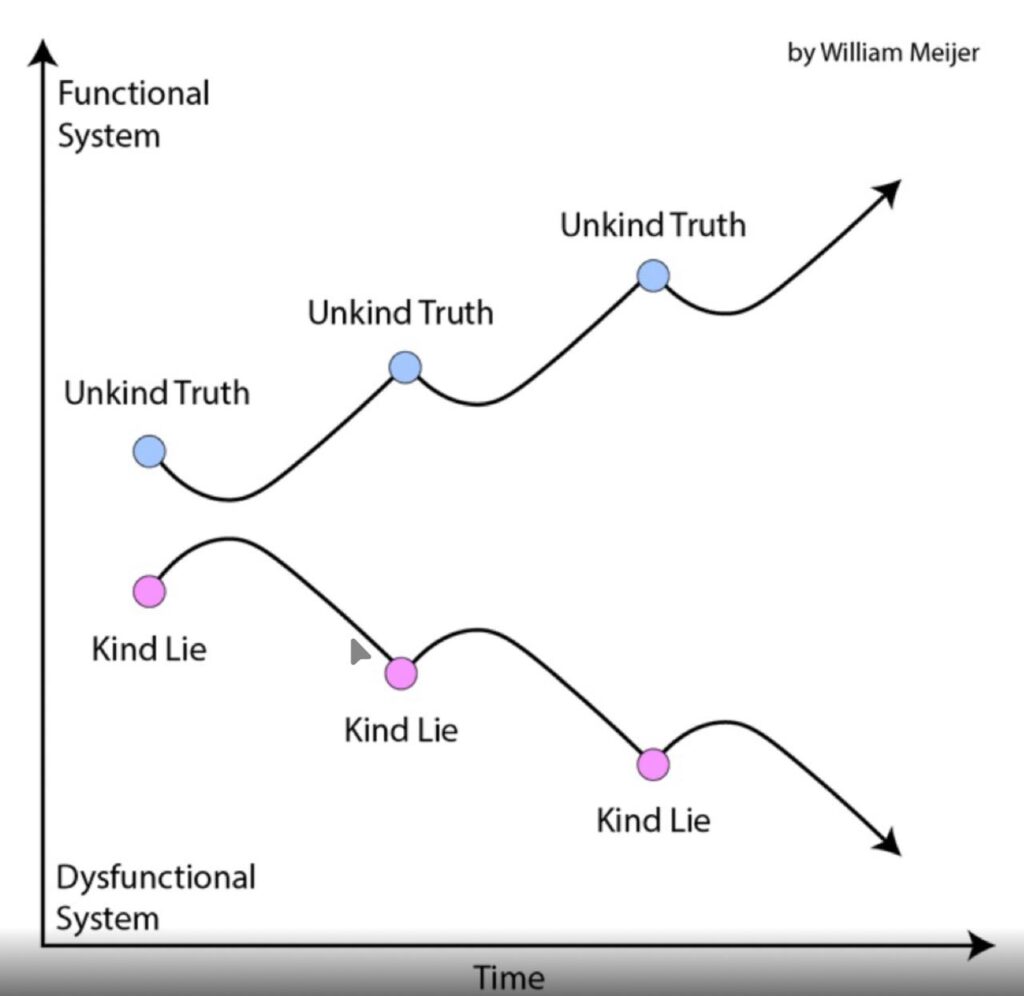
William Meijer drew this. It takes about three seconds to understand. It takes years to truly act on.
1. The admiral who would not lie to himself
James Stockdale was a United States Navy vice admiral who spent over seven years as a prisoner of war in Hỏa Lò Prison in Hanoi, a facility American POWs referred to, with characteristic dark humour, as the Hanoi Hilton. He was tortured more than twenty times. He had no release date. He had no certainty that he would survive. And yet he emerged as one of the most coherent and psychologically intact of all the American POWs, and became the inspiration for what Jim Collins would later name the Stockdale Paradox.
Collins asked him directly: who did not make it out? Stockdale’s answer was immediate. The optimists. Not the pessimists. The optimists.
“They were the ones who said, ‘We’re going to be out by Christmas.’ And Christmas would come, and Christmas would go. Then they’d say, ‘We’re going to be out by Easter.’ And Easter would come, and Easter would go. And then Thanksgiving, and then it would be Christmas again. And they died of a broken heart.”
The paradox is this: you must hold two things simultaneously. Unwavering faith that you will prevail in the end. And equally unwavering willingness to confront the most brutal facts of your current reality. Not one or the other. Both at once.
This is what Meijer’s diagram shows. The kind lie is the optimist who tells people we’ll be out by Christmas. The unkind truth is the admiral who says: I do not know when we get out, but we will adapt to survive until we do, and every piece of honest information we have is a resource, not a threat.
Stockdale wrote about his experience at length in In Love and War (1984), co authored with his wife Sybil, and later in Thoughts of a Philosophical Fighter Pilot (1995). Collins drew on extensive interviews with him for Good to Great (2001), which remains the definitive popular account of the paradox.
2. The technology decisions that nobody wanted to make
I have watched this pattern destroy technology programmes across banks, retailers, and large enterprises, and I have watched it rescue a few. The form it takes in technology is almost always the same.
A programme is running late. The honest conversation would be: we underestimated the data migration, the vendor’s API is not production quality, and we need to reduce scope or extend the deadline. That conversation is uncomfortable. It means admitting to an executive who has been championing the programme that the original plan was wrong.
So instead, the team finds a way to say things that are not technically untrue but are functionally misleading. We are on track to hit the revised milestone. The critical path items are being managed. Green status on the RAG report. The kind lie, delivered in PowerPoint.
Each lie buys a few weeks of comfort and costs months of recovery. The platform eventually launches on a foundation that everyone in the room knew was unstable. The technical debt accumulates. The maintenance burden grows. And two or three years later, someone is tasked with writing a business case for a replacement system that, if you follow the chain of decisions backward far enough, would never have been needed if someone had told the truth in the fourth month of the original programme.
The kind lie does not protect the programme. It just moves the pain downstream and makes it larger. Ward Cunningham, who coined the term technical debt in 1992, described exactly this dynamic: the debt itself is not the problem, but the interest payments compound until they consume the capacity to do anything else.
3. AI is the most dangerous place to be kind
I spend a significant portion of my working life helping organisations think about AI strategy, and the kind lie problem is currently more acute in this domain than anywhere else I encounter. The pressure to present AI as transformative, production ready, and already delivering measurable return is enormous. Boards want to hear it. CEOs have told investors we are an AI driven organisation. The marketing materials have gone out.
And so teams tell kind lies. We describe proof of concept accuracy rates as if they reflect production conditions. We present cost savings that assume user behaviour changes that have not happened yet. We describe our AI readiness in terms of what we intend to build, not what we have actually shipped.
This is not a new problem dressed in new clothes. It is the same credibility erosion that followed the first wave of big data investments in the early 2010s, the RPA wave of the late 2010s, and every enterprise blockchain programme that was announced with fanfare and quietly wound down eighteen months later. The technology changes. The narrative pattern does not.
The Stockdale Paradox applied to AI strategy looks like this: you must hold the genuine conviction that AI will reshape your organisation’s competitive position over the next five years, and you must simultaneously be willing to say clearly that your current data governance is not AI ready, your model evaluation capability does not yet exist, you have one team that knows what they are doing and nine that are experimenting with no framework, and the vendor you committed to eighteen months ago has been lapped twice by the open weights ecosystem.
The faith and the facts must coexist. The moment you let the faith suppress the facts, you are on the pink line.
I have watched organisations approve AI budgets based on narratives that everyone in the room privately doubted. The investments get made. The timelines slip. The board loses confidence not because the technology failed, but because the honest conversation about preconditions and sequencing never happened. The unkind truth, delivered eighteen months earlier, would have saved the programme. Andrew Ng’s framing of the AI readiness stack data, platforms, people, and governance as prerequisites rather than parallel workstreams, is a useful structure for that honest conversation.
4. Managing teams through the dip
The hardest place to apply this is not in a boardroom. It is in a one on one with someone who has been working eighteen hour days for six months on a programme that you now have to tell them is going to be restructured.
This is where most managers reach for the kind lie. We soften the message until it no longer contains the information the person actually needs. We say things like: there are going to be some changes coming, and we want to make sure everyone is set up for success. We protect people from the reality that they are about to have their scope significantly reduced, or that the direction has changed, or that the decision they championed has been reversed.
We tell ourselves this is compassion. It is not. It is our own discomfort, projected as a courtesy to the other person.
Kim Scott’s concept of Radical Candor names this failure mode precisely. She calls it ruinous empathy: feedback that is withheld or diluted in the name of kindness, but that actually denies the person the information they need to grow or respond. The manager feels better. The person is worse off. The kind lie, in human resources clothing.
The genuinely kind thing, the thing that actually serves the person in front of you, is to tell them the truth with enough lead time for them to respond. The dip in Meijer’s diagram is real. The unkind truth does create disruption. But the disruption is bounded, and the person retains their agency. They know where they stand. They can make decisions. They can adapt.
The kind lie removes agency. It lets people invest further in a direction that is already closed, plan around assumptions that are already false, and carry confidence that is already unsupported. When the truth arrives, as it always does, it arrives without lead time, and the disruption is far larger than the unkind truth would ever have caused.
Stockdale’s POWs who survived did not thrive because reality was kind to them. They thrived because they chose to see it clearly. You give your team the same gift when you are honest about what is actually happening.
5. The strategy document nobody wanted to write
There is a version of this that shows up specifically in technology strategy, and it is the document that has been sanitised until it no longer contains a single dangerous sentence. Everyone in the organisation has a view that some major infrastructure is failing, that the integration layer is an unreasonable liability, that the vendor relationship has become extractive, or that the architecture made sense in 2016 and does not make sense now.
But the strategy document that goes to the board says: we continue to invest in our core platforms while selectively introducing modern capabilities. Which is a kind lie that means: we know this is broken but we cannot get agreement to say so out loud.
The organisations I have seen make the sharpest and most durable technology improvements all did the same thing at some point: they wrote the document that was honest about the current state. Not catastrophising, not demoralising, not assigning blame, but genuinely clear. Here is what we have. Here is where it limits us. Here is what it will cost us to keep living with it versus what it will cost to address it. Here is our recommendation.
That document is uncomfortable to write. It is more uncomfortable to present. And it is the beginning of every meaningful improvement I have seen a large organisation actually execute. Richard Rumelt’s definition of good strategy in Good Strategy Bad Strategy (2011) starts exactly here: an honest diagnosis of the current situation, before any discussion of objectives or action. The diagnosis is not the strategy. But without it, everything that follows is built on sand.
6. The discipline of holding both
The Stockdale Paradox is not a licence for pessimism or for learned helplessness dressed up as realism. The admiral did not survive by cataloguing every reason they might not make it home. He survived by holding the conviction that they would, while refusing to let that conviction distort his perception of what was actually happening around him.
Applied to technology leadership, this means something specific. You are allowed, and in fact required, to hold a genuine and energising vision of where your organisation is going. What the system will look like when the architecture is clean. What the team will be capable of when the platform constraints are resolved. What the customer experience will be when the data is actually usable. You are allowed to mean it, and to say it often, and to make decisions in service of it.
What you are not allowed to do is use that vision to avoid the honest conversation about today. The vision is not a reason to put green on the RAG report. The ambition is not a reason to omit the technical debt from the board pack. The faith is not a reason to avoid telling your team member that the restructure is coming. The blue line dips every time the truth is told. That is the cost. And then it rises. That is the compounding.
Every organisation is making a choice, continuously and often unconsciously, about which line it is on. It is not a single decision. It is a pattern of small ones: whether to flag the issue in the standup, whether to escalate the concern to the steering committee, whether to tell the candidate the role is actually harder than the job description implies, whether to write the strategy document that names what everyone knows.
The discipline is not in any single act of courage. It is in building the habit of choosing the blue line, dip and all, because you understand that the alternative is the pink arrow pointing relentlessly down and to the right.
7. A closing note on kindness
Meijer’s labels are deliberately provocative. Unkind truth. Kind lie. The word unkind is doing something important there. He is not calling it an uncaring truth, or a harsh truth. He is calling it unkind, because it does cause a moment of discomfort, and we should not pretend otherwise.
The discomfort is real. The dip is real. Telling your executive sponsor that the programme needs to be reset is genuinely difficult. Telling a candidate that the culture is demanding is not the easy interview answer. Telling the board that the architecture needs replacement investment is not how you make friends in a budget committee.
But there is a deeper sense of kindness available to us if we are willing to look for it. It is the kindness of respecting the people in your organisation enough to let them operate in reality. It is the kindness of giving your team the information they need to make good decisions. It is the kindness of not making someone’s world smaller by protecting them from what is actually happening in it.
Stockdale survived not because he was untouched by the brutal facts of his captivity, but because he chose to see them and to keep going anyway. That combination, clear eyes and unbroken will, is not unkind. It is the most generous version of leadership available to us.
Tell the truth. Hold the vision. Let the line do what it does.
References
- Meijer, W. — Kind Lie vs Unkind Truth diagram (LinkedIn)
- Collins, J. — Good to Great (2001), HarperBusiness — source of the Stockdale Paradox
- Collins, J. — The Stockdale Concept, jimcollins.com
- Stockdale, J. & S. — In Love and War (1984), Harper & Row
- Stockdale, J. — Thoughts of a Philosophical Fighter Pilot (1995), Hoover Institution Press
- Rumelt, R. — Good Strategy Bad Strategy (2011), Crown Business
- Scott, K. — Radical Candor (2017), St. Martin’s Press
- Cunningham, W. — Technical Debt (1992), c2.com
- Ng, A. — AI Transformation Playbook, DeepLearning.AI
- Wikipedia — Hỏa Lò Prison
- Wikipedia — Robotic Process Automation