Category: Corporate Culture


Why AI Pilots Fail to Reach Production (And How to Fix It)
Gartner says 40% of agentic AI projects will fail by 2027. I think they’re being optimistic. Walk into almost any large enterprise right now and you’ll find the same scene: a glossy AI pilot, a proud press release, a steering committee meeting monthly to “track progress,” and an absolutely zero percent chance that any of […]
Read more →
Enterprise Software Tiering: Why Bundle Pricing Fails
By Andrew Baker, CIO at Capitec Bank There is a category of enterprise technology vendor whose approach to pricing is so fundamentally at odds with how purchasing decisions actually get made that it borders on self-defeating. Their commercial model is built on access gates, bundled tiers, and a deeply held belief that controlling what a […]
Read more →
Cloudflare Free Tier Review: Why It Works for Enterprise
By Andrew Baker, CIO at Capitec Bank There is a truth that most technology vendors either do not understand or choose to ignore: the best sales pitch you will ever make is letting someone use your product for free. Not a watered-down demo, not a 14-day trial that expires before anyone has figured out the […]
Read more →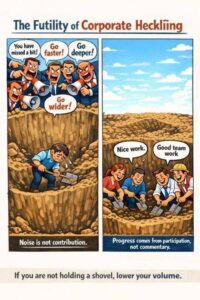
Corporate Heckling: Why Low-Context Oversight Fails Teams
There is a peculiar sport played in large organisations. It looks like leadership and sounds like governance, hiding behind frameworks, maturity models, and operating rhythms. But in reality it is something far less noble. It is corporate heckling. Corporate heckling is what happens when a function narrates from the sidelines with low context and high […]
Read more →
Leadership Bloat: When Management Consumes the Business
1. The Shoe Planet Problem In The Hitchhiker’s Guide to the Galaxy, there is a planet where the inhabitants become so obsessed with shoes that the shoes eventually take over. The civilisation does not collapse because it lacks intelligence. It collapses because something peripheral accumulates mass until it dominates everything essential. Leadership bloat is the […]
Read more →
Technology Leadership Assessment for Business Heads
This is an assessment exists to surface how you actually think about leadership of technologists. Answer honestly. Not as the executive you present in interviews. As the leader you become when the deadline is real, the team is pushing back, and someone senior is asking you for certainty you do not have. Every option is […]
Read more →
Logic First Leadership: The Cost of a Ruthless Mindset
1. The System That Built Everything I have spent my entire career inside a single operating system. Logic first. Reality over narrative. Strip the problem down, find the root cause, fix it, move on. Do not waste time on feelings that will resolve themselves once the facts are clear. Do not slow down for comfort […]
Read more →
Naked Teams: How to Strip Away Defensive Process
1. The Uncomfortable Silence After the Music Stops Every organisation that runs on defensive process has a soundtrack. Standups hum at 9am. Sprint reviews crackle on Fridays. Retros generate their familiar low frequency guilt. Planning ceremonies fill the gaps. Remove all of it and the first thing you hear is silence, and silence in a […]
Read more →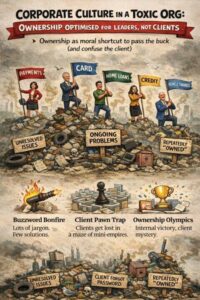
Toxic Ownership Models: How Corporate Culture Fails Clients
1. Ownership Has Been Turned Into a Moral Shortcut Ownership has become one of the most lazily celebrated concepts in modern organisations. Leaders demand it reflexively, teams chase it performatively, and entire operating models are justified by invoking it as if ownership itself produces outcomes. It does not. Ownership is merely a structural choice, and […]
Read more →Why Boredom Drives Innovation More Than Busy Work
1. Fear, Motion, and the Illusion of Progress In the last few months I’ve come up with two of the most powerful fraud controls of my career. Not in a workshop. Not in a brainstorm with sticky notes and a facilitator. I walked to the car park, lay down in my car, closed my eyes, […]
Read more →