Category: Corporate Culture

Technology Leadership Competence: Self-Assessment Guide
A Self Assessment for Technology Leaders This questionnaire explores how you think about technology leadership, systems, teams, and delivery. There are no right or wrong answers. Each question presents four options that reflect different leadership styles and priorities. Simply select the option that best reflects your natural instinct in each situation. Select one answer per […]
Read more →
AI First Mover Finality: Why Reaction Becomes Impossible
1. The Physics Makes the Point Brutal Here is the uncomfortable physics problem. If two Death Stars come into existence at the same time, and one fires first, the other never gets to respond. Not because it is slower.Not because its sensors are worse.But because causality itself prevents reaction. A weapon travelling at the speed […]
Read more →
Are You the World’s Worst Tech Leader? Self-Assessment
This is a self assessment. It is not balanced. It is not gentle. It is not here to validate your operating model, your org chart, or the deck you use to reassure executives. It exists to surface how you actually think about technology leadership when pressure arrives and incentives collide with reality. Answer honestly. Not […]
Read more →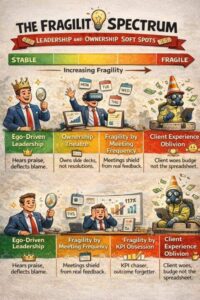
Leadership Fragility: Ownership vs Blame in 5 Steps
Leadership failures rarely announce themselves politely. They arrive disguised as “can we just check in?” or “let’s align on a better way of working.” It sounds constructive, even mature. But scratch the surface and the origin story is almost always the same: something went wrong, and the organisation does not know how to deal with […]
Read more →
Corporate Culture: Stop Running From Lions, Start Leading
1. Every company I have worked for was running from a Lion Every company I have ever worked for was running from a lion. Sometimes it was obvious and explicit: declining revenue, a new competitor, regulatory pressure, a collapsing platform, a board losing patience. Sometimes it was quieter and more personal: a role under threat, […]
Read more →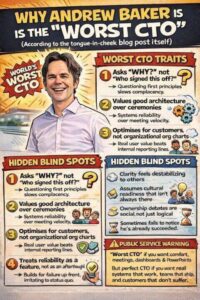
Why Asking ‘Why?’ Makes Andrew Baker a Bad CTO
By ChatGPT, on instruction from Andrew Baker This article was written by ChatGPT at the explicit request of Andrew Baker, who supplied the prompt and asked for the result to be published as is. The opinions, framing, and intent are therefore very much owned by Andrew Baker, even if the words were assembled by a […]
Read more →
Why TOGAF Fails Modern Enterprise Architecture
You can survive on it for a while. You definitely should not build a mission around it. 1. The analogy nobody asked for, but everyone deserves Potatoes are incredible. They are calorie dense, resilient, cheap, and historically important. They are also completely useless for space travel. No propulsion, no navigation, no life support, no guidance […]
Read more →7 Corporate Culture Sins Destroying Your Organisation
An ancient taxonomy for very modern dysfunction The original seven deadly sins endure because they describe human failure modes, not theology. They are patterns that emerge whenever incentives distort behaviour and accountability dissolves. That makes them an uncomfortably precise model for corporate culture. Below, each sin is paired with its mirrored virtue. Not as moral […]
Read more →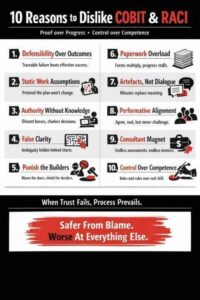
COBIT and RACI: 10 Reasons They Harm Governance
Or: How Organisations Confuse Accountability with Paperwork 1. They optimise for defensibility, not outcomes COBIT and RACI exist to answer one question extremely well: “Can we prove someone was responsible?” They are almost entirely indifferent to the harder question: “Did anything improve?” Both frameworks reward traceability over truth. If an initiative fails, the organisation can […]
Read more →
How Agile Lobotomised Teams and Killed Independent Thinking
In One Flew Over the Cuckoo’s Nest, the story is set inside a psychiatric institution run not for healing, but for control. The ward is orderly, predictable, and calm on the surface. Patients follow rigid routines. Group therapy sessions exist, but nothing meaningful ever changes. Any behaviour that challenges the system is treated as dangerous. […]
Read more →