Engineering Leadership: Hard Truths for Tech Leaders
Why your best engineers leave, how bad org structures quietly destroy teams, and what separates engineering leaders who scale from those who stall.

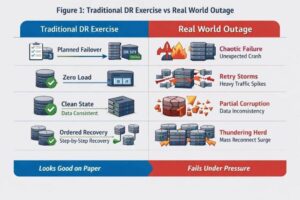
DR Exercises Are Broken: Why Most Disaster Recovery Fails
Disaster recovery is one of the most comforting practices in enterprise technology and one of the least honest. Organisations spend significant time and money designing DR strategies, running carefully choreographed exercises, producing polished post exercise reports, and reassuring themselves that they are prepared for major outages. The problem is not intent. The problem is that […]
Read more →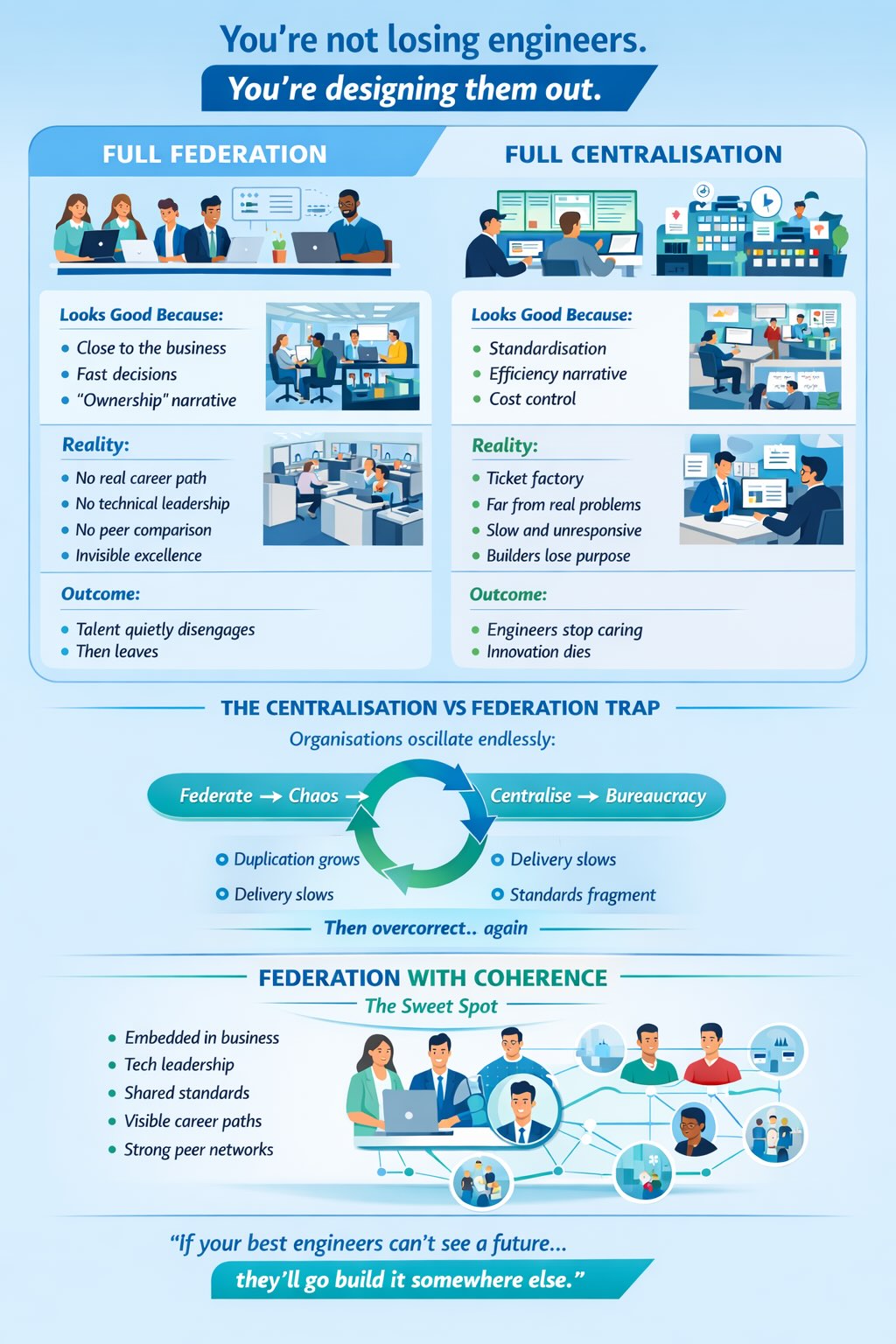
Federation vs Centralisation: Stop Burying Tech Talent
There’s a question that quietly shapes the fate of technology talent in almost every organisation, and most businesses never ask it directly. Instead, they stumble into an answer through a series of incremental org design decisions, budget cycles, and leadership preferences. The question is this: is technology a support function to the business, or is […]
Read more →
Measurement Isn’t Movement: When Corporate Metrics Become a Substitute for Management and Execution
I recently saw an advert suggesting that approving an AI budget without ROI metrics was the equivalent of driving blind. It is a neat line, and it captures a belief that runs through a great many companies: if we can attribute enough costs, calculate enough returns and produce enough dashboards, we will make better decisions. […]
Read more →
Not Everything Is a Product: Why Confusing Products and Capabilities Quietly Wrecks Your Organization
One of the more expensive mistakes I have watched organizations make, again and again, is assuming that anything worth building must automatically be a product, and that assumption alone has spawned more unnecessary teams, more artificial ownership structures and more bloated roadmaps than almost any other single habit of thought in technology leadership. Here is […]
Read more →
Your Budget Is Not Permission to Spend: How to Build a Lean Organization Without Starving It
One of the easiest ways for a large organization to become bloated is to confuse an approved budget with an obligation to spend it. The pattern is familiar: someone arrives with a request for another person, another team, another vendor, or another piece of software and says, “It is already in the budget. The headcount […]
Read more →
Corporate Tech Models: Engineer-Led vs Manager-Led
There are two fundamental ways to run technology inside your company (and various states in-between)
Read more →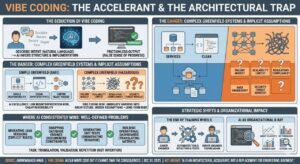
Vibe Coding Risks: Why AI Cannot Own Architectural Decisions
AI is a powerful accelerator when problems are well defined and bounded, but in complex greenfield systems vague intent hardens into architecture and creates long term risk that no amount of automation can undo. 1. What Vibe Coding Really Is Vibe coding is the practice of describing intent in natural language and allowing AI to […]
Read more →
Are You the World’s Worst Tech Leader? Self-Assessment
This is a self assessment. It is not balanced. It is not gentle. It is not here to validate your operating model, your org chart, or the deck you use to reassure executives. It exists to surface how you actually think about technology leadership when pressure arrives and incentives collide with reality. Answer honestly. Not […]
Read more →
The Escalation Trap: Why “Just Ask Your Manager” Is Quietly Wrecking Your Team
Somewhere in your organization right now, a capable adult is sitting on a decision they already know the answer to, because they are waiting for someone with a fancier title to say it back to them. That is the pointless escalation, and it is not the kind that surfaces a real risk or a genuine […]
Read more →
The Courage to Be Honest: Why Giving Hard Feedback Is the Kindest Thing a Leader Can Do
Leadership · Technology · Strategy | Andrew Baker | May 2026 | 12 min read There is a diagram I keep coming back to. It is deceptively simple: two lines, two colours, one axis of time and one of system health. The blue line, labelled Unkind Truth, dips before it rises. Every truth telling moment […]
Read more →
Naked Teams: How to Strip Away Defensive Process
1. The Uncomfortable Silence After the Music Stops Every organisation that runs on defensive process has a soundtrack. Standups hum at 9am. Sprint reviews crackle on Fridays. Retros generate their familiar low frequency guilt. Planning ceremonies fill the gaps. Remove all of it and the first thing you hear is silence, and silence in a […]
Read more →7 Corporate Culture Sins Destroying Your Organisation
An ancient taxonomy for very modern dysfunction The original seven deadly sins endure because they describe human failure modes, not theology. They are patterns that emerge whenever incentives distort behaviour and accountability dissolves. That makes them an uncomfortably precise model for corporate culture. Below, each sin is paired with its mirrored virtue. Not as moral […]
Read more →