Engineering Leadership: Hard Truths for Tech Leaders
Why your best engineers leave, how bad org structures quietly destroy teams, and what separates engineering leaders who scale from those who stall.


AI First Mover Finality: Why Reaction Becomes Impossible
1. The Physics Makes the Point Brutal Here is the uncomfortable physics problem. If two Death Stars come into existence at the same time, and one fires first, the other never gets to respond. Not because it is slower.Not because its sensors are worse.But because causality itself prevents reaction. A weapon travelling at the speed […]
Read more →
Why You Keep Doing the Wrong Thing Even When You Know Better
Why the hardest system I have ever tried to upgrade is myself Over the past three years I have been getting a lot of help with something far more important than technology: how to be a better dad and a better husband. Here is the strange part. Almost from day one, what I was being […]
Read more →
Toxic Ownership Models: How Corporate Culture Fails Clients
1. Ownership Has Been Turned Into a Moral Shortcut Ownership has become one of the most lazily celebrated concepts in modern organisations. Leaders demand it reflexively, teams chase it performatively, and entire operating models are justified by invoking it as if ownership itself produces outcomes. It does not. Ownership is merely a structural choice, and […]
Read more →
Enterprise Software Tiering: Why Bundle Pricing Fails
By Andrew Baker, CIO at Capitec Bank There is a category of enterprise technology vendor whose approach to pricing is so fundamentally at odds with how purchasing decisions actually get made that it borders on self-defeating. Their commercial model is built on access gates, bundled tiers, and a deeply held belief that controlling what a […]
Read more →Technology Leadership Competence: Self-Assessment Guide
A Self Assessment for Technology Leaders This questionnaire explores how you think about technology leadership, systems, teams, and delivery. There are no right or wrong answers. Each question presents four options that reflect different leadership styles and priorities. Simply select the option that best reflects your natural instinct in each situation. Select one answer per […]
Read more →
Technology Leadership Assessment for Business Heads
This is an assessment exists to surface how you actually think about leadership of technologists. Answer honestly. Not as the executive you present in interviews. As the leader you become when the deadline is real, the team is pushing back, and someone senior is asking you for certainty you do not have. Every option is […]
Read more →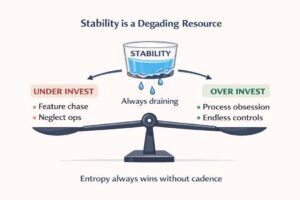
Why Forced Regular Stability Work Beats Reactive Fixes
Why do Companies Get Stability So Wrong? Most companies do not fail because they cannot innovate. They fail because they misjudge stability. Some organisations under invest. They chase features, growth, and deadlines while stability quietly drains away. Outages feel sudden. Incidents feel unfair. Leadership asks how this happened “out of nowhere”. Other organisations over invest. […]
Read more →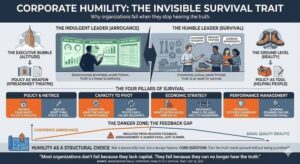
Corporate Humility: Why It’s a Leadership Survival Trait
Most organisations don’t fail because they lack intelligence, capital, or ambition. They fail because leadership becomes arrogant, distant, and insulated from reality. What Is Humility? Humility is the quality of having a modest view of one’s own importance. It is an accurate assessment of one’s strengths and limitations, combined with an openness to learning and […]
Read more →The Triplication Paradigm: Why Removing Duplication Fails
Introduction In most large corporates technology will typically report into either finance or operations. This means that it will tend to be subject to cultural inheritance, which is not always a good thing. One example of where the cultural default should be challenged is when managing IP duplication. In finance or operations duplication rarely yields any benefits […]
Read more →Why Least Privilege Security Is a Lie: 3 Root Causes
In technology, there is a tendency to solve a problem badly by using gross simplification, then come up with a catchy one liner and then broadcast this as doctrine or a principle. Nothing ticks more boxes in this regard, than the principle of least privileges. The ensuing enterprise scale deadlocks created by a crippling implementation […]
Read more →
Sinking Car Syndrome: When Bad Architecture Is Terminal
There are two types of post incident review in technology. The first is genuinely useful, since you learn something, fix something, and sleep better afterward. The second is an elaborate ritual in which intelligent adults spend considerable time and money working out why a car sank, before commissioning a study on how to make the […]
Read more →
Stop Email Threads: 5 Rules for Smarter Team Collaboration
Email trees are not an accident. They are the predictable outcome of organisations repeatedly using the wrong tool for the wrong job. Despite decades of evidence, email is still treated as a collaboration platform rather than what it actually is: a slow, lossy message delivery system. The result is wasted time, fragmented thinking, and an […]
Read more →