Next Generation AI SEO for WordPress Just Launched And its Totally Free!!!
1. Introduction
Download the plugin here: https://wordpress.org/plugins/cloudscale-seo-ai-optimizer/
S3 download (updated frequently): https://andrewninjawordpress.s3.af-south-1.amazonaws.com/cloudscale-seo-ai-optimizer.zip
For more than a decade the WordPress SEO landscape has been dominated by a small group of plugins. Yoast SEO, Rank Math, and All in One SEO have collectively powered millions of sites and shaped how authors think about optimisation.
These plugins are very good at what they were designed to do. They analyse content, highlight issues, and guide authors toward better search optimisation. But there is a problem. They do not actually fix anything.
They act as advisory dashboards. They point out what is wrong with a page and then expect a human to manually correct the issue.
That model made sense in 2010 when most sites had dozens of pages. It makes far less sense in a world where sites contain thousands of posts and where artificial intelligence can perform optimisation automatically.
CloudScale SEO AI Optimizer approaches the problem from a very different angle. Instead of acting as a scoring assistant, it attempts to automate the optimisation process itself.
This article compares CloudScale SEO AI Optimizer with the major WordPress SEO plugins and explores why the future of SEO tooling may look very different from what we use today.
Download the latest plugin zip here: CloudScale SEO WordPress Plugin
2. The WordPress SEO Landscape
Three plugins dominate the WordPress SEO market.
Yoast SEO has long been the most widely used SEO plugin in the ecosystem. It provides readability scoring, SEO scoring, schema generation, and deep integration with the WordPress editor.
Rank Math entered the market later but gained popularity by bundling many advanced features into a single plugin including schema libraries, analytics integration, and keyword tracking.
All in One SEO focuses on marketing driven optimisation and provides features such as WooCommerce SEO support and ranking dashboards.
All three plugins follow the same fundamental philosophy. They analyse content and provide guidance to the author. The author then performs the optimisation manually.
This workflow works well for small sites but becomes increasingly inefficient as content volume grows.
3. Feature and Cost Comparison
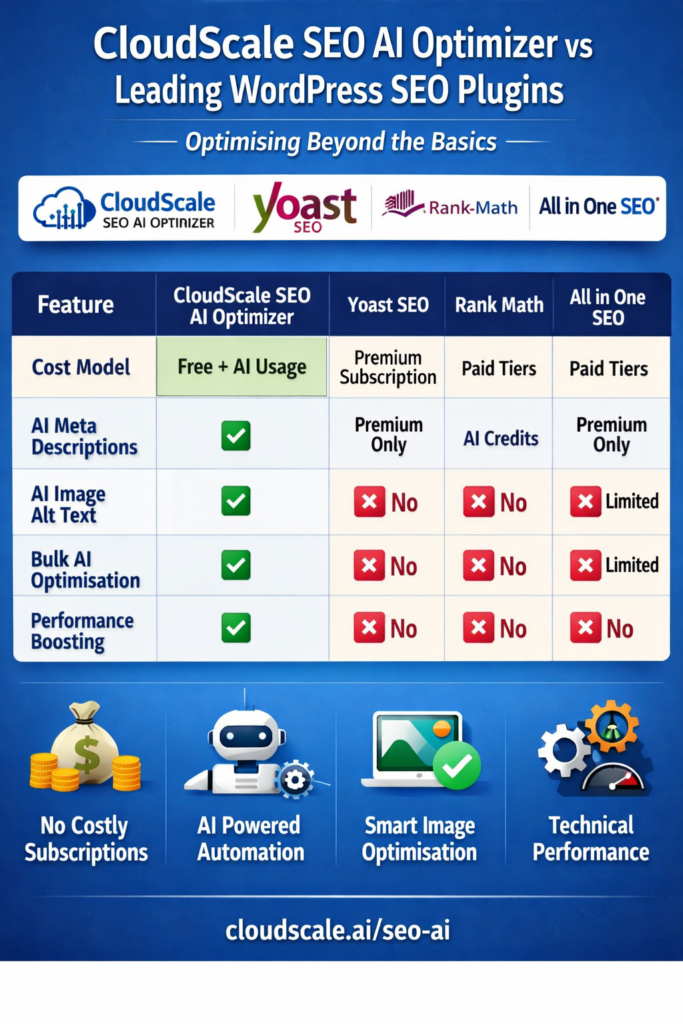
The easiest way to understand how CloudScale SEO AI Optimizer differs from traditional plugins is to compare the core capabilities side by side. Three capability areas have no equivalent in any competing plugin. The automated Related Articles engine builds and injects internal links across your entire post library using pure PHP with no API calls and no ongoing cost. The Category tools covering Health Dashboard, Drift Detection, and AI assisted reassignment treat taxonomy as an ongoing operational concern rather than a one-time setup task. The AI Article Summary Box generates a three-field structured summary per post and writes those fields directly into Article JSON-LD schema, giving search engines and AI crawlers richer structured data than any traditional SEO plugin produces. AIOSEO offers a Link Assistant dashboard that audits and suggests internal links, but the links still require manual application post by post. CloudScale generates and injects them automatically across the entire site in a single batch operation.
| Capability | CloudScale SEO AI Optimizer | Yoast SEO | Rank Math | All in One SEO | AIOSEO AI |
|---|---|---|---|---|---|
| Cost model | Free plugin, pay only AI provider usage | Free version plus premium subscription | Free version plus paid tiers | Free version plus paid tiers | Paid tiers with proprietary AI credits |
| Typical annual cost for advanced features | AI usage often only a few dollars per month | About 99 dollars per site per year | About 95 dollars per year for advanced plan | About 124 dollars per year for pro plan | About 124 dollars per year plus AI credit top-ups |
| SEO titles and descriptions | Yes | Yes | Yes | Yes | Yes |
| Open Graph and social metadata | Yes | Yes | Yes | Yes | Yes |
| Canonical tag control | Yes | Yes | Yes | Yes | Yes |
| XML sitemap generation | Yes | Yes | Yes | Yes | Yes |
| Robots rules management | Yes | Limited | Limited | Limited | Limited |
| llms.txt support | Yes | No | No | No | No |
| AI provider choice | Anthropic Claude or Google Gemini, bring your own key | No | Third party only | No | OpenAI only via proprietary credit system |
| AI meta description generation | Yes, bring your own key with full prompt control | Premium feature | AI credits | Premium feature | Yes, proprietary AI credits, Pro plan required |
| AI title generation | Yes, bring your own key with full prompt control | No | Limited | No | Yes, five suggestions per post, Pro plan required |
| AI bulk optimisation | Yes, entire site in one scheduled pass | No | Limited | Limited | No, per post only |
| Multi-turn length correction | Yes, up to 3 escalating passes | No | No | No | No |
| AI image alternative text generation | Yes | No | No | No | No |
| AI article summary box | Yes, three fields written to JSON-LD schema | No | No | No | No |
| Automated related articles | Yes, scores and injects across entire post library with no API cost | No | No | No | No |
| Internal linking dashboard | No, links injected automatically without manual interface needed | No | No | Yes, Link Assistant with orphaned post detection | Yes, Link Assistant with orphaned post detection |
| You Might Also Like block | Yes, second internal linking block per post | No | No | No | No |
| Category Fixer with AI | Yes, AI proposes reassignments from existing categories only | No | No | No | No |
| Category Health Dashboard | Yes, post count, distribution, overloaded and redundant category metrics | No | No | No | No |
| Category Drift Detection | Yes, AI verdict with confidence rating and suggested action per category | No | No | No | No |
| Gutenberg sidebar panel | Yes, full meta and summary editing without leaving the editor | Limited | Limited | Limited | Yes |
| Scheduled optimisation jobs | Yes, per day scheduling with 28 day run history | No | No | No | No |
| Bulk processing across posts | Yes | Limited | Limited | Limited | No |
| Performance optimisation options | Yes | No | No | No | No |
| Mixed content scanning and fixes | Yes | No | No | No | No |
| Script defer and font optimisation | Yes | No | No | No | No |
| Tracking parameter cleanup | Yes | Limited | Limited | Limited | No |
| Accessibility improvements | Yes | Limited | Limited | Limited | Limited |
The most important difference here is economic. Traditional SEO plugins charge subscription fees for advanced features, and AIOSEO’s AI capabilities are gated behind both a Pro subscription and a proprietary credit system. CloudScale SEO AI Optimizer is free and only incurs the direct cost of whichever AI provider you choose to use, with full control over the model, the prompt, and the spend.
4. The Architectural Difference
The real difference between these tools becomes clear when you look at their underlying workflow.
Traditional SEO plugins operate using an advisory model.
Content is written in the editor.
The plugin analyses the page.
The plugin produces recommendations.
The author manually fixes the issues.
CloudScale SEO AI Optimizer shifts the model toward automation.
Content is written in the editor.
Artificial intelligence analyses the page.
Optimisation suggestions are generated automatically.
Metadata and accessibility improvements can be applied across the entire site.
Instead of acting as a traffic light system that tells authors what is wrong, the plugin attempts to fix those issues automatically.
5. Metadata and Head Tag Control
Metadata management is the core function of any SEO plugin.
CloudScale SEO AI Optimizer manages titles, descriptions, canonical tags, Open Graph tags, Twitter cards, and JSON LD schema directly through WordPress hooks.
An important architectural choice is that the plugin becomes the single source of truth for metadata. It disables canonical output from other plugins such as Yoast, Rank Math, and Jetpack to prevent duplicate tags.
Anyone who has debugged a WordPress site with conflicting SEO plugins will immediately understand the value of this design.
6. Artificial Intelligence Content Optimisation
Most modern SEO tools have started adding artificial intelligence features. In most cases those features are small additions such as generating titles or meta descriptions.
CloudScale SEO AI Optimizer takes a much deeper approach.
The plugin integrates with multiple model providers including Anthropic and Gemini. Administrators can configure prompts, token limits, and model selection directly inside WordPress.
Descriptions can be generated individually or across large numbers of posts. The plugin can also run scheduled optimisation jobs using WordPress Cron.
Generated descriptions are validated automatically to ensure they fall within recommended character limits.
For large content libraries this dramatically reduces the amount of manual editing required.
7. Accessibility and Image Optimisation
Accessibility signals increasingly influence search visibility, particularly for image indexing.
Most SEO plugins allow authors to add alternative text to images but provide little assistance in generating it.
CloudScale SEO AI Optimizer introduces artificial intelligence vision models to generate image alternative text automatically.
Images can be processed individually or in bulk across an entire site. Generated descriptions are validated and corrected if they exceed expected character ranges.
This improves both accessibility compliance and image search performance.
8. Automated Related Articles and Internal Linking
Internal linking is one of the most consistently underutilised levers in SEO. Search engines use internal links to understand site structure, distribute page authority, and determine which posts are topically related to each other. Most WordPress sites manage internal linking entirely by hand, which means it rarely happens consistently at scale.
CloudScale SEO AI Optimizer now includes a fully automated Related Articles engine that handles this without any AI API calls or ongoing cost.
For every published post the engine finds and ranks other posts on the site that are topically related. It uses a scoring model built around signals already present in your content: shared categories, shared tags, keyword overlap in post titles, keyword overlap in AI summary text, and a recency bonus for recently published posts.
Two blocks are injected automatically on the front end. A Related Articles block appears near the top of each post, directly after the AI summary box, showing the closest conceptual matches. A You Might Also Like block appears at the bottom before the comments section, drawing from a wider pool to extend session depth.
Both blocks are generated entirely in PHP with no external requests, no AI tokens, and no cost.
The admin interface provides a full post status table with batch controls: generate for your entire post library in one pass, refresh after restructuring categories or tags, retry errors, or reset and rebuild. Reducing the link count takes effect immediately without regeneration. Increasing it shows a warning to run a refresh so the additional links can be scored and stored.
For sites with hundreds or thousands of posts this feature alone can meaningfully improve crawl efficiency, internal authority distribution, and time on site, all without touching a single post manually.
9. Category Health and Drift Detection
Poorly structured categories confuse both site visitors and search engines. A category that mixes unrelated topics sends contradictory signals about what a site covers, and most sites have no way to detect this at scale.
CloudScale SEO AI Optimizer includes two tools that address this systematically.
The Category Health Dashboard analyses every category and surfaces metrics covering post count, distribution, overloaded categories, and redundant or underused ones. This gives administrators a clear operational view of their taxonomy before making structural changes.
Category Drift Detection goes further. It uses AI to read the titles of posts in each category and determine whether the category has a coherent topic focus or whether it has drifted into catch-all territory. Each flagged category receives a verdict, a confidence rating, example titles used as evidence, and a specific suggested action such as splitting the category, renaming it, or merging it into an adjacent one.
Together these features treat category management as an ongoing operational concern rather than something that gets configured once and forgotten.
10. Bulk Optimisation at Scale
One of the largest operational problems with traditional SEO plugins is scale.
Optimising a site with hundreds or thousands of posts manually is extremely time consuming.
CloudScale SEO AI Optimizer introduces batch processing and scheduled optimisation jobs that allow artificial intelligence to analyse and optimise large numbers of pages automatically.
For large publishers or knowledge bases this changes SEO from a manual editing task into an automated operational process.
11. Technical SEO Infrastructure
Search optimisation involves more than just content. Crawler behaviour, index management, and URL structure all influence how search engines interact with a site. The plugin includes a number of features designed to support this.
Dynamic XML sitemaps can be generated automatically. Robots rules can be configured to control indexing of search pages, attachment pages, and error pages.
The plugin also introduces support for llms.txt which allows site owners to define how large language model crawlers interact with their content.
Tracking parameters can be stripped automatically to prevent duplicate content issues.
These capabilities extend the plugin beyond traditional on page SEO.
12. Performance Optimisation
One of the more unusual aspects of CloudScale SEO AI Optimizer is that it also includes performance optimisation features.
Traditional SEO plugins generally avoid performance features because they overlap with caching plugins and optimisation frameworks.
CloudScale includes options for script deferment, HTML and CSS minification, font loading optimisation, and mixed content detection.
Administrators can scan their site for insecure resources and automatically correct them.
These changes influence both page load performance and search ranking signals.
13. Who This Plugin Is For
The plugin appears to be designed primarily for technically minded site operators.
The administrative interface exposes configuration for artificial intelligence providers, crawler behaviour, optimisation scheduling, accessibility processing, and performance tuning.
This approach is likely to appeal most strongly to developers, founders, and technically inclined publishers who prefer operational control inside WordPress.
14. The Bigger Strategic Shift
The most interesting aspect of this plugin is not the individual features. It is the philosophy behind them. Traditional SEO plugins help authors write optimised content. CloudScale SEO AI Optimizer attempts to automate the optimisation process itself. That difference may seem subtle but it represents a fundamental shift in how SEO tooling works.
Instead of analysing problems and asking humans to fix them, optimisation becomes a system level capability.
15. Final Verdict
Traditional WordPress SEO plugins have been extremely successful because they help authors improve their content. But they still rely heavily on manual work. CloudScale SEO AI Optimizer attempts something different. It treats search optimisation as an automated operational process rather than a manual editing task.
Artificial intelligence analyses the site.
Optimisation can be applied across the entire content library. Accessibility and technical issues can be addressed automatically.
Traditional SEO plugins tell you what is wrong with your site. CloudScale attempts to fix it.
16. References
| Source | Description |
|---|---|
| https://github.com/andrewbakercloudscale/wordpress-seo-ai-optimizer | CloudScale SEO AI Optimizer repository |
| https://yoast.com | Yoast SEO plugin overview |
| https://rankmath.com | Rank Math plugin overview |
| https://aioseo.com | All in One SEO plugin overview |