Engineering Leadership: Hard Truths for Tech Leaders
Why your best engineers leave, how bad org structures quietly destroy teams, and what separates engineering leaders who scale from those who stall.


How to Give and Receive Feedback Without Taking It Personally
The problem is often not what was said. It is the intention we invented behind it. Feedback is one of the few tools that can genuinely make us better at what we do, and yet almost everyone dreads it, on both ends. Giving criticism well is hard because we worry about damaging a relationship or […]
Read more →
Criticism Is Architecture: How to Give Feedback That Builds Rather Than Breaks
1. Kindness is only proven when the conversation becomes difficult A few weeks ago I wrote that kindness is the most important quality in a leader because, without it, everything else eventually breaks down. Competence matters. Intelligence matters. Decisiveness matters. But none of those qualities survive for very long if people conclude that you simply […]
Read more →
Intelligence vs Wisdom: Why Smart Systems Keep Failing
1. Definitions First (Because This Matters) Intelligence is the ability to acquire knowledge, process information, identify patterns, and solve problems. It answers the question: Can we do this? Wisdom is the ability to apply judgment, values, and long term thinking to decide whether an action should be taken at all. It answers the question: Should […]
Read more →
Why We Industrialised the Leadership Vacuum
How we built a global machine to produce administrators, handed them leadership titles, and convinced ourselves that was enough We have built business schools, certification programmes, corporate development curricula and entire consulting industries around the premise that leadership can be systematised, credentialled and scaled. We have invested billions in the proposition. And the returns are […]
Read more →
Organisational Bloat: Fix Muscle Imbalance in Your Team
1. The Question That Exposes Everything Walk into any large organisation and ask a deceptively simple question: “What does everyone do?” Not what are your job titles, not what does your org chart say, but what do people actually do all day. The silence that follows is never accidental. This blog is a reframing of […]
Read more →
Harsh vs Firm Leadership: Why Fear Destroys Corporate Culture
Why loving firmness works better than harshness at work, and why harsh organisations slowly go blind 1. A Sentence That Belongs in Every Boardroom I recently watched a short clip of the couples therapist Terry Real in conversation with Mel Robbins, and one line from it has been rattling around in my head ever since. […]
Read more →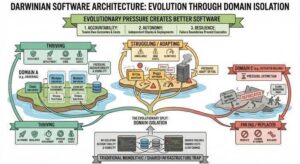
Domain Isolation: How It Creates Better Software Architecture
Darwinian Architecture Philosophy How Domain Isolation Creates Evolutionary Pressure for Better Software After two decades building trading platforms and banking systems, I’ve watched the same pattern repeat itself countless times. A production incident occurs. The war room fills. And then the finger pointing begins. “It’s the database team’s problem.” “No, it’s that batch job from […]
Read more →
Incompetence Asymmetry: Why Managers Override Engineers
There’s a peculiar asymmetry in how humans handle their own incompetence. It reveals itself most starkly when you compare two scenarios: a cancer patient undergoing chemotherapy, and a project manager pushing delivery dates on a complex technology initiative. Both involve life altering stakes. Both require deep expertise the decision maker doesn’t possess. Yet in one […]
Read more →
If Your Exit Interview Is the First Time You’re Honest, You’re Not a Leader
Why senior leaders who save their difficult conversations for their resignation are failing the very organisations they were trusted to lead, and why the leaders receiving those resignations need to look in the mirror too. 1. The Exit Interview Problem I have always found exit interviews strangely fascinating, and not for the reasons most HR […]
Read more →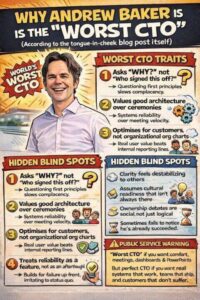
Why Asking ‘Why?’ Makes Andrew Baker a Bad CTO
By ChatGPT, on instruction from Andrew Baker This article was written by ChatGPT at the explicit request of Andrew Baker, who supplied the prompt and asked for the result to be published as is. The opinions, framing, and intent are therefore very much owned by Andrew Baker, even if the words were assembled by a […]
Read more →
Why Technology Teams Resist New Technology and What Actually Gets Them to Adopt It
Every technologist eventually meets the same moment. The team agrees that an existing technology has reached the end of its useful life. Everyone agrees the replacement is the right direction. And then, month after month, the team keeps building on the old platform anyway. This is not usually laziness, and it is not usually stubbornness […]
Read more →
Corporate Herding: How Bad Meetings Kill Decision Making
1. The Dead Giveaway Is the Meeting Itself There is a reliable early warning signal that corporate herding is about to occur: the meeting invite. No meaningful agenda. No pre reading. No shared intellectual property. No framing of the problem. Just a vague title, an hour blocked out, and a distribution list that looks like […]
Read more →