Engineering Leadership: Hard Truths for Tech Leaders
Why your best engineers leave, how bad org structures quietly destroy teams, and what separates engineering leaders who scale from those who stall.


The Hidden Cost of Leadership Misalignment
Alignment is expensive. Misalignment costs more. For a long time I thought that being on the same page was overrated. I learned how wrong that was at home some years before I properly understood it at work. My wife and I have been married for more than two decades. We love each other, and there […]
Read more →
How to Tell If You Are a Micromanager: A Self Diagnosis Guide for Leaders
The Manager in the Mirror: How to Know If You Are the Problem There is a particular kind of manager who works harder than anyone else on the team, arriving before the others and leaving after them, their calendar packed wall to wall, their inbox never quiet, touching every deliverable before it leaves the building […]
Read more →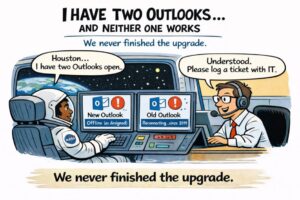
I Have Two Outlooks on a NASA Spacecraft and Neither Works
1. Ground Control to Major Redmond In early April 2026, four astronauts aboard the Orion spacecraft radioed Mission Control. They were travelling at over four thousand miles per hour, more than thirty thousand miles from Earth, on NASA’s first crewed lunar mission in more than fifty years. The hardware that got them there represents the […]
Read more →
The Difference Between Leadership and Management: Why Leaders Create Discomfort and Managers Mask it
1. Management and Leadership Are Not the Same Thing There is a fundamental confusion in how organizations talk about leadership, because we use the word interchangeably with management and we should not. Management is the art of moving things from point A to point B; it is process, it is orderly, and you can measure […]
Read more →
Why Kindness Is the Most Important Quality in a Leader (And Without It, Nothing Else Works)
I have spent a long time thinking about what separates the leaders who build things that outlast them from the ones who leave wreckage where organisations used to be. There are thousands of frameworks, countless MBA modules, and an entire industry devoted to answering that question, and most of them are wrong, or at least […]
Read more →
The South African Banking Paradox: Abundance, Consolidation, and the Coming Reckoning
These thoughts are my own and I am often wrong, so don’t get too excited if you disagree with me. South Africa is experiencing a banking paradox. Consumers have never had more choice, with digital challenger banks, retailer backed banks, insurer led banks, and mobile first offerings launching at a remarkable pace, while at the […]
Read more →
Cloudflare Free Tier Review: Why It Works for Enterprise
By Andrew Baker, CIO at Capitec Bank There is a truth that most technology vendors either do not understand or choose to ignore: the best sales pitch you will ever make is letting someone use your product for free. Not a watered-down demo, not a 14-day trial that expires before anyone has figured out the […]
Read more →
The 10 Nil Paradigm: Why Your 8 Hour Outage Isn’t a “Blip”
1. Who Farted? If someone farts in a meeting room, everyone notices immediately. It is uncomfortable, distracting, and changes the entire atmosphere, yet strangely nobody wants to address it directly. People glance at each other, suppress reactions, maybe make a weak joke, and then carry on as if nothing really happened, even though everyone knows […]
Read more →
Why Agile Fails: Sprints, SAFe and Ceremonial Process
Or: How We Turned Software Development Into Ticket Farming and Ceremonial Theatre 1. Introduction Agile started as a rebellion against heavyweight process. It was meant to free teams from Gantt charts, upfront certainty theatre, and waterfall failure modes. Somewhere along the way, Agile became exactly what it claimed to replace: a sprawling, defensible process designed […]
Read more →
Stop Slinging MUD: The Hidden Cost of Shipping a Date
1. MUD: The Most Expensive Habit in Technology Over the course of my career I have watched intelligent, experienced people confidently announce delivery dates for projects that nobody in the room could possibly predict with any real accuracy. Sometimes those dates came from programme managers. Sometimes they came from architects. Sometimes they came from executives. […]
Read more →
The Leadership Handoff: How Learned Helplessness And Management Bottlenecks Are Slowing AI Era Organizations
1. The Rugby Lesson Most People Learn the Hard Way If you have ever played rugby, you learn very quickly what a handoff is. You approach a player too high, too upright, or too casually, and suddenly there is a massive palm in your face while your dignity disappears backwards across the grass. The handoff […]
Read more →
Leadership Success: Are You Earning It, or Borrowing It?
1. Two million users A product review lands on your desk. It shows 2 million users, and the team presenting is proud. Rightly so. Two million is a large number by any measure. Then you look at the parent organisation. It has 8 million active customers, and the feature has been sitting prominently inside the […]
Read more →