Banking Technology & Cybersecurity: Real-World Engineering
Fraud systems, payments engineering, banking malware, and what building secure financial technology looks like inside one of Africas largest retail banks.


How Banks Can Break Client Hypnosis: Contextual Authorisation and the Fight Against Social Engineering Fraud
by Andrew Baker 1. Opening: The Client Has Been Captured The fraud victim approving a transaction they believe is a refund is not making a mistake. They are not confused or careless or naive. They are operating under full psychological capture, executing instructions from an authority figure they have been conditioned over the course of […]
Read more →
Regulatory Risk: The Missing Seventh Pillar of the AWS Well Architected Framework
A free, open source tool that measures how hard it would be to leave AWS across a whole AWS Organization or OU, works out what a second AWS region would cost, and turns the answers into a board ready report. Every regulated firm that runs on AWS has had the same conversation. Someone in a […]
Read more →
From Zero to Exploit Detection: A Practical Guide to Nuclei Templates for Pen Testing
Vulnerability scanning used to mean choosing between a handful of expensive commercial scanners or writing your own scripts for every check you cared about. Nuclei changed that calculation. It is an open source scanning engine built by ProjectDiscovery that runs YAML defined templates against targets, and the template library has grown into one of the […]
Read more →NMAP + Claude MCP: 20 Vulnerability Scans on macOS
Introduction NMAP (Network Mapper) is one of the most powerful and versatile network scanning tools available for security professionals, system administrators, and ethical hackers. When combined with Claude through the Model Context Protocol (MCP), it becomes an even more powerful tool, allowing you to leverage AI to intelligently analyze scan results, suggest scanning strategies, and […]
Read more →
AWS CLI: ZSP: Keeping AWS Keys Out of Plaintext on Your Mac
A free, open source macOS tool that takes long lived AWS keys out of ~/.aws, seals them with the Secure Enclave, and asks for Touch ID before any of them is used. Who is this for? This is a simple, free, open-source security improvement for anyone using AWS CLI on a Mac, particularly developers, freelancers […]
Read more →Scan SSL/TLS Ciphers With nmap and sslscan on macOS
To retrieve a list of the SSL/TLS cipher suites a particular website offers you can either use sslscan or nmap alternatively you can just use nmap (note: i use “-e en0” to bypass zscaler): Another variant (including cert dates, again “-e en0” is used to bypass zscaler):
Read more →SYN Flood Testing With hping3: Parallel Processes Guide
A SYN flood test using hping3 that allows you to specify the number of SYN packets to send and scales horizontally with a specific number of processes can be created using a Bash script with the xargs command. This approach allows you to distribute the workload across multiple processes for better performance. The Script This […]
Read more →Mac Terminal: Scan TLS Certificates with NMAP and SSLScan
The below script will give you basic information on a websites certificate: NMAP is provides a simple way to get a list of available ciphers from a host website / server. Additionally, nmap provides a strength rating of strong, weak, or unknown for each available cipher. First, download the ssl-enum-ciphers.nse nmap script (explanation here). Then from the same […]
Read more →
WordPress XMLRPC.PHP Brute Force Testing Guide for macOS
A Comprehensive Security Testing Guide for Mac Users 1. Introduction WordPress xmlrpc.php is a legacy XML-RPC interface that enables remote connections to your WordPress site. While designed for legitimate integrations, this endpoint has become a major security concern due to its susceptibility to brute force attacks and amplification attacks. Understanding how to test your WordPress […]
Read more →
CVE-2024-3094: Detecting the XZ Utils SSH Backdoor
Executive Summary CVE-2024-3094 represents one of the most sophisticated supply chain attacks in recent history. Discovered in March 2024, this vulnerability embedded a backdoor into XZ Utils versions 5.6.0 and 5.6.1, allowing attackers to compromise SSH authentication on Linux systems. With a CVSS score of 10.0 (Critical), this attack demonstrates the extreme risks inherent in […]
Read more →
Why Core Banking Was a Bad Idea From the Start
A companion piece to Core Banking Is a Terrible Idea. It Always Was. It is 1972. A group of very serious men in very wide ties are gathered in a very beige conference room. They are about to make decisions that will haunt your change advisory board fifty years from now. The following is a […]
Read more →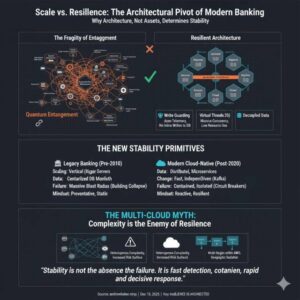
Why Bank Architecture Determines Resilience More Than Size
1. Size Was Once Mistaken for Stability For most of modern banking history, stability was assumed to increase with size. The thinking was the bigger you are, the more you should care, the more resources you can apply to problems. Larger banks had more capital, more infrastructure, and more people. In a pre-cloud world, this […]
Read more →