Your Interview Process Is Cloning Your Weaknesses

Leadership interviews systematically mislead organisations because they measure performance under artificial conditions rather than actual leadership capacity. The real constraint mirrors distributed systems theory: effective leaders must balance consistency, availability, and adaptability, but optimising for any two inevitably compromises the third. Interviews reward rehearsed coherence while concealing the genuine trade offs leaders navigate under pressure.
Most organisations believe their interview process selects for leadership. It does not. It selects for the ability to perform leadership in a low stakes, well prepared, time limited conversation in front of a panel that has already decided what it wants to see. That is a different thing entirely, and confusing the two is costing organisations and individuals more than anyone is willing to admit.
There is a theorem in distributed systems that says you can have consistency, availability, and partition tolerance, but you only ever get to pick two. The third one costs you something real. Leadership has exactly the same structure, and until you understand the triangle, you cannot design an interview process that tells you anything true.
1. The Triangle and What It Actually Means
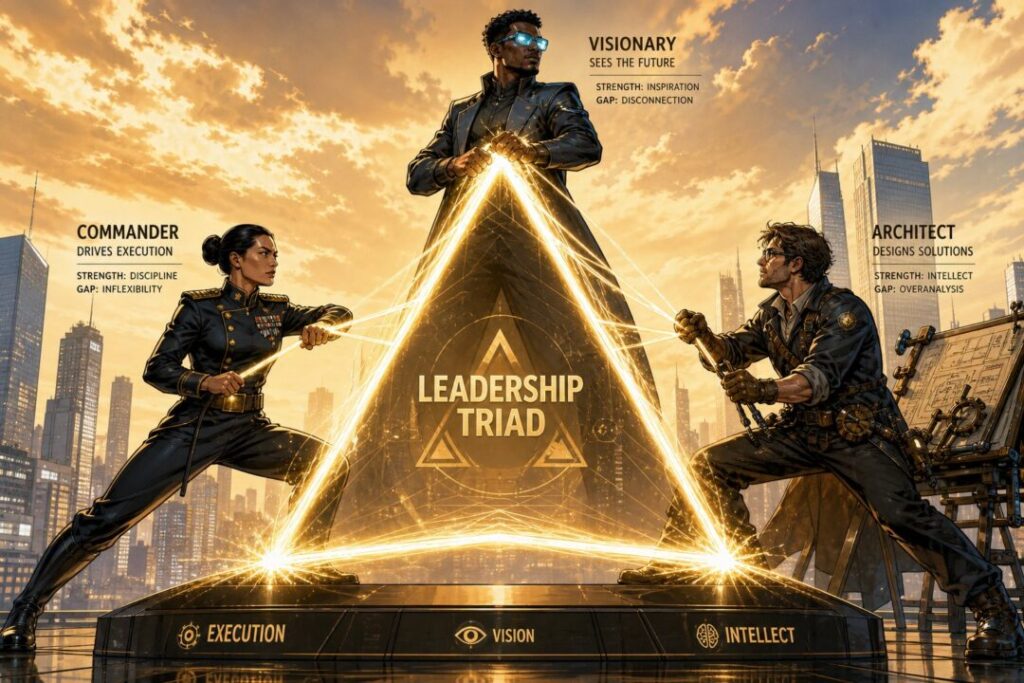
Every leader you will ever interview, every leader you will ever be, sits somewhere in a triangle of three properties: Leadership presence and vision, intellectual depth and ideas generation, and operational execution. You get two. The third is always the growth edge, always the gap, always the discomfort. The interview process exists, or should exist, to find that gap. Not to confirm the two strong points. Not to celebrate the qualities already present. To find the one that is absent or underdeveloped, name it clearly, and then make an honest decision about what to do with that information. Most interview processes do none of this.
Before the model is useful it needs to be grounded. Leadership presence and vision is the property that allows someone to set direction, create followership, and hold a room when the answer is not yet clear. It is not charisma, though charisma sometimes accompanies it. It is the ability to make people believe the destination is real and worth moving toward. Intellectual depth and ideas generation is the property that produces original thinking, identifies structural problems before they become crises, and connects domains that others keep separate. It is the person in the room who changes the frame of the question rather than competing to answer it fastest. Operational execution is the property that converts intention into outcome at scale, the capacity to build systems, hold people accountable, absorb complexity without losing forward motion, and still be standing when the project is finished.
The three pairings produce three recognisable archetypes. The Visionary carries Leadership and IP but not Operations, inspires and provokes but leaves organisations in a permanent state of exciting incompletion, always another idea before the last one landed. The Commander carries Leadership and Operations but not IP, runs a large machine with genuine authority and can deliver almost anything you define clearly, but struggles when the machine needs to be redesigned from first principles. The Architect carries IP and Operations but not Leadership, indispensable, often the real engine of a team, building the things that actually work, but unable to create the followership that executive roles require. Every organisation has all three archetypes somewhere in its leadership population. The question is whether anyone has named which archetype sits in which seat, and whether those seats were designed around an honest understanding of what the role actually needed. And before you finish this paragraph, you have already placed yourself in one of the three. That matters, and we will come back to it.
2. The Organisational Sin Nobody Audits
There is a failure mode more damaging than a bad hire and more common than most leaders are prepared to acknowledge. It is the structure that was never designed around what the organisation needed to achieve. It was designed, gradually and without anyone quite admitting it, around what the existing leaders were capable of hiring.
Walk into enough organisations and you find the same pattern. Teams populated with administrators, reporters, managers, analysts, and leaders, layer upon layer of people whose primary function is to coordinate, summarise, present, and govern the work of others. And somewhere beneath all of that, a thin and overstretched layer of people actually doing the work, actually building the things, actually solving the problems the organisation exists to solve. The ratio is wrong. The structure is inverted. And the reason it got that way is not complexity or growth or the demands of a regulated environment. The reason is that at some point a leader hired someone they were comfortable with, that person hired someone they were comfortable with, and the pattern repeated until the organisation became a mirror of its own leadership preferences rather than a machine designed to produce outcomes.
Birds of a feather flock together is not a business strategy. It is a social club with a budget. The damage it causes is not immediately visible because the meetings are well attended, the decks are well structured, and the reporting looks clean. What is invisible is the absence of the people who would push back, who would build differently, who would ask why the process exists at all before agreeing to document it. Those people were never hired because they made the existing leadership uncomfortable. They did not remind the panel of themselves. They asked questions that had no clean answers. They were not selected, and the organisation is weaker for every round of that selection that happened without anyone noticing the pattern.
This is a leadership sickness, and like most leadership sicknesses it is self reinforcing. The more a structure fills with people hired in the image of existing leadership, the more that structure resists the kind of hire that would correct it. The Visionary organisation that has spent three years hiring Visionaries has built a panel that genuinely cannot recognise operational depth as a virtue. The Commander organisation that keeps hiring Commanders has built a culture that reads intellectual provocation as a threat rather than an asset. The sickness produces the conditions that perpetuate it, and by the time someone external looks at the structure and names what has happened, the correction is painful enough that most organisations choose to manage the problem rather than fix it.
The audit that should happen before any hiring process begins is not a headcount review. It is an honest map of what the organisation needs to be able to do that it currently cannot, followed by an equally honest assessment of whether the existing hiring panels are capable of selecting for those properties or whether they will, left to their own devices, simply reproduce themselves again. If the answer to the second question is no, the panel needs to change before the job description is written.
3. The Carnival Parade and Why Panels Make It Worse
Picture a carnival parade. The floats go by. The leadership candidates walk their strengths in front of a panel who have already decided what they are looking for, and the candidates perform accordingly. The interviewers cheer for the floats they like, a selection is made, and everyone else goes home. No feedback. No naming of the gap. No conversation about what actually happened. The unsuccessful candidate walks away with a vague sense of rejection and zero signal about what to work on. The next interview they walk the same float past the same type of panel and wonder again why it did not land.
This is not an interview process. It is a parade with a hidden scoring rubric and no obligation to share the results. The harm is not just to the candidate in the moment. It is cumulative. Every parade they walk through without honest feedback is another month or year where the gap goes unnamed and therefore unaddressed. The individual cannot grow toward the third property because nobody has ever told them clearly which property is missing.
The panel is not a neutral observer in this failure, and this is the part organisations rarely examine. Panels hire toward their own dominant properties. A panel of Visionaries undervalues the Commander who cannot work a room but can deliver anything you put in front of them. A panel of Architects distrusts the leader whose influence operates through relationships rather than rigour. A panel of Commanders is uncomfortable with the intellectual who reframes problems instead of solving the ones already on the table. The parade does not just obscure the candidate’s gap. It systematically amplifies the panel’s, and the organisation ends up cloning its existing leadership profile rather than hiring toward what it actually needs. Before any interview process can be fixed, the panel has to do something most panels never do: identify their own archetype, name their own bias, and design the process to counteract it rather than confirm it.
4. Be Intentional Before You Walk Into the Room
There is a question that runs silently beneath almost every interview and it is the wrong question. It sounds like: do I like this person? Are they like me? Can I relate to them? It feels like instinct and it gets dressed up as cultural fit and leadership presence and executive gravitas, but what it actually is, stripped of the flattering language, is the panel deciding whether the candidate reminds them of themselves. This is not a selection criterion. It is a mirror held up to the panel’s own preferences, and hiring against it produces leadership populations that are increasingly homogeneous and increasingly blind to the gaps the organisation actually needs to fill.
The right question is harder and more specific: what does this person need to have, in terms of properties, experience, and development, to be successful in this role, and am I in a position to help them get there? These are two separate questions and both of them matter. The first forces clarity about the role itself, what the triangle demands of whoever sits in it, what the gap is that needs to be hired toward, and what success actually looks like beyond the first ninety days. The second forces honesty about the hiring manager’s own capacity and intent, whether they have the time, the skill, and the genuine willingness to develop someone rather than simply deploy them. If you cannot answer the first question clearly before the interview begins, you are not ready to be hiring the role. You have not done the work of understanding what it needs. If you cannot answer the second question honestly, you are not ready to be making an offer. You may be about to make a promise, implicitly, that you have no intention of keeping.
This reframe changes the entire orientation of the conversation. The panel is no longer asking whether they would enjoy having lunch with this person. They are asking whether this person, with the right support and the right development, can grow into what this role demands. That is a more demanding question to sit with and a more useful one. It keeps the panel focused on the candidate’s trajectory rather than their current comfort level, on what the role requires rather than what the panel finds familiar, and on the organisation’s obligation to the person they are about to appoint rather than the organisation’s preference for an easy working relationship.
5. What the Interview Should Actually Be
A useful interview is not a parade. It is a progressive stress test designed to find where understanding breaks down and behaviour changes. You start with the domains the person is confident in, let them settle into their strengths, and then you start asking harder questions, questions that move toward the gap, questions that require the person to operate in less comfortable territory. You watch what happens when the framing shifts from vision to execution, from execution to systems thinking, from ideas to people decisions. You note where the answers become vague, where the examples become recycled, where the energy drops or the defensiveness rises. That is the data. Not the confidence, not the fluency, not the eye contact. The actual content of what someone says when the comfortable territory runs out.
The questions that find the gap look different depending on which gap you are probing. To test the operations gap in a Visionary, stop asking about strategy and ask about the last time a delivery went badly wrong and what they personally did to recover it, not the team, not the process, them specifically. To test the IP gap in a Commander, ask them to diagnose a structural problem in their own industry that nobody in their organisation is talking about yet and give them nowhere comfortable to hide behind execution experience. To test the leadership gap in an Architect, ask them to describe a moment when the team did not want to go where they needed to go, and how they moved them without the authority to compel. These questions are hard to perform. They require genuine experience of operating in territory that does not come naturally, and absence of that experience shows immediately in the quality and specificity of the answer.
This is what it means to touch the eyeball of the soul, not to cause pain but to find the edge of genuine capability, the place where authentic thinking ends and performed confidence begins, the place where growth is actually needed. Done well, this is not unkind. It is the most respectful thing you can do for a person. You are treating them as someone capable of growth rather than someone to be managed through a selection process without their knowledge. And because the panel has already named its own archetype and its own bias, the questions can be designed deliberately to probe what the panel would naturally overlook rather than what the panel would naturally reward.
6. A Good Interview Is Exhausting and Should Be
Here is something almost nobody says about the interview process but should be stated plainly: a genuinely good leadership interview is emotionally draining for everyone in the room. Not because it should be adversarial or theatrical, but because real inquiry into where a person’s thinking breaks down, where their defaults take over, where their growth edge actually sits, requires full presence and full honesty from both sides of the table. If you walk out of an interview feeling fine, you probably did not do it properly.
This has real practical consequences for how interviews should be scheduled and run. Never put two of these conversations in the same day. The second one will be a shadow of the first, the panel flattened by the emotional weight of the morning, the candidate receiving a diminished version of the process they deserve. Plan each conversation in advance with enough specificity that the panel knows which gap they are probing, which questions they are carrying in, and which moments they are prepared to sit with. Awkward silences are not failures of the process. They are often the most productive moments in it, the space where a candidate stops performing and starts actually thinking. Push through them rather than rescuing the person from the discomfort.
When a line of questioning reaches genuine intensity, when the gap has been found and the conversation has moved into territory that is visibly difficult for the candidate, take a break rather than pushing through to exhaustion. A short pause allows both parties to reorient, signals that the difficulty is intentional and respected rather than accidental, and often produces more honest conversation in the second half than anything that happened in the first. Bring people into the panel who carry a fundamentally different archetype from the hiring manager, not as a token gesture toward diversity of opinion but as a structural counterweight to the bias that will otherwise dominate the room. The Commander running the process needs an Architect in the panel who will notice what the Commander cannot see and ask the questions the Commander would never think to ask. The conversation that results from that combination is more uncomfortable for everyone and more valuable for exactly that reason. Dwell on specific past events rather than accepting general claims. When a candidate describes how they handled something, go back into it, ask what they were actually thinking in that moment, ask what they would do differently, ask what it revealed about how they default under pressure. The gap almost always shows up not in the first answer but in the third or fourth follow up question when the prepared narrative has been exhausted and what remains is the unpolished truth.
7. The Outcome Should Be a Conversation Not a Verdict
When the interview is a carnival parade, the outcome is binary. Selected or not selected. The candidate has no agency in that verdict and no information to act on. When the interview is a progressive stress test designed to find the gap, the outcome becomes a genuine conversation. You can say: here are the two properties you carry with real depth and here is the third property where growth is needed before this role makes sense. The appointment, if it happens, is either an unexpected upside because the person grew faster than expected, or it is confirmation that more time and more development needs to happen first. Both outcomes are honest. Both outcomes are useful. Neither outcome leaves the person standing on the pavement wondering what just happened.
This requires the panel to have done the work beforehand of mapping the role to the triangle. Which two properties are already present in the organisation and which third property is the gap the role must fill? A strong operational organisation hiring a new executive might need intellectual provocation even if it creates friction. A visionary business might desperately need operational discipline even if the candidate who carries it does not perform as impressively in an unstructured conversation. Knowing which gap you are hiring toward changes everything about how you read interview behaviour, and it forces the panel to confront its own archetype before bias contaminates the process rather than after it already has.
8. The Conversation Nobody Has
Sometimes the conversation that needs to happen is not about which property is underdeveloped and how to close it. Sometimes the conversation is about whether the level being aimed for is ever going to be a realistic destination. Organisations are extraordinarily reluctant to have this conversation. It feels cruel. It feels presumptuous. It feels like it might be wrong. So instead of having it, organisations keep the person in a holding pattern of vague encouragement and near misses, absorbing their energy and effort in pursuit of a destination that the organisation already suspects is not achievable.
If someone is struggling on a six foot ladder, telling them they just need more time before they walk on the moon is not kindness. It is the absence of kindness wearing kindness as a costume. The genuine kindness is the harder conversation, the one that says: the properties you carry are genuinely valuable and there are roles where you will excel and lead and win, and the executive leadership track is probably not one of them, and that is not a moral judgement, it is an honest read of the gap and what closing it would actually require. And this conversation has a positive form that organisations almost never reach because they are too busy softening the negative one. The Architect who is redirected honestly into a role built around IP and Operations, a principal engineer, a chief of staff, a deep domain expert with real delivery authority, can become truly exceptional. Not a consolation prize version of the executive they almost were, but a leader in the fullest sense of what their specific combination of properties makes possible. That outcome is only available to people who were told the truth early enough to choose it deliberately rather than arrive at it by exhaustion.
9. This Applies to You Too
Here is the thing the model does to every person who encounters it. You placed yourself in one of the three archetypes somewhere in section one and you have been reading with that placement in your peripheral vision ever since. The Visionary reading this piece knows which delivery went sideways and has a complicated relationship with that knowledge. The Commander reading this piece has a colleague whose thinking they find impractical and wonders sometimes if they are missing something. The Architect reading this piece has led through influence rather than authority and knows exactly how much harder that is than it looks from the outside.
The model is not a verdict on you any more than it is a verdict on the people you interview. It is a design constraint. The question it asks of you as a leader is the same question it asks of every candidate sitting across the table: do you know which property is your gap, have you named it clearly, and are you doing something real about it or are you floating the same strengths past the same admiring audiences and calling that growth. The leaders who genuinely develop across all three properties almost always had a moment where someone told them clearly which property was missing and what closing that gap would actually look like. The honesty was the catalyst, not the comfort.
10. The Cost of Getting This Wrong
Every leader who should have had the gap named and developed instead floats past on their strengths, gets selected, and then runs into the gap at scale where it causes real damage. The Visionary who cannot execute leaves a trail of energised and ultimately disappointed teams. The Commander who cannot think strategically optimises the organisation efficiently toward the wrong destination. The Architect who cannot lead builds brilliant systems that nobody follows. You already know these profiles. Every organisation has them. And in almost every case there was an interview process somewhere earlier in that person’s career that could have named the gap and chose instead to celebrate the parade.
Distributed systems engineers who understand the CAP theorem do not curse the constraint. They design around it with clarity and intention, building systems that are honest about what they sacrifice and optimised for what they prioritise. The human cost of not doing the same in leadership development is not theoretical. It is the executive who derails at scale because nobody told them the gap was there. It is the high potential who spent a decade chasing a destination that was never right for them. It is the organisation that keeps selecting the same archetype because the panel could not see past its own dominant properties. The gap is not a disqualifier. It is a design constraint. The interview process that names it clearly, and builds a genuine development conversation around it, does more for the individual, for the organisation, and for the quality of leadership over time than any number of parades. Stop cheering the floats. Start finding the gap.