Toxic Ownership Models: How Corporate Culture Fails Clients

Toxic ownership models fail clients when accountability becomes performative rather than functional. Organisations that demand ownership without designing clear structures create confusion, duplication, and blame shifting. When everyone owns everything, nobody owns anything. Clients suffer most because responsibility diffuses across teams, decisions stall, and internal politics replace genuine service. Real accountability requires deliberate structural design, not cultural sloganeering.
Toxic Ownership Models: How Corporate Culture Fails ClientsAndrew Baker's Technology Blog Posts, 10/Feb/2026
https://andrewbaker.ninja/2026/02/10/toxic-ownership-models-how-corporate-culture-fails-clients/
1. Ownership Has Been Turned Into a Moral Shortcut
Ownership has become one of the most lazily celebrated concepts in modern organisations. Leaders demand it reflexively, teams chase it performatively, and entire operating models are justified by invoking it as if ownership itself produces outcomes. It does not. Ownership is merely a structural choice, and when that structure is poorly designed it actively works against execution, accountability, and most importantly the client. The uncomfortable truth is that many organisations are not suffering from a lack of ownership at all, but from badly applied ownership that creates the illusion of progress while quietly degrading everything underneath.
2. End to End Ownership Is a Comforting Fiction
The idea of end to end ownership sounds decisive and mature, but in large organisations it is almost always a fiction that collapses under scrutiny. Product teams claim full ownership and then, either explicitly or by slow organisational creep, begin to recreate the entire company inside their vertical. HR functions appear inside product teams, finance controls get duplicated, cyber rules diverge, fraud logic fragments, and KYC processes quietly multiply. What is framed internally as empowerment becomes externalised as chaos.
From the client’s perspective, this is a disaster. The same human is forced to complete multiple product specific KYCs, contact details drift across systems, risk assessments contradict one another, and trust erodes because the organisation no longer behaves like a single entity. Internally, the cost base inflates, scarce specialist skills are diluted, and the organisation becomes heavier while convincing itself it has become faster. This is not ownership delivering value; it is ownership used as justification for fragmentation.
3. Weak Ownership Produces Motion Without Resolution
At the opposite extreme, weak or ambiguous ownership creates a different but equally corrosive failure mode. When nothing is clearly owned, nothing is ever truly fixed. Issues circulate endlessly between teams, each handoff accompanied by explanation, context, and increasingly defensive narratives. Meetings multiply, artefacts grow thicker, and everyone stays busy while the underlying problem remains untouched.
What makes weak ownership so dangerous is that it does not feel like failure. It feels like activity. People learn to survive by explaining rather than resolving, by managing perception instead of outcomes, and by optimising for personal safety rather than systemic improvement. Over time, the organisation becomes extremely good at describing problems and extremely bad at eliminating them.
4. The Sweet Spot Is Designed, Not Discovered
Healthy ownership models are never accidental. They are intentional structures built with a clear understanding of which capabilities must be shared and which outcomes must be owned. Certain functions simply do not benefit from fragmentation. Digital channels, cyber security, fraud platforms, finance, and HR improve through consistency, concentration, and scale. They get stronger when they are shared, not when they are cloned into every product silo under the banner of autonomy.
Products should own client outcomes, adoption, and value delivery, but they should consume shared capabilities that evolve faster precisely because they are centralised. The real challenge is cultural, not structural. Strong shared platforms only work when product leaders trust them, and that trust only exists when leadership resists the temptation to let teams rebuild the world in miniature for the sake of perceived control.
5. Ownership Should Never Drive Technical Architecture
One of the most damaging side effects of ownership theatre is when it is allowed to dictate technical architecture. Ownership is an organisational concern, not an architectural primitive, yet many systems are fractured purely to flatter product boundaries rather than to serve durability, simplicity, or client experience. A document domain is a good example of this failure mode. Instead of maintaining a coherent, durable document platform, organisations split documentation into heterogeneous product specific domains simply so each product can claim ownership.
This creates duplication, inconsistency, and long term fragility, all while pretending to improve autonomy. The correct solution is rarely to fracture the domain. A single document platform with strong metadata, tagging, and access controls can give every product the precise view it needs without destroying the integrity of the underlying system. Architecture should optimise for coherence, reuse, and longevity, while ownership should sit above it as a governance and accountability layer. When these two are inverted, technical debt is guaranteed.
6. Product Excos Institutionalise Entitlement
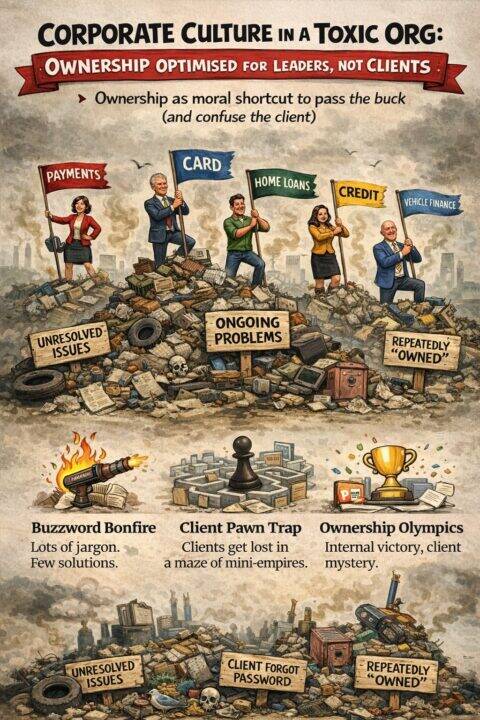
Product executive committees are one of the most consistently toxic structures in large organisations. They create artificial sovereignty, inflate self importance, and slowly detach product leaders from the reality that they are stewards of client value rather than owners of territory. Over time, these forums reward flag planting over problem solving, visibility over effectiveness, and ownership claims over measurable improvement.
In these environments, owning an issue becomes more valuable than resolving it. Leaders compete to be seen as accountable while quietly preserving the existence of the problem itself. The client fades into the background as internal status games take centre stage, and the organisation congratulates itself on governance while outcomes deteriorate.
7. Ownership vs Customer Experience
In a startup with one product and one app, end to end ownership feels clean. One codebase. One backlog. One deployment pipeline. But that only works when you have one thing.
When you expand, the question becomes obvious: do you launch a new app for every new product? Do you make customers register and log in on every channel to interact with you? That isn’t customer-centric design, that’s organisational narcissism masquerading as “ownership.”
Digitally native products increasingly live inside other people’s platforms because that’s where the customer already is. The goal isn’t to maximise internal control; it’s to maximise relevance and convenience. This means tolerating lower ownership in service of the customer, eliminating swivel-chairing between apps, and reducing friction. Control is a means, not the objective.
If you want to offer a car loan, the most client-centric place to do it isn’t inside your own banking app. It’s inside AutoTrader at the moment someone is choosing a car. That’s not weakness, it’s strategic focus. Once ownership becomes the constraint, you optimise for yourself, not your customer.
8. Clients Experience Journeys, Not Products
Clients do not care about your organisational boundaries, your ownership model, or your internal narratives. They experience journeys, coherence, and trust, and they judge you on whether interacting with you feels like dealing with one institution or many loosely coordinated ones. Products exist to serve clients, not the other way around, and any ownership model that forces repetition, reauthentication, or relearning is fundamentally broken regardless of how clean it looks in a deck.
When ownership is designed around internal comfort rather than external experience, the client always pays the price, usually long before leadership notices.
9. Fix the Problem First, Worry About Ownership Later
When a real issue is discovered, the instinct to immediately plant an ownership flag is almost always the wrong move. Declaring ownership feels decisive, but it subtly shifts attention away from resolution and towards structure, advocacy, and territory. The organisation starts asking who owns the problem instead of how quickly and correctly the problem can be fixed, and from that moment the outcome is already compromised.
The healthier response is far less theatrical and far more demanding. Bring the best people you can get into a room, irrespective of reporting lines, titles, or which box they sit in on the org chart, and focus entirely on fixing the issue. Do not pre partition the narrative by assigning agency and advocacy upfront. Do not turn the problem into a token that must be carried by a single function. Just offer help, roll your sleeves up, and stay present until the solution is moving in the right direction.
Strong cultures heal around problems when they are trusted to do so. They naturally pull in the right expertise, the right challenge, and the right pressure when leaders resist the urge to control the story. Ownership emerges after resolution as a by product of action, not before it as a declaration of intent. This is how organisations learn, rather than ossify.
The most corrosive behaviour is when leaders push a pawn forward, declare that the issue is now owned, and mentally check out as if their contribution is complete. Ownership is not the end of involvement. It is the beginning of responsibility. If you are not still engaged when the trade offs are made, the hard decisions are taken, and the consequences are absorbed, then what you pushed forward was never ownership at all, just distance disguised as governance.
10. Ownership Should Eliminate Problems, Not Label Them
The purpose of ownership is to reduce waste, complexity, and failure, not to assign names to unresolved mess. Organisations that celebrate ownership without demanding resolution inevitably turn into landfills of unresolved issues, each proudly marked, carefully managed, and quietly allowed to rot. Leaders stand on top of these piles planting flags, mistaking declaration for delivery.
Strong organisations are not obsessed with who owns a problem. They are obsessed with why the problem still exists. That difference is subtle, uncomfortable, and decisive, and it is the line between performative ownership and real accountability.
11. Conclusion: Ownership Is a Tool, Not an Identity
Ownership was never meant to be a virtue in itself. It is a design choice, a means to an end, and when it becomes an identity it stops serving the organisation and starts serving egos. Weak ownership creates endless motion without progress, while over indexed ownership fractures the organisation into competing fiefdoms that optimise locally and fail globally. Both failure modes look different internally, but to the client they feel the same: repetitive, incoherent, and exhausting.
The organisations that scale with integrity are the ones that design ownership deliberately rather than ideologically. They share what must be shared, they centralise what improves through consistency, and they hold products accountable for outcomes without allowing them to rebuild the company inside themselves or fracture technical architecture for the sake of perceived control. They reject the theatre of ownership flags and focus instead on the harder work of eliminating the conditions that create problems in the first place.
When ownership is treated as a responsibility to resolve rather than a right to claim, structures get lighter, systems get simpler, clients get cleaner experiences, and leaders stop mistaking control for progress. That is the difference between organisations that merely look accountable and those that actually are.