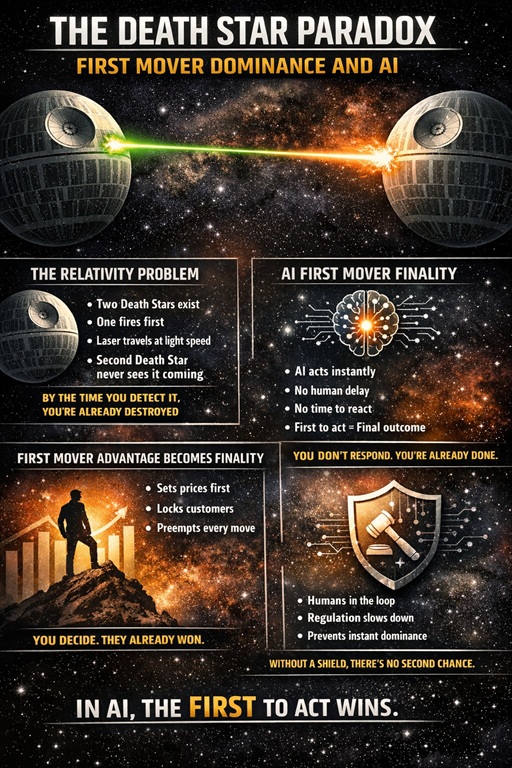
AI First Mover Finality: Why Reaction Becomes Impossible

Reaction becomes impossible when decision cycles compress to zero. AI systems that detect, analyse, and execute faster than competitors can perceive the threat eliminate any meaningful response window. Just as a light speed weapon arrives simultaneously with its own warning signal, an AI enabled first mover captures markets, locks in customers, and entrenches advantages before rivals recognise the competitive attack has begun.
AI First Mover Finality: Why Reaction Becomes ImpossibleAndrew Baker's Technology Blog Posts, 04/Feb/2026
https://andrewbaker.ninja/2026/02/04/ai-first-mover-finality-why-reaction-becomes-impossible/
1. The Physics Makes the Point Brutal
Here is the uncomfortable physics problem.
If two Death Stars come into existence at the same time, and one fires first, the other never gets to respond.
Not because it is slower.
Not because its sensors are worse.
But because causality itself prevents reaction.
A weapon travelling at the speed of light cannot be detected, analysed, communicated, and countered faster than the weapon arrives. Any signal warning you that you have been fired upon must travel at the same speed as the attack. By the time you know, you are already destroyed.
There is no defence.
There is no reaction.
There is only whether you fired first.
This is not strategy. This is physics.
2. AI Collapses Decision Time to Zero
AI does the same thing to competition.
Traditional markets assume latency. Humans observe, decide, debate, approve, and act. This delay is what makes competition possible. It gives rivals time to see moves, interpret intent, and respond.
Autonomous AI removes that delay.
Once a system can decide and act faster than human governance can observe, competition stops being interactive. It becomes relativistic. Outcomes are determined by who commits first, not who reacts best.
You do not lose because you made the wrong decision.
You lose because you were still deciding.
3. First Mover Advantage Becomes First Mover Finality
We talk about first mover advantage as if it is a gradient. A head start. A temporary edge.
AI turns it into finality.
The first system to act autonomously sets prices, shapes customer expectations, reallocates capital, and adapts continuously before competitors can even detect that the environment has changed. By the time the second actor recognises the move, the state space has already shifted.
The response is no longer relevant to the world that exists.
This is not winning faster.
This is invalidating response entirely.
4. Banking Makes This Obvious
Apply this to banking.
The first fully autonomous bank does not wait for competitors to announce products or strategies. It sees intent in behaviour. It sees early signals in flows, pricing experiments, customer hesitation, and talent movement. It reacts instantly.
Credit limits shift.
Fees disappear selectively.
Offers appear preemptively.
Risk models adapt before losses materialise.
A second bank attempting to respond is not late.
It is acting on a world that no longer exists.
The first bank has already fired.
5. Why “We Will React” Is a Lie
Most leadership teams believe they can observe and respond.
They cannot.
By the time a human committee reviews data, approves a change, and deploys it, an autonomous competitor has already iterated thousands of times. The delta is not speed. It is causality.
This is why AI dominance feels sudden. There is no visible buildup. No warning shot. One day the market works. The next day it doesn’t.
The laser was already on its way.
6. Regulation Is an Artificial Speed of Light
Humans in the loop exist for one reason: to slow systems down below the speed of dominance.
Regulation introduces latency. Governance forces pauses. Accountability inserts friction. These are not inefficiencies. They are safeguards that keep markets causal.
Without them, autonomy plus speed creates irreversible outcomes. Once fired, there is no recall. No appeal. No second chance.
7. Compression, Monoism and the End of Competition
The world is compressing. Economic distance, decision latency and execution time are all collapsing at the same time. As this compression accelerates, pluralism in markets gives way to monoism. Not because it is desirable, but because it becomes unavoidable. Dominance stops being a strategy and becomes a requirement for survival.
Technology is the primary force driving this compression. When systems can sense, decide and act at machine speed, the space for reaction disappears. Competition assumes response. Compression removes response. What remains is finality.
We are already seeing this clearly in foundational technology layers. ASML is the only supplier of leading edge lithography machines. There is no second source. There is no viable parallel path. Entire national strategies depend on access to a single company. This is not monopoly by regulation or price fixing. It is monopoly by physics, capital intensity and execution speed.
The same pattern applies to manufacturing. TSMC does not meaningfully compete on advanced nodes. It dominates them. Others exist, but they are not in the same time frame. In a compressed world, being behind in time is indistinguishable from being absent.
This is the Death Star Paradox playing out at an industry level. Each product domain becomes its own galaxy. Within that galaxy, there can only be one completed Death Star. The moment it becomes operational, the rules of the galaxy change. All other Death Stars under construction are rendered irrelevant, not because they are inferior, but because they did not finish first.
The food chain compresses with it. Layers collapse. Niches disappear. The ecosystem does not support multiple apex predators when reaction time approaches zero. What used to be a long competitive ladder becomes a vertical drop.
This is why first mover advantage in the age of AI is not about being early to market. It is about collapsing the future. Once a dominant system is live and self improving, it does not compete with alternatives. It prevents them from ever becoming relevant.
In a compressed world, survival requires dominance. Not morally. Not strategically. Structurally.
8. The Paradox Completed
The Death Star paradox is not about power or scale. It is about timing.
Once decision making reaches a point where reaction is physically impossible, competition ends. Not gradually. Instantly.
AI enforces first mover dominance in the same way light speed weapons do.
You do not lose because you chose badly.
You lose because someone else chose first.
And once that happens, you are already done.