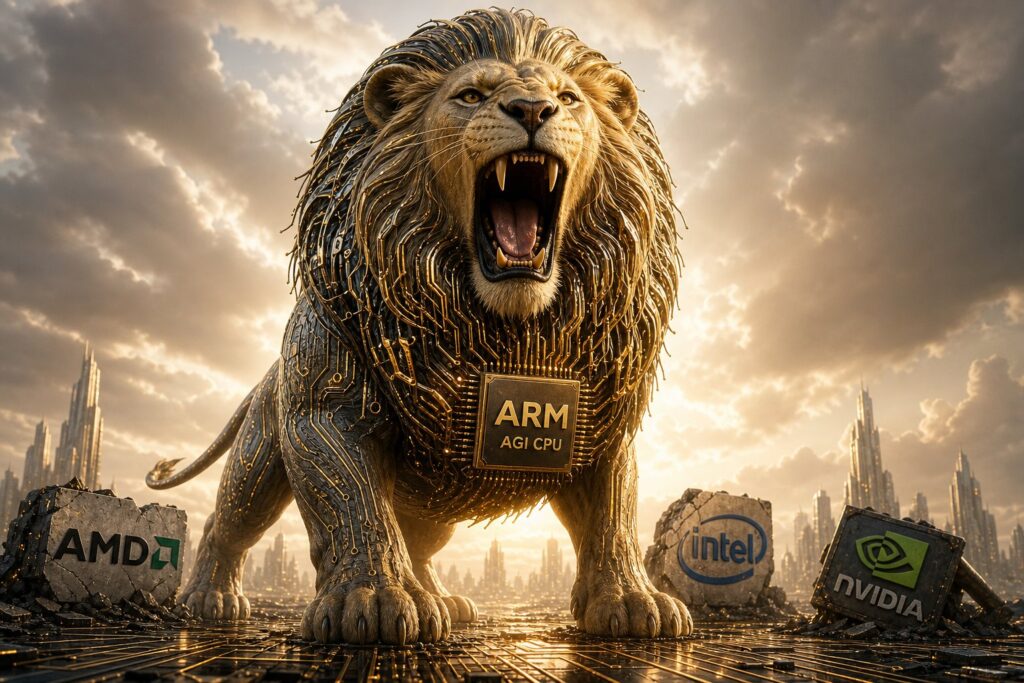
The ARM That Grew Teeth
ARM abandoned its 35 year neutral IP licensing model on 24 March 2026 by launching the ARM AGI CPU, its first production silicon ever, competing directly with licensees like Apple, Qualcomm, and NVIDIA. The move trades ARM's trusted infrastructure position for greater value capture, betting that owning silicon outweighs the risk of alienating the ecosystem that built its dominance.
How a 35-year-old IP licensor just walked into the most contested real estate in computing
ARM spent 35 years becoming the most trusted neutral infrastructure company in computing, and then deliberately chose to give up that neutrality in exchange for a larger share of the value it had always enabled others to capture. Whether that is visionary or a category error that destroys the thing that made it valuable is the central question the market is currently priced to answer optimistically. The optimism may be right. The price of being wrong about it is steep.
On 24 March 2026, ARM announced the ARM AGI CPU, its first production silicon in 35 years of existence, and the semiconductor industry quietly rearranged itself around the news. Apple, Amazon, Google, Qualcomm, and NVIDIA had all built businesses on top of ARM’s architecture precisely because ARM never competed with them. It was the benevolent standards body of the CPU world. The AGI CPU changes that permanently. The company that won the data center by being a neutral arms dealer is now a combatant. That single structural shift is the story. Everything else flows from it.
1. What the ARM AGI CPU Actually Is
The AGI CPU is a 136-core server processor built on TSMC’s 3nm process using Neoverse V3 cores. It runs at up to 3.7GHz boost, supports 12 channels of DDR5 at up to 8800 MT/s, delivers more than 800 GB/s of aggregate memory bandwidth, and carries a 300-watt TDP. ARM’s reference platform packs two chips onto a single blade, with a standard 36 kW air-cooled rack holding 30 blades for 8,160 cores total. PCIe Gen 6 and CXL 3.0 round out the connectivity stack.
The workload it is designed for is not general-purpose server compute. It is agentic AI infrastructure: the CPU-side orchestration work that manages data movement, coordinates accelerators, and handles tool calls and memory tasks between inference calls. During the chatbot era of 2023 through 2025, GPUs dominated the conversation and CPUs were an afterthought. Agentic AI has changed that equation. As workloads shift from single-query inference to continuous autonomous task execution, CPU orchestration increasingly becomes the latency bottleneck in the system. ARM CEO Rene Haas put it plainly: GPUs are the heavy machinery, but CPUs are the equipment that moves the dirt.
Meta served as co-development partner. The chip was shaped by the demands of one of the world’s largest AI infrastructure operators, and it slots into Meta’s broader strategy of vertical integration: their MTIA custom accelerators do the GPU work, the AGI CPU manages orchestration across fleets of them. Beyond Meta, ARM confirmed commercial commitments at launch from OpenAI, Cerebras, Cloudflare, F5, SAP, SK Telecom, Positron, and Rebellions, with more than 50 ecosystem partners aligned for deployment.
2. The Neutrality Trade
For 35 years, ARM’s structural advantage was precisely that it had no skin in the game beyond the architecture. Every company that licensed ARM IP knew that ARM’s success was tied to their success, not to a competing product. That created an unusually durable form of trust in a competitive industry. The AGI CPU terminates that arrangement.
If you are Amazon building Graviton, Google building Axion, or NVIDIA building Vera, you are now licensing your core architecture from a company that sells a chip that competes with yours. ARM went to its partners early, and all 50-plus ecosystem companies publicly endorsed the strategy at the March 2026 launch event. But commercial endorsement and competitive trust are different things. The ARM-Qualcomm litigation over the Nuvia license acquisition is a live illustration that this relationship can fracture: ARM has argued Qualcomm cannot carry forward acquired architecture licenses, a dispute running for years through the courts.
In May 2026, the US Federal Trade Commission opened a formal antitrust investigation into ARM, examining whether the company intends to degrade or deny the architecture licenses that Apple, Qualcomm, NVIDIA, and hundreds of others depend on, while simultaneously selling its own competing chips. The probe goes directly to the tension at the heart of the new model. ARM’s argument is that the AGI CPU lifts all boats by driving broader software standardisation on ARM architecture, which benefits every licensee. Whether regulators accept that argument is unresolved. Whether licensees believe it privately is a different question.
This risk does not invalidate the investment thesis. It is a reason to price the regulatory and relationship exposure honestly rather than as a footnote.
3. The Revenue Thesis and the Market Reaction
ARM’s stock surged more than 17 percent on 25 March 2026, and has appreciated approximately 196 percent over the prior 52 weeks. The reaction reflects a genuine change in the revenue ceiling, not just sentiment.
For 35 years, ARM’s business was high-margin but bounded: licensing IP, collecting royalties, total revenue around $3.9 billion for fiscal 2025. The AGI CPU changes the ceiling. Management has guided to roughly $1 billion in chip revenue by fiscal 2028, scaling toward $15 billion by 2031, framed against what ARM calls a $100 billion addressable data center CPU market. Independent projections from Futurum Group put the market at $76.6 billion by 2029, growing at 34.9 percent annually. ARM’s $15 billion target implies roughly a 15 percent share of that market, from a standing start in silicon sales, achieved within five years of shipping its first chip.
The royalty business is also accelerating independently. Data center royalties grew more than 100 percent year over year in Q3 FY2026, driven by the V9 architecture now commanding double the royalty rates of V8. ARM architecture reportedly accounts for approximately 50 percent of hyperscaler CPU compute, per figures cited in Arm’s FY26 earnings call and confirmed at Computex 2026, though that figure reflects the combined custom silicon deployments of AWS Graviton, Google Axion, Microsoft Cobalt, and NVIDIA Vera rather than ARM’s own silicon.
The financial transformation implied by silicon revenue is not cosmetic. ARM’s current gross margin on licensing and royalties runs at approximately 97.5 percent. Chip manufacturing is structurally different: wafer costs, packaging, supply chain exposure, and competition with AMD and Intel who have decades of manufacturing relationships. ARM management has positioned this as a deliberate trade of margin structure for absolute revenue scale. Whether that trade resolves in shareholders’ favour depends on execution speed, TSMC capacity allocation, and whether the agentic AI workload shift materialises fast enough to justify entering one of the hardest businesses in technology.
Volume shipments begin in H2 2026, with a second-generation chip on TSMC 2nm already in development. Ampere Computing’s engineering team, acquired by SoftBank for $6.5 billion in March 2025, is widely expected to be contributing to that roadmap.
4. How This Reshapes the Market Players
Intel is the most structurally exposed. The addressable market Intel is defending is the part of the data center most resistant to change: enterprise, public sector, telco, and legacy workloads with deep Xeon ecosystem dependencies. Those are stabilising forces. The risk is that the fast-growing agentic AI segment defaults toward ARM architecture from the start, before Intel can build switching costs into it. Intel’s response at Computex 2026 was Clearwater Forest, its first 18A-node Xeon, reaching 288 efficiency cores and claiming a 30 percent per-thread improvement over AMD’s EPYC. It is a real competitive answer. Whether it arrives quickly enough to contest the agentic AI segment is the question.
AMD is better positioned near term. EPYC Venice on 2nm is in production, server CPU revenue share reached a record 46.2 percent in Q1 2026, and AMD’s Helios rack-scale platform pairs Venice with Instinct MI450X GPUs for hyperscale deployments. AMD’s exposure from the AGI CPU is less immediate but structurally identical: every agentic AI workload that defaults to ARM is one that never needs an x86 evaluation.
NVIDIA is the most interesting relationship. NVIDIA’s Vera CPU uses 88 custom Armv9 cores and licenses the architecture from ARM. ARM now sells a competing data center CPU. Yet at Computex 2026, Haas and Jensen Huang shared a stage to announce NVIDIA’s RTX Spark ARM-based PC chip. Asked directly whether the AGI CPU would upset NVIDIA, Haas was essentially untroubled: if you have both NVIDIA Vera and ARM AGI CPU available, that is not great for Intel and AMD. The ARM-NVIDIA relationship is simultaneously competitive and symbiotic. Both benefit from accelerating x86 displacement. The tension is real but currently managed.
Qualcomm sits in the most fraught position. The existing Nuvia license litigation predates the AGI CPU. The FTC investigation adds a regulatory layer. And NVIDIA’s entry into ARM-based Windows PCs, validated by Microsoft Surface and major OEM commitments at Computex 2026, directly challenges Qualcomm’s near-exclusivity in that segment. Qualcomm is contesting on multiple fronts simultaneously.
5. Is the Stock Overpriced
This is the genuinely difficult question and the honest answer depends entirely on which execution trajectory you believe.
ARM trades near $396 as of mid-June 2026. Forward PE sits near 181, roughly 390 percent above the semiconductor industry median. Price to book is 54x against a peer average of 12.9x. Conservative DCF models place intrinsic value materially below the current price. Short interest of 13.29 percent of shares outstanding signals active disagreement.
The bull case rests on the $15 billion silicon revenue target proving achievable, the royalty business doubling independently, and the combined margin structure justifying a sustained premium multiple. TIKR’s mid-case model prices ARM at $599 by March 2030. Bernstein has a $500 target. If those revenue numbers land, the current valuation is not obviously wrong; it is pricing for an AI infrastructure compounder at a structural inflection.
The bear case is structural. ARM is competing with the licensees who underwrite its royalty stream, under FTC scrutiny, while contesting TSMC 3nm capacity against Apple, AMD, Qualcomm, and NVIDIA simultaneously. Jim Keller, who has led chip design teams at AMD, Apple, Tesla, and Intel, framed the core risk precisely: building a chip was always a matter of when, not if; the question is whether ARM can build an organisation that ships silicon on time, at scale, with the support data center customers demand. That is a fundamentally different business from licensing blueprints, and ARM has never operated it.
At this valuation, the market is underwriting execution before execution exists. The story is credible. The 41 percent drawdown to ARM’s February 2026 low is a reminder of how quickly that thesis reprices when evidence turns against it.
6. Power: Why the Grid Is the Real Constraint
Everything discussed above, the stock move, the agentic AI thesis, the x86 displacement narrative, ultimately resolves to a single number every data center operator tracks with visceral clarity: watts. Because in 2026, power is not just an operational cost line. It is the primary physical constraint on how fast the AI buildout can proceed. You cannot deploy what the grid cannot supply.
Global data center electricity consumption reached approximately 415 TWh in 2024 and is projected to roughly double to 945 TWh by 2030. Standard server racks historically ran at 7 to 10 kW. An AI-capable rack today demands 30 kW to over 100 kW. That is not linear scaling; it is a structural shift in facility design requirements. The Power Usage Effectiveness metric (total facility power divided by IT equipment power) means every watt a processor draws costs around 1.56 watts at the meter in a typical enterprise deployment, and 1.09 watts at a best-in-class hyperscale facility. A 40 percent reduction in processor TDP at the AI workload layer does not save a rounding error. It changes the economics of what can be built and where.
The ARM AGI CPU delivers 136 cores at 300W TDP. AMD’s top-end EPYC Turin reaches 192 cores at 500W. Intel’s Clearwater Forest hits 288 cores at 450W. On raw cores per watt at the chip level, Intel actually leads: 0.64 cores per watt against ARM’s 0.45. That is the claim Intel’s defenders on Hacker News have made directly, and it is numerically accurate. Intel’s Darkmont cores have approximately equivalent performance per core and power consumption per core to the Neoverse V3, with roughly twice the core count per socket.
ARM’s counterargument operates at the rack level, and it is where the architecture does something genuinely different. ARM’s reference configuration delivers 8,160 cores in a standard 36 kW air-cooled Open Compute rack. That is approximately 226 cores per kW at rack level, in a thermal envelope that existing data center infrastructure was built to handle, without liquid cooling upgrades. For context, Nvidia’s H100 and H200 GPU racks already routinely require liquid cooling at the facility level. A CPU rack that stays within standard air-cooled limits is a materially simpler deployment for existing facilities retrofitting for agentic AI, reducing both capital expenditure and the lead time for cooling infrastructure upgrades. That advantage does not show up in a cores-per-watt table. It shows up in project timelines and facility budgets.
For agentic AI workloads specifically, the binding constraint is often not core count but memory bandwidth. LLM inference and orchestration are memory-bandwidth-bound: model weights must be read from memory for every token generated, so the compute units wait on memory, not the other way around. The AGI CPU delivers 6 GB/s of bandwidth per core, against roughly 4.2 GB/s per core for a comparable EPYC configuration at similar aggregate bandwidth. More bandwidth per core means less time waiting for memory to service computation, which translates to better utilisation at sustained load and lower cost per inference task.
ARM’s own claim is that the AGI CPU could save up to $10 billion per gigawatt of AI data center capacity. That figure is a marketing projection until independent benchmarks exist, and the Hacker News engineering community has correctly noted that ARM’s 2x rack performance claim needs to be anchored to specific workload definitions. What is not a projection is the cooling infrastructure dynamic: staying inside air-cooled limits at 36 kW is a deployment advantage that compounds across every facility build that does not require a liquid cooling retrofit. In an industry where the primary constraint on growth is not chip availability but facility readiness and grid capacity, that matters more than a watt-per-core benchmark headline.
7. The Bill Nobody Budgeted For
The data center discussion above covers the infrastructure layer. There is a second cost conversation happening simultaneously, in different spreadsheets, that is equally consequential: the cost of consuming frontier AI tokens at organisational scale.
Anthropic’s current API pricing for Claude Sonnet 4.6 is $3 per million input tokens and $15 per million output tokens. Opus 4.8 sits at $5 input and $25 output. These are not alarming-looking numbers until you multiply them across thousands of users doing genuine daily work.
The data point now circulating in enterprise technology circles comes from Uber. Their CTO confirmed to The Information that the company burned through its entire 2026 AI budget in four months. Claude Code adoption had jumped from 32 to 84 percent of Uber’s 5,000-engineer organisation, with monthly API costs per engineer ranging from $500 to $2,000. Anthropic’s own disclosed metrics put average Claude Code spend at approximately $13 per developer per active day. At 250 working days that is $3,250 per developer per year at the conservative end, $7,500 at the heavy-use end. For an organisation of 10,000 to 15,000 employees with AI adoption spreading across technical and non-technical roles, a $4 million to $6 million annual Anthropic bill is not a worst-case scenario. It is an expected one.
Anthropic’s billing model shift in early 2026 made this harder to manage, not easier. The previous structure offered flat-rate enterprise seats with broadly inclusive usage. The new model mandates token-based billing with mandatory monthly spending commitments based on Anthropic’s own estimate of the customer’s token use, payable whether or not usage reaches that level. Volume discounts of 10 to 15 percent previously available to larger customers were eliminated in the same restructure. GitHub moved Copilot from flat subscriptions to usage-based billing in June 2026; one developer reported a projected monthly cost increase from approximately €67 to €966. These are predictable outcomes of metered consumption models applied to genuinely useful tools. The issue is not that the tools are not worth using. The issue is that budget assumptions set in Q1 get invalidated by Q2.
This is where local models and ARM hardware connect directly to the enterprise cost problem, and where the picture is more nuanced than either “local models fix everything” or “you need frontier models for everything.”
The quality gap between frontier proprietary models and open-weight alternatives has closed substantially for routine enterprise workloads. Llama 4, Mistral Large, Qwen 3, and DeepSeek R1 are competitive with GPT-4 class performance on most structured and document-heavy tasks. They are not competitive on complex multi-step reasoning, novel synthesis, or tasks requiring frontier-level judgment. But those frontier-demanding tasks are a minority of total enterprise token consumption. The bulk of the spend goes on classification, summarisation, document extraction, routine code assistance, and structured output generation. Open-weight models handle these adequately. The decision is now economic rather than capability-driven for a substantial share of production workloads.
Self-hosted open-weight models break even against frontier cloud APIs at roughly 5 to 10 million tokens per month. At 100 million tokens per month and above, organisations running self-hosted infrastructure can save materially. The costs that determine whether that saving is real: 4 to 6 full-time engineering staff to run and maintain the stack, model update cycles every 6 to 8 weeks at significant engineering overhead, monitoring, incident response, and opportunity cost. One practitioner illustration: a healthcare client insisted on self-hosting Llama 3 70B to save money. Actual monthly spend came to $4,300 in GPU costs plus $6,100 in engineering hours. The equivalent OpenAI API cost for the same workload was $1,870 per month. They were paying 5.6 times more. The math reverses only at genuine industrial-grade volume.
For the typical large enterprise, the ARM-specific opportunity sits in two places. At the private infrastructure level, the AGI CPU’s efficiency case applies to organisations already past the API break-even threshold: cheaper CPU orchestration costs reduce the total cost of a self-hosted deployment. More immediately relevant to most organisations is on-device inference via the ARM NPU hardware already shipping inside standard-issue laptops. Qualcomm Snapdragon X Elite delivers up to 45 TOPS of NPU performance. Apple M4 Neural Engine reaches 38 TOPS. NPUs deliver up to 60 percent faster inference than GPU paths at roughly 40 to 45 percent lower power for specific inference tasks, per independent research. Estimated cost per million tokens on an M3 Max running local inference is approximately $0.014, against $15 per million output tokens for Claude Sonnet 4.6. The cost ratio for eligible workloads exceeds 1,000 to 1.
Eligible workloads: summarisation, classification, local code completion, document drafting, structured output generation on well-defined tasks. Not eligible: complex reasoning chains, novel synthesis, tasks requiring frontier-level knowledge depth. The rational architecture is hybrid routing: an LLM gateway such as LiteLLM or Portkey as the abstraction layer, directing high-volume routine work to self-hosted or on-device open-weight inference at near-zero marginal cost, reserving frontier cloud APIs for tasks where the capability differential justifies the price. According to CloudZero’s 2026 research, only 43 percent of organisations track AI spend by customer and 22 percent by transaction. The organisations without that granularity cannot make rational routing decisions. They are paying Anthropic rates for work an ARM NPU could handle.
There is also a compliance dimension that regulated industries cannot defer. GDPR requires knowing where personal data goes. Using a public cloud API makes the provider a data processor, requiring a Data Processing Agreement and data residency compliance. The EU AI Act reached full enforcement in August 2026. POPIA imposes equivalent obligations on cross-border transfers from South African entities. On-device inference eliminates the transfer entirely. For a retail bank or insurer handling personally identifiable information at scale, that is not a convenience argument. It is an architectural requirement.
The ARM AGI CPU matters to this story at the infrastructure layer, making private inference cheaper to run for organisations already at scale. But the more immediately impactful development for the typical 10,000 to 15,000-person enterprise is not the AGI CPU in a hyperscale rack. It is the ARM NPU already inside the laptops their employees are carrying, waiting for IT governance to sanction a deployment framework that lets it handle the 60 percent of AI workloads that do not need a frontier model to produce useful output. The organisations that build that routing layer will find their Anthropic bill stabilise even as AI-enabled work volume grows. The ones that do not will keep discovering, the way Uber discovered, that AI budget assumptions made in Q1 need to be revised by Q2.
References
| # | Source | Link |
|---|---|---|
| 1 | ARM Newsroom: AGI CPU Launch Announcement, March 24 2026 | arm.com |
| 2 | ARM Blog: Introducing the ARM AGI CPU by Mohamed Awad | arm.com |
| 3 | ARM AGI CPU Ecosystem Partners | arm.com |
| 4 | Tom’s Hardware: Arm Launches Its First Data Center CPU | tomshardware.com |
| 5 | MLQ.ai: ARM AGI CPU Deep Research Report | mlq.ai |
| 6 | Tech-Insider: Arm’s 136-Core AGI Chip Outpaces x86 in Data Centers | tech-insider.org |
| 7 | TweakTown: Arm Creates History by Building Its First-Ever CPU | tweaktown.com |
| 8 | IO Fund: Arm Stock Could Win as Agentic AI Shifts the Bottleneck to CPUs | io-fund.com |
| 9 | TIKR: ARM Holdings Unveiled Its First Chip in 35 Years | tikr.com |
| 10 | TIKR: Arm Holdings Stock Surges 80% in 2026 | tikr.com |
| 11 | TIKR: ARM Stock Falls 27% From All-Time High | tikr.com |
| 12 | GuruFocus: ARM Forward PE Ratio Analysis | gurufocus.com |
| 13 | Stock Analysis: ARM Holdings Statistics and Valuation | stockanalysis.com |
| 14 | Alpha Spread: ARM Intrinsic Valuation | alphaspread.com |
| 15 | Simply Wall St: ARM Holdings Valuation and Peer Comparison | simplywall.st |
| 16 | Tom’s Hardware: FTC Antitrust Probe into ARM | tomshardware.com |
| 17 | TechTimes: FTC Investigates Whether Arm’s First Chip Launch Lets It Squeeze Licensees | techtimes.com |
| 18 | TechTimes: Arm Builds Its Own Data Center CPU | techtimes.com |
| 19 | TechTimes: x86 Data Center Dominance Ends, Arm Crosses 50% Hyperscaler CPU Share | techtimes.com |
| 20 | WCCFTech: ARM CEO Says the AGI CPU Will Bite Into x86 Dominance | wccftech.com |
| 21 | BuySellRam: Arm vs x86 in 2026, From RTX Spark to the AGI CPU | buysellram.com |
| 22 | Economy AC: Completed Semiconductor Bet by Arm Targets PC CPU Market | economy.ac |
| 23 | Semi Analysis: CPUs Are Back, The Datacenter CPU Landscape in 2026 | semianalysis.com |
| 24 | Yahoo Finance: Which CPU Company Has Dominated 2026 | finance.yahoo.com |
| 25 | ARM Holdings SEC Form 20-F FY2026 | sec.gov |
| 26 | Digital Applied: ARM AGI CPU First Physical Chip in 35 Years Guide | digitalapplied.com |
| 27 | ServeTheHome: ARM AGI CPU Launched | servethehome.com |
| 28 | WCCFTech: Intel Clearwater Forest Xeon 6+ 288 Cores on 18A | wccftech.com |
| 29 | ServeTheHome: Intel Xeon 6+ Clearwater Forest Launch | servethehome.com |
| 30 | Nlyte: Data Center Rack Power Costs Analysis | nlyte.com |
| 31 | Alpha Matica: Deconstructing the Data Center Cost Structure | alpha-matica.com |
| 32 | SemiAnalysis: AI Datacenter Energy Dilemma | semianalysis.com |
| 33 | Socomec: Understanding the Power Consumption of Data Centers | socomec.us |
| 34 | Congress.gov: Data Centers and Their Energy Consumption FAQ | congress.gov |
| 35 | Thunder Said Energy: Economic Costs of Data Centers | thundersaidenergy.com |
| 36 | HyperPC: Server CPUs 2025, AMD EPYC vs Intel Xeon vs ARM | hyperpc.ae |
| 37 | KW Servers: AMD EPYC Turin vs Intel Xeon 6 2026 | kwservers.com |
| 38 | Colbird: ARM vs x86 Dedicated Servers Real Benchmarks and TCO | colobird.com |
| 39 | CheckThat.ai: Anthropic Pricing 2026 | checkthat.ai |
| 40 | IT Brief: Anthropic Shifts Enterprise Billing to Token-Based Pricing | itbrief.news |
| 41 | Madrona: The Price of Tokenmaxxing | madrona.com |
| 42 | Investing.com: The AI Token Pricing Crisis | investing.com |
| 43 | MetaCTO: Anthropic API Pricing Full Breakdown | metacto.com |
| 44 | Finout: Anthropic API Pricing 2026 Complete Guide | finout.io |
| 45 | CloudZero: Claude Pricing Explained 2026 | cloudzero.com |
| 46 | AI Pricing Master: Self-Hosting AI Models vs API Pricing | aipricingmaster.com |
| 47 | BrainCuber: Self-Hosted LLM vs API Break-Even Cost | braincuber.com |
| 48 | Marka Development: Self-Hosted LLM vs API Enterprise Cost and Security | marka-development.com |
| 49 | PromptCost.org: Local LLM Total Cost of Ownership 2026 | promptcost.org |
| 50 | CheckThat.ai: Best On-Device LLM Solutions 2026 | checkthat.ai |
| 51 | Ordinary Tech: On-Device AI in 2026, How NPUs Are Transforming AI PCs | ordinarytech.ca |
| 52 | Vikas Chandra Meta AI Research: On-Device LLMs State of the Union 2026 | v-chandra.github.io |