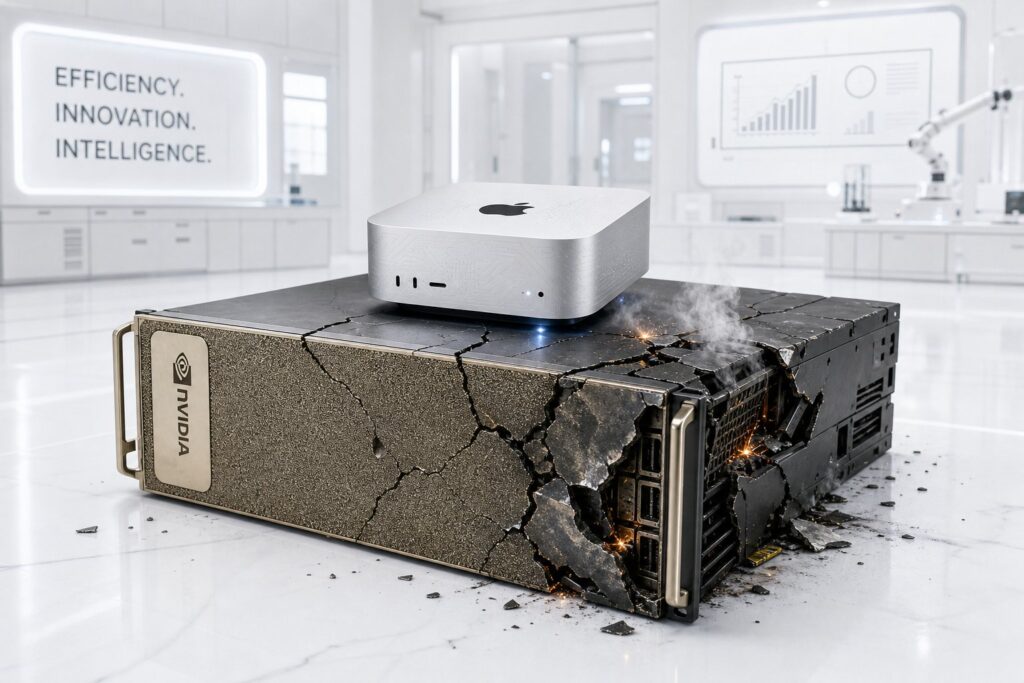
Apple Didn’t Plan This: How the Mac mini and Mac Studio Became the AI Industry’s Favorite Workstation

OpenAI bought tens of thousands of Mac minis and Mac Studios for reinforcement learning and computer use agents, and Anthropic rents Mac capacity through AWS. Apple did not plan this: unified memory, low idle power, thermal headroom and cheap density suit always on agent workloads, though no NVLink equivalent means DGX still wins for clustered frontier models.
A follow-up to DGX vs Mac Studio for Local LLMs: A Startup’s Guide to Choosing Your AI Hardware
When I wrote the DGX vs Mac Studio comparison in June, the framing was still that a startup buys hardware for its own inference workload. Since then the story has widened considerably. It is no longer just cash strapped founders picking a Mac Studio over a $350k DGX B300 node. Apple’s compact desktops have become raw material for the frontier labs themselves, and Apple got caught flat footed by its own hardware.
1. The demand nobody modeled for
Tim Cook told analysts on Apple’s Q2 2026 earnings call that the Mac mini and Mac Studio would stay supply constrained for several months, attributing it to unexpectedly strong adoption of agentic AI workflows rather than any planned enterprise push. At the time, Cook specifically pointed to advanced node SoC availability as the constraint, not memory. Reporting since then has been more specific about who is buying, and about a second, later pressure on top of that. The Information reports that OpenAI reportedly purchased tens of thousands of Mac minis and Mac Studios over the preceding months for reinforcement learning and computer use agent workloads, while Anthropic has reportedly been renting Mac capacity indirectly through AWS rather than buying hardware outright. Neither OpenAI nor Anthropic has publicly confirmed the scale of these deployments, so this remains reported rather than disclosed. Neither company built this into anyone’s demand forecast, including Apple’s own.
The mechanics of the shortage are almost identical to what I described in the memory bottleneck discussion in the DGX piece, just playing out at retail instead of in a benchmark table. Enterprise buyers doing agent training or persistent computer use workloads want maximum unified memory, so they are skewing every order toward the top end configurations, precisely the SKUs most exposed to the separate DRAM and memory supply crunch that has been squeezing the wider PC industry in 2026. That squeeze compounded the earlier SoC constraint Cook described in the spring. The price history reflects two distinct moves rather than one. Apple eliminated the entry $599 Mac mini configuration in May, pushing the effective starting price to $799, and then, following the August 25 M6 refresh, Apple’s own product page lists the new starting price at $899. Ordinary consumers have been getting crowded out by bulk buyers who do not care about price so long as memory bandwidth per dollar beats a datacenter GPU.
2. Why a machine designed for a desk works as an AI host
This is not just opportunistic demand shifting. It is the same architectural story from the DGX comparison, just applied to a two thousand dollar box instead of a ten thousand dollar one. The things that make unified memory attractive for a startup’s local inference server are largely the same things that make a Mac mini or Mac Studio a genuinely good fit for the specific workload OpenAI and others are running.
2.1 Persistent, low power, always on agents
A computer use or reinforcement learning agent that spends most of its time waiting on tool calls, browser actions, or environment feedback does not need continuous H100 class throughput. It needs a machine that can sit powered on around the clock without a five figure power and cooling bill. Apple’s own published figures make this starker than it first appears, and the gap to a GPU node is worth putting in a table rather than a sentence.
| Idle draw | Peak draw | 24/7 idle cost per node (US average) | Cooling | |
|---|---|---|---|---|
| M4 Mac mini | ~4W | ~65W | roughly $4 a year | passive convection through the chassis, fan rarely spins up, no ducting or airflow planning needed |
| M4 Pro Mac mini | ~5W | ~100W | roughly $5 a year | single internal fan, sits quietly on a desk under sustained load |
| M4 Max Mac Studio | ~6W | ~270W | roughly $6 a year | dual blower fans, office ambient air is sufficient even for long runs |
| M3 Ultra Mac Studio (512GB) | ~9W | ~270W | roughly $9 a year | same dual blower design as the Max Studio, no dedicated intake or exhaust planning required |
| DGX H100 (8 GPU node) | not built to idle | ~10,000W sustained | tens of thousands of dollars a year in power and colocation | requires raised floor precision cooling, typically liquid assisted or high volume forced air, with facility level HVAC sized specifically for the rack |
An agent host that spends most of its time waiting on an environment rather than computing sits at the idle end of that range for the bulk of its life, with peak draw only during the compute bursts of an actual step or inference call. The cooling story follows the same shape as the power story, not a smaller version of it. Every Mac in that table is designed to be cooled by whatever air already exists in a normal room, so a fleet of them adds no facilities requirement beyond the outlets they plug into. A DGX node is the opposite: it is designed on the assumption that a facility will build cooling capacity specifically for it, which is one of the line items behind the fifty to a hundred and fifty thousand dollars a year in colocation costs from the original TCO table. Multiply either the idle or the peak figures by ten thousand units and the comparison to a DGX fleet stops being about which chip is faster per token and becomes a straightforward facilities question: one of these fleets fits on an office floor with the air conditioning already installed, and the other does not.
2.2 Thermal headroom other small form factor Macs do not have
Unlike a MacBook, the Mac mini and Mac Studio have real fan and heatsink volume, so they can sustain heavy background compute for hours without thermal throttling, which matters for training loops or long agent traces running unattended.
2.3 Unified memory for models that do not need datacenter scale
Most computer use and agentic workloads are not running four hundred billion parameter frontier models locally. They are running smaller specialist or distilled models, or acting as one node in a much larger orchestration layer where the frontier model itself lives elsewhere. For that tier, the M series unified memory architecture described in the memory bandwidth section of the DGX piece, with no PCIe hop and weights and KV cache addressable at full bandwidth by every compute engine, is plenty, and it is dramatically cheaper per unit than provisioning GPU cloud capacity for a fleet of lightweight, mostly idle agents.
2.4 Density and footprint
A rack, a shelf, or even a closet of Mac minis is a genuinely different physical and financial proposition than a DGX pod. There is no need for raised floor, precision cooling, or three phase power to stand up a hundred of them.
2.5 The Mac is not just compute, it is the environment
This is probably the most important factor and the one easiest to miss. The reported OpenAI use case is specifically reinforcement learning and computer use agents, and a computer use agent needs thousands or millions of episodes in which it can open applications, click things, make mistakes, recover, generate a reward signal, and reset the environment. Contemporary agent research treats the environment and its resettable state as a central part of the training loop, not an afterthought. A Mac mini running macOS is not just a small inference server in that context. It is a disposable, resettable sandbox that happens to also be able to run the model.
That framing also resolves a question the rest of this article struggles to answer on its own. If Macs cluster so poorly, why would a lab want tens of thousands of them instead of a smaller number of far more capable GPUs? The answer is that this workload may not need clustering at all. Ten thousand independent episodes running on ten thousand independent machines is an embarrassingly parallel problem. Mac one runs episode one, Mac two runs episode two, and so on, with no need for any of them to address a shared memory space or coordinate at high bandwidth. NVIDIA built the best machine in the world for making many chips behave as one. For this particular workload, a lab may not want that. It may want the opposite: many small, cheap, fully independent machines that never need to behave as one at all.
Apple’s response has been to lean into it rather than fight it, and the sequence is worth stating plainly because it is a better story than “Apple got caught flat footed.” AI labs found an unintended use for a desktop computer. Demand for it surprised Apple badly enough to distort supply and pricing for months. Apple then turned around and made that accidental use case part of the product’s official positioning: its August 25 launch materials explicitly describe the new Mac mini as a machine for always-on, deskside agentic computing, and the WWDC 2026 distributed MLX and JACCL work described in section 3.1 is Apple building first-party infrastructure for exactly the multi-machine agent and fine-tuning workloads the market discovered on its own first.
3. Where it struggles: the case DGX still wins
None of this changes the conclusion from the original comparison. It just adds a category. The Mac mini and Mac Studio’s weaknesses as an individual AI workstation are largely the same ones laid out for the Mac Studio against DGX, and a few get sharper once the question is operating a fleet rather than a single desk unit.
3.1 Scale-up interconnect is the real gap
NVIDIA’s advantage is its scale-up fabric. An H100 DGX system gives its eight GPUs an extremely high-bandwidth GPU-to-GPU link through NVSwitch, up to 900 GB/s per GPU, that lets a model or training workload be sharded efficiently across all eight. Each GPU still has its own dedicated HBM; NVLink is not a shared memory space in the way Apple’s unified memory is within a single chip, it is a very fast fabric for moving data and gradients between separate memory pools. The newer Grace Blackwell architecture goes further still, extending memory-coherent NVLink across as many as 72 GPUs so that they behave much more like one large accelerator than a set of separate cards.
Apple has closed more of this gap than the original DGX comparison assumed, and it is worth being precise about what has actually shipped rather than treating this as community tooling bolted on the side. At WWDC 2026 Apple introduced JACCL, an open source collective communication library, sitting on top of RDMA over Thunderbolt 5, which shipped in macOS 26.2. JACCL provides the same class of primitive that NVIDIA’s NCCL provides on GPU clusters, all-reduce, all-gather, and broadcast, and MLX uses it as the communication backend for distributed inference and training across multiple Macs. In Apple’s own WWDC demo, four M3 Ultra machines connected over Thunderbolt 5 ran a trillion-parameter Kimi model that does not fit on any single Mac, and a four-node cluster reached roughly three times single-machine inference speed. This is meaningfully further than “exo and community projects sharding a model over plain Ethernet,” and UltraFusion is no longer the only first-party interconnect story; RDMA over Thunderbolt is now shipping, official, and documented.
None of that closes the gap to NVLink, it narrows how the gap should be described. The honest framing is performance, topology, and maturity rather than a flat absence of distributed capability. JACCL over Thunderbolt 5 tops out in the tens of gigabits per second with single digit microsecond latency, which is a different order of magnitude from NVSwitch’s hundreds of gigabytes per second per GPU, and practical clusters are currently a handful of Macs rather than the eight to seventy two GPU topologies NVIDIA supports natively. The feature is also young: it shipped in a 26.2 developer beta only months before this article, enabling it still requires a manual step in macOS Recovery, and Apple’s own guidance treats it as leading edge rather than a drop-in production feature yet. So the real gap is not “Apple cannot cluster Macs,” it is that Apple’s cluster fabric is an order of magnitude slower, tops out at a handful of nodes rather than dozens, and is far less mature than a fabric NVIDIA has been hardening for the better part of a decade. For a workload that genuinely needs one large model spread across dozens of tightly coupled chips at datacenter scale, DGX or a cloud GPU cluster is still the answer. For a model in the few hundred billion to roughly one trillion parameter range spread across three or four Macs on a desk, JACCL is a real, Apple-supported answer that did not exist when the original DGX comparison was written, and it is precisely the case section 2.5 argues the Mac fleet was probably never built for in the first place: most of what OpenAI and Anthropic are reportedly doing with tens of thousands of Macs needs no clustering at all.
3.2 No CUDA, still
Everything said in the ecosystem section of the DGX piece holds for a fleet of Mac minis as much as it did for a single Mac Studio. MLX and llama.cpp’s Metal backend keep improving, but research code is published in CUDA first, and an operations team running thousands of Mac minis for agent workloads still cannot run TensorRT LLM, vLLM’s CUDA kernels, or most fine tuning frameworks natively.
3.3 Fine tuning works; frontier training doesn’t
“Fine tuning is off the table” is now too absolute a claim, and this is another place Apple has shipped real capability since the original comparison. MLX LM supports both low rank and full model fine tuning, and with JACCL it now supports distributed fine tuning across multiple Macs as well as multiple GPUs on a single Mac. In Apple’s own WWDC 2026 demo, fine-tuning a Qwen 3.5 9B model scaled from roughly 180 tokens per second on a single M3 Ultra to around 600 tokens per second across several networked Macs, which is a genuinely usable fine-tuning throughput, not a proof of concept. Parameter efficient fine tuning of models in the 7B to 13B range, and distributed full fine tuning of somewhat larger models, is entirely practical on Apple Silicon today.
What remains genuinely unattractive, economically and technically, is frontier scale pretraining and large distributed training runs, where activation memory pressure, backward pass compute, and mixed precision throughput at scale still favor CUDA by a wide margin, and where the interconnect limits described in section 3.1 bite hardest. Nobody sensible is replacing a large GPU training cluster with Mac Studios for dense pretraining at frontier scale. But a team fine-tuning a 7B, 13B, or even a distributed 70B model on proprietary data now has a genuinely usable, Apple-supported path that simply did not exist a year ago.
3.4 No datacenter grade remote management story
DGX ships as enterprise infrastructure, with remote provisioning, out of band management, redundant power, and support contracts sized for a datacenter operator. A fleet of Mac minis, however elegant per unit, is closer to a room full of consumer desktops than a managed compute cluster, and standing up thousands of them with proper orchestration, monitoring, and failure recovery is not a solved problem the way it is on NVIDIA’s stack.
3.5 The supply chain that made it cheap is now the thing squeezing it
The entire cost argument in the original TCO table assumed Apple’s retail pricing and availability. That assumption is now shakier. Memory driven price increases and multi month lead times on exactly the configurations enterprise AI buyers want erode the in stock today advantage that made the Mac Studio such an easy recommendation for a startup in the first place.
4. The takeaway
The original framework still holds: name the workload before buying hardware. What has changed is that private inference for a resource constrained team is no longer the only case where a Mac makes sense. Cheap, low power, always on hosts for a swarm of agents is now a legitimate third category, and it is apparently large enough to distort Apple’s own retail supply chain.
The more precise way to state the boundary is this. NVIDIA deliberately built the best scale-up AI computer in the world, one job spread across a hundred tightly coupled GPUs. Apple may have accidentally built an extraordinarily good scale-out AI computer, a hundred thousand independent jobs spread across a hundred thousand small, cheap, disposable machines. Macs are a poor answer to the first problem and, on the evidence of what OpenAI and Anthropic are reportedly doing with them, potentially an excellent answer to the second. The moment a workload needs multiple chips to behave as one coherent memory space, whether that is a four hundred billion parameter model or a large distributed training run, it is Apple’s lack of a real scale-up interconnect, not compute or even memory bandwidth, that sends the decision back to NVIDIA. The moment a workload is instead thousands of independent, resettable environments, that same weakness may not matter at all.
There is a broader point sitting underneath all of this. Apple’s software has been the reliably good part of the company for a long time, the thing reviewers praise even in years when the hardware refresh is modest. What this episode suggests is that Apple Silicon itself, not macOS, may be the company’s next real growth line, and a genuinely different kind of one from the iPhone. The iPhone franchise is mature and largely a replacement cycle. Silicon sold into AI infrastructure is a market that did not exist for Apple two years ago and that Apple did not chase into existence, it walked into it because the chip happened to be good at something the market urgently needed. That is a much better position to be in than fighting for share in a saturated category. Whether it becomes a durable line of business rather than a one-off supply shock depends on two things this article has already touched on. Apple has to keep closing the software gap the way JACCL and MLX distributed training are starting to, since compute and memory bandwidth alone do not win a workload if the tooling around it stays a generation behind CUDA. And Apple has to manage a chip and memory supply chain that was sized for a phone and laptop replacement cycle, not for labs buying tens of thousands of units at a time, without repeating the shortage and price volatility that has defined the Mac mini and Studio for most of 2026. Get both right and Apple Silicon stops being a curiosity that happens to run LLMs well and becomes a genuine second engine next to the iPhone. Get either wrong and this remains a one-time story about a company that got lucky and then scrambled to keep up with its own hardware.
Related: DGX vs Mac Studio for Local LLMs: A Startup’s Guide to Choosing Your AI Hardware