The Universal Travel Adapter for AI, and Why OpenRouter Is So Cool
OpenRouter is an AI model gateway that exposes a single OpenAI compatible API to access over 400 models from 70 providers. Developers use one key and one balance, get automatic failover when a provider goes down, and can route requests by cost, speed or quality without changing application code.
Anyone who has travelled with a laptop knows the ritual. You arrive somewhere new, you pull out your charger, and you discover that the wall has entirely different opinions about what a plug should look like. The device in your bag has not changed and the electricity coming out of the wall has not changed in any way that matters, but the small piece of plastic between them refuses to cooperate, and so you end up owning a drawer full of country specific adapters that you can never find when you need them. Then at some point you buy a single universal adapter, and the problem simply stops being a problem you think about.
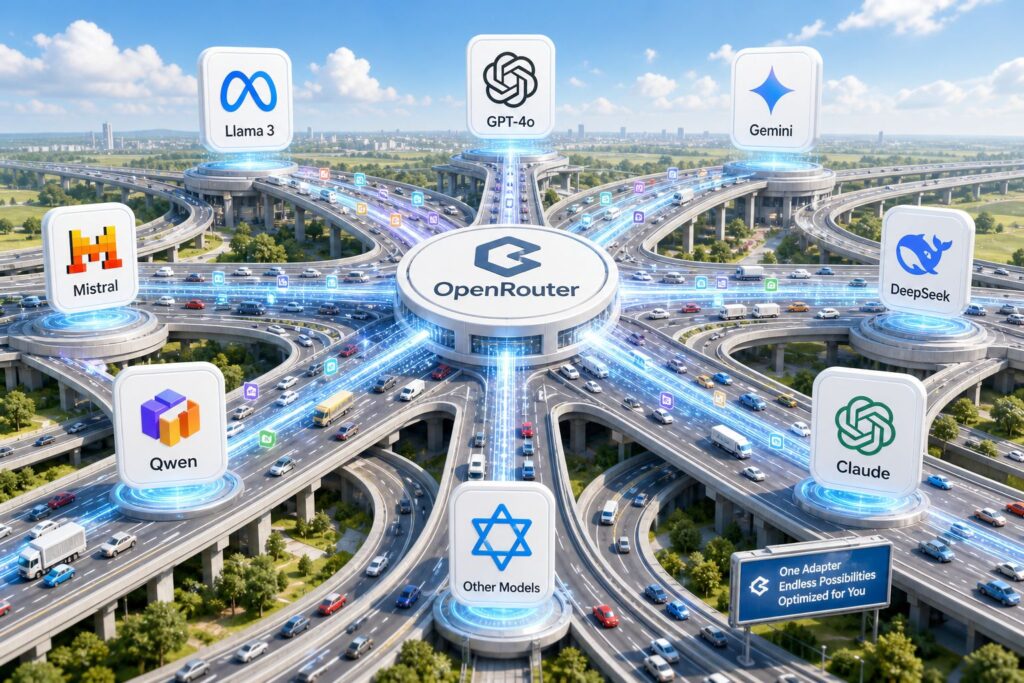
OpenRouter is that universal adapter for artificial intelligence. Every AI provider is a different country with a different socket, every provider interface is a different plug, your application is the device, and OpenRouter is the one adapter that lets the device work anywhere without being rewired. In May 2026 the company raised $113 million at a valuation of $1.3 billion, its annualised revenue climbed from roughly $1 million to roughly $50 million over eighteen months, and it now carries something in the region of 25 trillion tokens every week on behalf of more than 8 million developers, which is a great deal of money and traffic for a piece of plastic that sits between two things.
What follows is the case for why an AI model gateway is worth that much, and why it is one of the quietly cleverer pieces of infrastructure to emerge from this cycle.
1. Every provider built a different socket
Until fairly recently, choosing a model was a short decision, because there were only two or three serious answers. It is no longer a short decision at all. There are now hundreds of credible models from dozens of companies, spanning the American laboratories, the Chinese laboratories, the open source community, and an entire tier of specialist hosts who run other people’s models on their own hardware.
Every one of those options arrives with its own account to create, its own key to store, its own billing relationship to set up, its own preferences about how a request should be shaped, its own rate limits, and its own outages for you to absorb. If you are a small team that wants to test three models against your customer support tickets to see which one performs best, you have committed yourself to three vendors, three invoices, three integrations and three sets of documentation before you have written a single line of code that does anything useful for a customer.
The electricity is broadly the same in all of these places. You send some text, you get some text back. It is only the plugs that differ, which is precisely the sort of problem an adapter is for.
2. One key, one address, one interface
What OpenRouter does is collapse all of that into a single AI inference API, so that you deal with one key, one balance, one address and one request format. It currently sits in front of more than 400 models drawn from more than 70 providers, and the small design choice that made everything else possible is that it presents an OpenAI compatible API, which means the overwhelming majority of existing code already knows how to talk to it.
The practical consequence is worth stating plainly. If you have an application already speaking to OpenAI, you change an address and a key, and you can now reach Claude, Gemini, Llama, Mistral, DeepSeek, Qwen and several hundred others without touching your application logic. Used this way it becomes a Claude API alternative, a Gemini API client and an open source model host all at once, without ever having signed up to any of them individually.
3. What actually happens when a provider falls over
This is the part that people underestimate until it happens to them, because AI providers do go down, and an application wired directly into one provider goes down alongside it.
Picture the sequence. Your application sends a request for a particular model. The provider serving that model is overloaded and returns an error, or simply stops answering. Rather than passing that failure back to you, OpenRouter looks at the other providers hosting the same model and sends the request there instead. If none of them can serve it, it can fall back to a different model that you have nominated as acceptable. Your application code does not change, your users see a slightly slower response rather than an error page, and nobody has to be woken up.
              Your application
                     │
                     ▼
                 OpenRouter
        ┌────────────┼────────────┐
        ▼            ▼            ▼
      Claude        GPT         Gemini
     (primary)   (fallback)   (fallback)
        │            │            │
        └────────────┼────────────┘
                     ▼
              One response
                     │
                     ▼
              Your application
Written out like that it looks obvious, but building it yourself means writing and testing retry logic against every provider you use, keeping a live view of which providers are healthy, and maintaining all of it while you would rather be building your actual product. What you are really buying is the pooled reliability of seventy providers instead of a bet on one.
4. Routing for cost, speed or quality
Failover is the defensive case for LLM routing. The offensive case is that the same open source model is frequently hosted by half a dozen providers at different prices and different speeds, which gives you a genuine choice on every single request.
Sometimes you want the cheapest option, because the task is a bulk classification job running across a million records overnight and nobody is waiting for the answer. Sometimes you want the fastest option, because a person is sitting in front of a chat window watching a cursor blink. Sometimes you want the best answer available regardless of what it costs, because the output is going in front of a client. Those are three different routing decisions and OpenRouter lets you express all of them, either by preferring a provider explicitly or by letting the platform optimise on your behalf.
The saving is real but the more valuable thing is that the decision is now a knob you can turn rather than an architecture you are stuck with.
5. Changing your mind stops being expensive
Developers dislike vendor lock in for good reason, and this market gives them an unusually strong reason, given that a genuinely better or cheaper model appears every few weeks and that a single week in March 2026 saw twelve significant model launches.
The day a better model appears, changing provider is a configuration change rather than a rewrite. That sentence is the entire product, and everything else in this article is a consequence of it. The real cost of being tied to one vendor was never the money, it was the set of models you never evaluated because evaluating them was too much trouble.
6. It has accidentally become a map of the whole industry
This part goes well beyond convenience, and it is the thing I find most interesting about the company.
Because millions of developers make model choices on the platform every day, OpenRouter can see something that nobody else in the industry can see, which is what people actually use when they are spending their own money on software they have to ship. The company publishes this as a public leaderboard, and the picture it paints is considerably more honest, and considerably stranger, than anything you will learn from a benchmark.
Two findings stand out. The first is that on OpenRouter’s own numbers the relationship between a model’s benchmark scores and its share of real usage is close to inverse, which is to say that the models winning volume are not the ones topping the leaderboards but the ones charging the least. The second is that Chinese models went from under 2% of traffic on the platform to more than 45% in the space of roughly twelve months, while Anthropic’s models account for something like 12% of tokens but 46% of the revenue.
Those figures together describe two entirely different markets sitting on the same shelf, one a large volume commodity market in which price is very nearly the only thing that matters, and the other a premium market in which a much smaller group of buyers will happily pay a great deal for the best answer available. Benchmarks will tell you what a model is capable of in a laboratory, whereas OpenRouter tells you what people choose when they are paying, and those turn out to be very different questions.
7. Fusion is the point at which it stops being a middleman
In June 2026 the company shipped something that changes the story, a feature called Fusion, which rather than routing your question to a single model sends it to a panel of models all at once and then hands every answer to a judge model, whose job is to read them all, mark where they agree, mark where they contradict one another, note what any individual model missed, and synthesise a final response out of the combined analysis.
It amounts to an automated second opinion, and the results are the genuinely surprising part. OpenRouter’s own testing found that panels of frontier models outperform any individual frontier model on demanding research tasks, and, rather more unexpectedly, that panels assembled from cheap models can outperform some frontier models outright. The company’s claim is that Fusion approaches the quality of the best available models at roughly half the cost per call.
Something like this is only buildable by a company in OpenRouter’s position, because you need cheap, uniform, parallel access to hundreds of models before a panel is practical at all. It is the sort of product that emerges out of infrastructure rather than being planned in advance.
8. The honest caveats
Any fair account has to include these, so here they are.
OpenRouter charges a platform fee of 5.5% on top of provider pricing for anyone using the standard consumption tier. It does not mark up the underlying model prices, but it is not free either, and while the fee is comfortably worth paying for most teams, going direct starts to make financial sense at very large scale. There is a bring your own key option that softens this considerably, since you can route your own provider accounts through the platform with no fees on the first $25,000 of monthly list price inference and a 5% fee after that.
It is also, unavoidably, a dependency, because OpenRouter owns no models and no hardware of its own and is fundamentally a dispatch layer, which means that when a major provider restricts access or changes its terms, OpenRouter is downstream of that decision along with everybody else.
The most substantial criticism is a strategic one that its sceptics have made rather sharply, which is that by putting 400 models on a single shelf sorted by price and latency, OpenRouter actively turns models into interchangeable commodities, and the more successfully it does that, the less anyone needs a sophisticated router to choose between them. If model quality and pricing eventually converge, the argument runs, developers will simply call whichever option is cheapest and the routing layer loses its reason to exist. Whether that is an imminent threat or a decade away depends entirely on whether the current fragmentation of the model market is a passing phase or a permanent condition, and thoughtful people land on both sides of that question.
9. The short version
| Without OpenRouter | With OpenRouter |
|---|---|
| One integration for every provider | One integration in total |
| A billing account per provider | One billing layer |
| Vendor lock in | Switching is a configuration change |
| Failover written and maintained by hand | Automatic routing between providers |
| A different interface for every model | One consistent interface |
| Pricing compared manually across tabs | Routing by cost, latency or quality |
10. Why it matters
The best infrastructure tends to share a quality that is difficult to name, which is that it takes an expensive decision and makes it cheap, and in doing so it quietly changes what people are willing to attempt.
Before OpenRouter, the question of which model to use was a commitment, in that you chose, you integrated, and then you lived with the consequences for a year. After OpenRouter it becomes a question you answer empirically, by trying five options, measuring which one works, keeping the winner, and revisiting the whole thing next month when something better inevitably ships. Everything else, including the failover, the single invoice and the free tier with its two dozen models for people who just want a poke around, follows from that.
Stripe standardised the way software talks to money and Kubernetes standardised the way software talks to servers, and OpenRouter is attempting something of the same order for the way software talks to intelligence. If it works, the adapter disappears into the wall and nobody thinks about plugs again, which is the most flattering thing that can happen to a piece of infrastructure.
Sources
OpenRouter Series B announcement, OpenRouter pricing, TechCrunch on the $1.3 billion valuation, BigGo Finance on the commoditisation paradox, Surpassing Frontier Performance with Fusion, OpenRouter provider routing documentation.