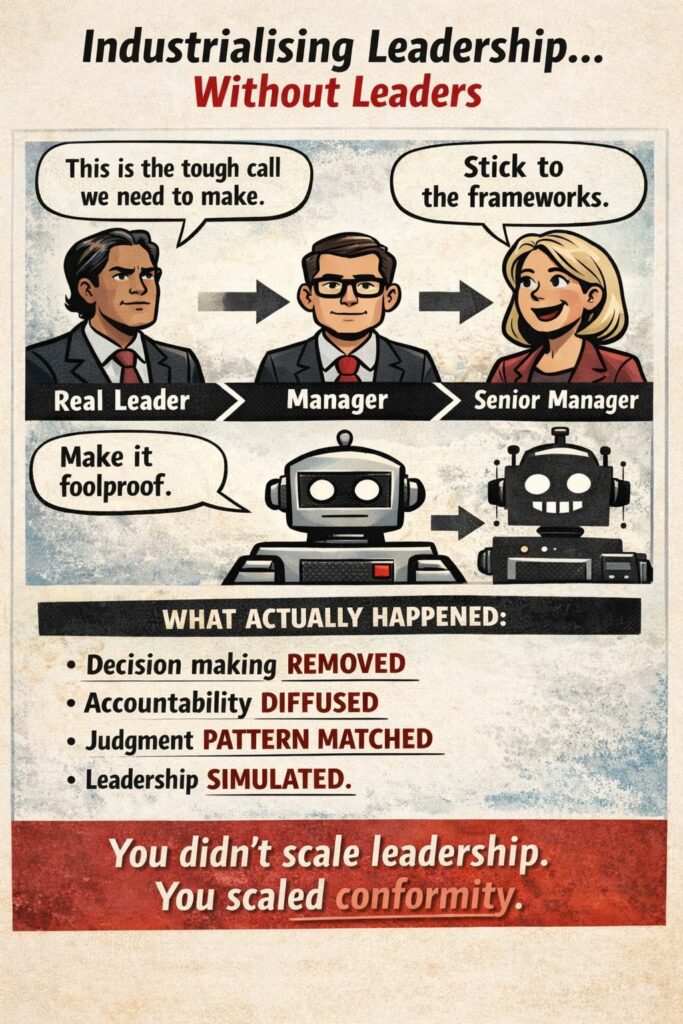
Are We Industrialising the Leadership Vacuum with a fixation on mimicking?
How we built a global machine to produce administrators, handed them leadership titles, and convinced ourselves that was enough
We have built business schools, certification programmes, corporate development curricula and entire consulting industries around the premise that leadership can be systematised, credentialled and scaled. We have invested billions in the proposition. And the returns are all around us, in organisations that are operationally sophisticated and strategically hollow, in cultures that are process-rich and vision-poor, in companies that benchmark obsessively against each other and wonder why no one is pulling ahead. We did not accidentally produce a leadership vacuum. We industrialised one. We built the machine, we trained the people, we handed out the titles, and we called it leadership development. The question this article wants to ask is a simple and uncomfortable one. What if we got it completely wrong?
1. What Administration Actually Is
Administration is the management of existing things. It is the coordination of processes, the approval of decisions, the alignment of timelines and the governance of budgets. It is necessary work, and it adds real operational value, but it requires no originality, no courage and no vision. Most critically, it can be copied. Every administrative framework, every governance structure, every approval process your company runs today has been done before, probably better, by someone else. You can hire a consultant to install it, benchmark it against your competitors, copy it from a Harvard case study and implement it next quarter. And that is precisely why leaders retreat into it, because when you are administering, you are safe. You are following a playbook. You have cover. You can point to the processes, the documentation, the alignment meetings and say look, we are being rigorous, even as your company drifts strategically, your best people quietly disengage and your market moves on without you. Administration is the perfect hiding place for someone who holds a leadership title but lacks the courage to actually lead.
2. What Leadership Actually Requires
Leadership, real leadership, is terrifying. Not because it is hard to execute, but because it requires you to go first. By definition, if you are leading, you are in front. You are doing something before it has been proven, taking a position before the data is conclusive, articulating a direction before everyone agrees, and challenging an assumption before the market has confirmed you are right. You are, in the most uncomfortable sense of the word, exposed. There is no playbook for genuine leadership. You cannot copy your way to the front, and you cannot benchmark originality. If everyone else is already doing it, it is not leadership but followership with better branding. This is why so few people actually do it. It is far easier, and far more socially acceptable, to call a strategy alignment meeting than to sit alone with your thinking and ask what you actually believe about where this market is going and whether you are willing to stake your reputation on it. Leadership requires originating thought. It requires the intellectual courage to teach people something they do not already know, to challenge the way your industry thinks, and to see patterns others have not yet named. It requires reading deeply, reflecting seriously and engaging with ideas that have nothing obvious to do with your quarterly targets. None of that is administrable, none of it shows up in a project management tool and none of it is comfortable.
3. The Vulnerability Gap
Here is the structural flaw at the heart of modern business leadership. We have built systems that reward the appearance of progress over the reality of it. When a leader administers, they generate visible output. Meetings happen, documents get produced, decisions get logged and there is a comforting trail of activity that can be pointed to and measured. When a leader leads, truly leads, much of the value is invisible. The insight that reframes a strategic challenge, the conversation that changes how a talented person sees their career, the question asked in the right room at the right moment that shifts the direction of the entire company. These things are real and they compound over time, but they do not generate a paper trail and they are deeply uncomfortable to sit with, because genuine leadership means being wrong in public. It means committing to a direction before you have consensus. It means your thinking is exposed, visible and available for criticism in a way that a well-run approval process never is. So we choose administration, and we call it leadership, and everyone agrees not to question it, because the alternative is too frightening.
4. The MBA Problem
This brings us back to the credential. The MBA was designed to produce skilled administrators, people who can read a balance sheet, manage a P&L, run an efficient operation and optimise a business that already exists. These are valuable skills, but they are not leadership skills. And by holding up the MBA as the gold standard of leadership preparation, we have built an entire global educational infrastructure designed to train the wrong capability. We teach people how to administer existing systems but we rarely teach them how to originate new thinking. We do not teach intellectual courage. We do not teach how to hold a strategic conviction in the face of uncertainty, how to challenge a market narrative or how to develop wisdom rather than just competence. The result is a pipeline of highly credentialled administrators who believe they are leaders because the systems they entered told them so. They sit in leadership roles, administering carefully, copying best practice and generating activity, wondering privately why it never quite feels like enough. It never feels like enough because it is not leadership, and some part of them knows it.
5. The Leadership Void and How Companies Hide It
Organisations without genuine leadership do not collapse cleanly. They compensate. They add layers of management and build governance frameworks, documentation requirements and coordination rituals. They create artefacts, strategy decks, OKR cascades and quarterly business reviews, that generate the feeling of rigour without the substance of direction. These structures are not inherently wrong, but they become catastrophic when they substitute for leadership rather than support it. What they produce is an organisation that is exhaustingly busy and strategically inert. Everyone is working hard, the calendar is full, the processes are running, and the company is slowly and quietly copying its way to irrelevance, doing what the competition did last year, benchmarking against the industry average and optimising a strategy that made sense in a different world. You cannot always measure the presence of great leadership, but you can measure its absence in the slow erosion of competitive differentiation, in cultures that are technically functional but creatively dead, and in the growing gap between what a company is doing and what it could be doing if someone were actually out front, thinking first.
6. The Question No One Wants to Ask
Here is the question every leader should sit with honestly and privately, without the defensive instinct to point at a full calendar as proof of contribution. When did you last originate something? Not approve something, not align something, not review something someone else created, but genuinely originate a thought about your market, your customer, your company or your industry that was yours, that challenged the prevailing view and that required intellectual courage to say out loud? When did you last teach someone something they could not have learned from anyone else in your organisation? When did you last read something that changed how you think, and then changed how your company thinks as a result? If the honest answer is that you cannot remember, that is not a time management problem. It is a leadership problem, and no amount of administrative efficiency will solve it.
7. What To Do Instead
The path forward is not complicated, but it is uncomfortable. Delegate aggressively, because every approval you are sitting on that does not require your specific insight is a theft from the person who should be making that decision and from the organisation that needs you thinking about something more important. Give people budgets, give them authority, trust them to act and review periodically rather than govern continuously.
Consider what happens when you do the opposite. You approve a travel budget, sandboxed with clear spend limits and policies, and then you approve every individual travel request that falls within it. The message to your team is not rigorous governance. The message is that you do not trust them to manage something as simple and basic as travel, even inside boundaries you yourself defined and agreed. So they learn. They learn to do all the work required to get a budget approved, and then to come back to you for reapproval on every decision that budget was supposed to empower them to make. Now extend that pattern to a conflict between two peers. Neither of them will resolve it directly with each other, because the culture has taught them that decisions, including social ones, flow upward. They will bring it to leadership for a steer, some advice, some counsel, just to check. This plays out across the entire organisation as a kind of validation compulsion, where nothing moves and nothing resolves without a leadership signature on it. Leaders become internally fixated, permanently pulled into decisions that should never have reached them, and find themselves burnt out and blind to the macro risks and opportunities that are actually their job to see. Meanwhile the people around them are frustrated, stifled and genuinely uncertain about what they are and are not empowered to do. That uncertainty is not a personality problem in your staff. It is a leadership problem at the top, and it compounds every single day it goes unaddressed.
Remove yourself from the approval chain, because if you are a bottleneck on operational decisions the problem is not the volume of decisions but the fact that you have failed to build the trust and capability in your team that would allow them to proceed without you. Protect real thinking time, not planning time or strategy offsite time, but actual unstructured thinking time where you read, reflect, question and sit with hard problems until something original emerges. This will feel unproductive, and it is the most productive thing you can do. Teach rather than administer, because your highest leverage as a leader is not the decisions you make but the quality of thinking you develop in the people around you. A leader who teaches people to think differently multiplies their impact indefinitely, while a leader who administers their team keeps that team permanently dependent. And finally, have a view, on your industry, your market and where the world is going, not a view borrowed from a consultant or copied from a competitor, but a view that is yours, that you have earned through genuine thought and are willing to defend. This is what strategic leadership actually looks like, and everything else is administration with a better job title.
8. The Harder Truth
We cannot solve this problem with better habits or time management techniques alone, because the deeper issue is that we have built a business culture that is fundamentally more comfortable with administration than with leadership. Administration is measurable, defensible and safe. Leadership is none of those things. It is uncertain, exposed and deeply personal. When you lead, you are on the line, not the process, not the framework, not the governance structure, but you. That is why so few people truly do it. But it is also why, when you encounter a genuine leader, someone who thinks originally, teaches relentlessly, challenges the prevailing view and points confidently toward a direction no one else has named yet, the effect on an organisation is unmistakable. People grow, strategy sharpens and energy returns, not because of magic but because someone in a leadership role is actually leading. The MBA taught you how to administer, and that was never going to be enough. The work of becoming a leader, an original thinker, a teacher, a risk-taker willing to be exposed and wrong and out front, is yours to do, and it starts with being honest about which one you have been doing.
9. The Ownership Inversion
One of the things that companies complain about most persistently is the so-called “lack of ownership.” It appears on engagement survey results, in post-mortems, in frustrated conversations between senior leaders who cannot understand why their people do not act like they care. It is treated as a cultural deficiency in the workforce, as a hiring problem, as a generational failing. It is almost never treated as what it actually is: a structural outcome of how the organisation has chosen to lead.
Lack of ownership is not authored by staff. It is authored by leaders, and the mechanism through which they author it is not negligence or malice but the very administrative instinct that the rest of this article has been describing. Ownership, real ownership of the kind where a person thinks about a problem at midnight not because they were asked to but because they genuinely feel responsible for it, cannot be mandated or installed through a framework. It emerges from one condition and one condition only, which is that someone was genuinely given something and trusted to take care of it without being told exactly how.
The moment you hand a person a role and then fill every hour of that role with prescribed activities, pre-approved playbooks, mandatory status meetings and atomic instructions about what you want and when you want it, you have not given them ownership. You have given them a costume. They are performing the appearance of responsibility while you retain the substance of it, and then you wonder why they do not act like owners.
This is the ownership inversion. You administer their role so completely that you effectively make every meaningful decision yourself, and then you hold them accountable for the outcomes of decisions that were never truly theirs. The accountability sits with the person while the authority sits with you, and you call the resulting disengagement a cultural problem.
9.1 The Lobotomy Disguised as Oversight
There is a particular kind of leader, and they are everywhere, who genuinely believes that detailed oversight is a form of care, that telling people exactly what to do demonstrates thoroughness and that a full diary indicates a high-performing team. This belief is not malicious. It often comes from the same anxiety that drives administrative retreat in the first place, which is the need to feel in control of something, to see visible evidence of rigour and to have a defensible answer when things go wrong.
But what it does functionally is lobotomise the people beneath it. When you tell someone exactly what to do, you have removed the one thing that builds genuine capability over time, which is the requirement to think. You have taken a person who could have developed judgment, strategic instinct and contextual intelligence, and reduced them to an executor of your preferences. When they cannot think independently, when they escalate everything, when they wait for direction and fail to show initiative, you diagnose the problem as a talent issue, when the reality is that you built that behaviour systematically, meeting by meeting, instruction by instruction, approval by approval, until learned helplessness became the rational response to the environment you created.
9.2 What Real Delegation Looks Like
Genuine ownership transfer is not comfortable to give or receive. It requires the leader to say, in effect, that this is yours, that they trust the person to figure out how to take care of it, that they are there to think with them and not for them, and that they will hold them accountable for the outcome without prescribing the path. That conversation exposes the leader as much as the person receiving the accountability, because if you genuinely give ownership and the person fails, you cannot retreat behind the process. You made a judgment call about a human being, and you were wrong, and that is visible in a way that a well-governed approval chain never is.
This is why real delegation is rare. It requires a tolerance for ambiguity and a willingness to be wrong in a way that administrative oversight neatly avoids. When everything is governed, prescribed and approved, failure belongs to the system, but when you trust a person and they fail, the failure is personal and reflects on your judgment, and most leaders are not willing to carry that exposure. True delegation means giving someone a budget and an outcome and leaving the path between those two things genuinely open. It means your role in the subsequent weeks is to ask questions rather than provide answers, and that when they bring you a decision, your default response is “what do you think?” rather than “here is what I would do.” It means you review the destination periodically without controlling the route, and you intervene when values are violated or when the person is genuinely stuck, not merely when you would have done it differently. Different is not wrong, and this is perhaps the hardest thing for controlling leaders to internalise, because the person you gave ownership to will make choices you would not have made, and your discomfort with those choices is not a signal to intervene. It is simply the price of ownership transfer, and if you cannot pay it, you have not actually delegated anything.
9.3 The Administrative Overhead Tax
There is also a more structural dimension to this that organisations rarely account for honestly. When you impose significant administrative overhead on leaders, the reporting cycles, the documentation requirements, the attendance at coordination rituals that exist primarily to generate the appearance of alignment, you are not just consuming their time. You are consuming the cognitive and emotional bandwidth that genuine ownership requires. Ownership is not just a permission. It is a mental posture that requires the capacity to hold a piece of the business in your mind continuously, to sense when something is drifting, to feel the weight of responsibility and respond to it proactively. That posture is fundamentally incompatible with a diary that is structured from eight in the morning to six at night with back-to-back meetings, most of which require attendance rather than contribution.
You cannot ask people to think like owners in the margins of an administrative life. The cognitive overhead of constant reporting, constant alignment and constant documentation leaves no room for the kind of slow, accumulative thinking that genuine ownership demands, and when someone’s week is full before it starts, they are not managing a business but processing a queue. The organisation has confused activity for ownership so thoroughly that neither party notices the difference anymore.
9.4 Ownership as the True Measure of Leadership
The degree to which ownership genuinely exists in your organisation is one of the clearest diagnostics of whether you have leaders or administrators in your senior roles. A genuine leader is compelled, almost constitutionally, to give ownership away, not because they are unambitious or passive but because they understand that their leverage is not in the decisions they make personally but in the quality of the decision-making they develop across the people around them. An administrator, by contrast, tends to accumulate control even when they believe they are delegating. They create processes that require their sign-off, schedule reviews that are actually approvals with a different name, and ask for updates that are actually a mechanism for re-entering decisions that should have been final. They are not doing this consciously in most cases but are simply more comfortable in control than in trust, and so they recreate control structures wherever ownership should exist.
If you want to know whether your organisation has a leadership problem or a talent problem, ask yourself honestly whether you have actually given anyone anything that is genuinely and irreversibly theirs, or whether you have given out titles and accountability while quietly holding onto the authority that would make those things real. If the answer is the latter, the lack of ownership you are experiencing is not a mystery because you built it, and the path out of it begins not with a culture programme or an engagement survey but with the much harder act of letting go, trusting a person and sitting with the discomfort of not knowing exactly what they are going to do next. That discomfort is not a problem to be managed. It is what leadership actually feels like from the other side, and if it is absent, the odds are good that leadership itself is too.