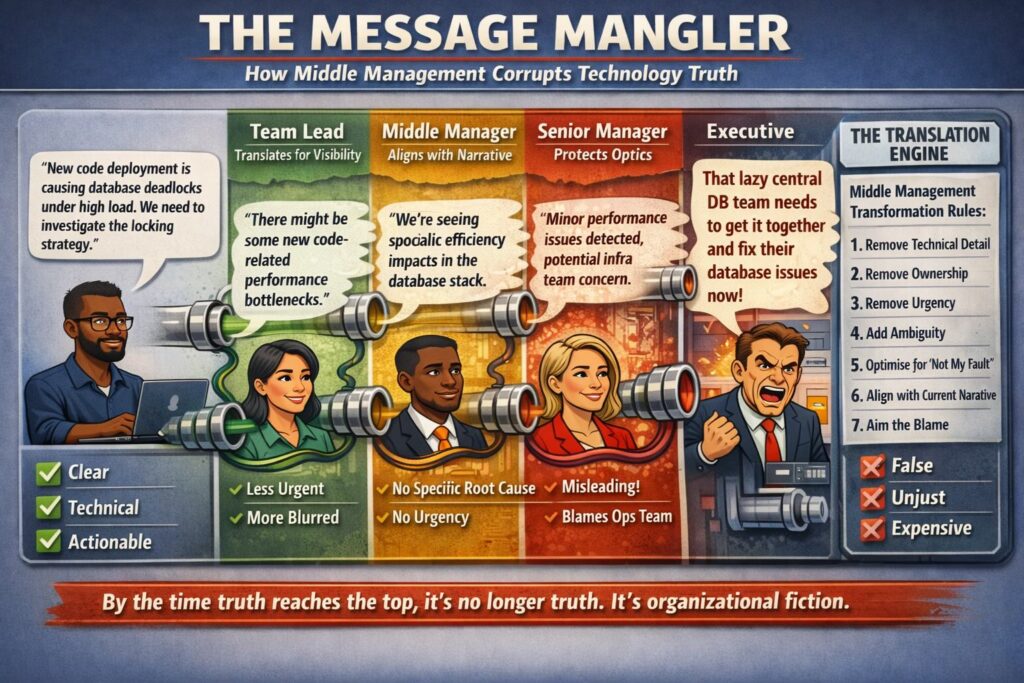
The Message Mangler: How Middle Management Can Corrupt Technology Truth
And why your business is making decisions on fiction
There’s a silent killer sitting in most large organisations. It doesn’t appear on any risk register, it doesn’t show up in your sprint velocity charts, and it certainly won’t announce itself in your next all-hands. It operates quietly, in the gap between what actually happened and what gets reported upward.
Meet the Message Mangler.
The Telephone Game at Enterprise Scale
You know how the children’s game of telephone works: a message gets whispered from ear to ear, and by the time it reaches the end of the line, it bears almost no resemblance to the original. Now imagine that game being played with your technology delivery status, your platform dependencies, your engineering bottlenecks, and the people doing the whispering have a personal stake in how the story lands.
That’s middle management in a technology-heavy business unit, operating without technical grounding and under pressure to perform.
The message starts as something like: “We underestimated the complexity of the integration, our team made some poor architectural decisions early on, and we’re now paying down that debt.” By the time it reaches the business head, it’s become: “The central platform team had resource constraints, and team X was pulled onto other priorities. We were blocked.”
It sounds plausible, it sounds specific, it’s also largely fiction. But fiction dressed in the language of accountability.
The ABM Reflex: Anything But Me
This is the ABM Pattern, Anything But Me, and it is one of the most corrosive behavioural anti-patterns in technology organisations. It isn’t always malicious. Sometimes it’s a survival instinct. Managers in high pressure environments learn very quickly that admitting failure invites scrutiny, and scrutiny can feel existential. So they develop a sophisticated deflection toolkit: the Dependency Shield (“We were waiting on the central team”), the Priority Fog (“Team X got pulled into higher-priority work”), the Resource Alibi (“We didn’t have the headcount to absorb the work”), and the Process Blame (“Governance cycles slowed us down”).
Each of these may contain a grain of truth, but when they become the default narrative, when your team is never the cause and always the victim, you’re no longer in a delivery conversation. You’re in a theatre production.
How Business Leaders Get Fooled Into Deepening Silos
Business heads are smart, experienced people, but they’re often not technically fluent and they’re consuming these mangled messages through layers of interpretation. When they repeatedly hear that cross-team dependencies are the root cause of delays, they do what any rational leader would do: they try to eliminate the dependency. The answer becomes hire more, build it in-house, become self-sufficient.
And so the business unit bloats: more engineers, more product managers, more layers. The logic is sound on the surface; reduce external friction, accelerate delivery. But the diagnosis was wrong. There was never a dependency problem. There was a delivery accountability problem, and adding headcount to a team that hasn’t reckoned with its own failures doesn’t fix anything. It just gives the ABM machine more fuel, richer deflection narratives, more complex internal politics, and an ever-widening distance between reality and the boardroom.
The Red Flag You’re Probably Ignoring
Here is a diagnostic question every business leader should ask about their technology teams: “When did your team last own a failure, fully, clearly, and without a ‘but’?” If the answer is uncomfortable silence, or a list of caveats, or a pivot to what someone else did wrong, you have a problem.
Teams that believe they are perfect and that the world around them is the perpetual source of their problems are not high-performing teams. They are masking and projecting. They have built an identity around invulnerability, and that identity is now the primary obstacle to growth. This isn’t a performance management footnote; it’s a cultural emergency. A team that cannot diagnose its own failures cannot improve, and a team that cannot improve will keep failing with increasingly polished excuses.
There is one structural change that cuts through the deflection more effectively than almost anything else: when a central or platform team is being cited as the reason for a failure, they need to be in the room. Not represented by a summary slide, not paraphrased by the person doing the blaming, but present, with a voice and the right to challenge the narrative. It can be an argument; that is fine. Visible, honest disagreement between teams is considerably healthier than a clean story that was manufactured in a corridor beforehand and arrived in the meeting fully formed. The deflection only survives when the people it targets are absent.
Beyond presence in the room, central platforms should operate as open source internally. If a business unit needs something added or changed and the central team cannot prioritise it, the business unit should be able to do it themselves and contribute it back. This removes the most common and often legitimate complaint about central teams, that they move too slowly and don’t prioritise the right things, and it removes it structurally rather than through governance. It also makes the “we were blocked waiting on the central team” argument much harder to sustain. Either the business unit fixed it, or it wasn’t actually the priority they claimed it was. Delivery is rarely one team’s problem, and the structures around it should reflect that rather than creating clean channels through which blame can flow in a single direction.
Consider what this looks like in practice. One organisation suffered rolling outages for over a year. After every incident, business leaders demanded an investigation into what had changed, operating on the reasonable but flawed assumption that if something worked yesterday, it should work today unless someone had tampered with it. The reality, which never made it cleanly into those conversations, was that the service in question had received almost zero maintenance for years. It was running on unsupported software and unsupported hardware, and the teams responsible were too afraid of failure to do the work required to fix it. The outages weren’t caused by change. They were caused by the prolonged, fearful avoidance of it. That distinction never reached the people making decisions, because the Message Mangler was doing its job.
The team that eventually fixed it made changes almost every night for three months. Some of those changes went badly. Most went well. They owned the failures without deflection and celebrated the successes without exaggeration. By the end of it, the narrative around change had been fundamentally rewritten: change is essential, it must be done well, lessons must be learnt, and failures cannot be repeated. That rewriting didn’t happen in a boardroom. It happened through sustained, unglamorous, high-stakes work that nobody else had been willing to pick up.
The Fix Is Simpler Than You Think
The antidote to the Message Mangler is not a new framework, not a reorganisation, and not another layer of programme governance. It’s technically competent, fearless leadership at the business unit level, and it’s worth being precise about what technically competent actually means.
It does not mean a finance head who has sat through enough sprint reviews to know the vocabulary. It does not mean a generic manager with strong stakeholder skills and a passing familiarity with agile. It means someone who has written and shipped code, who has debugged a production incident at midnight, who has felt the weight of an on-call rotation and understands viscerally what it costs a team to carry unsupported infrastructure. That background gives a leader something that no amount of dashboard training can replicate: a finely tuned nonsense detector. When a deflection narrative doesn’t add up technically, they know it, and they can say so with enough specificity to make the deflection collapse.
It’s also worth noting that many organisations deliberately place non-technical leaders over technology teams, viewing them as safer, more commercially aligned, less likely to go native. This is precisely the choice that creates fertile ground for the Message Mangler. A finance head or a generic manager cannot interrogate a technical narrative because they lack the instinct to know when something doesn’t stack up. They may sense that something is off, but without the grounding to pin it down, the deflection succeeds by default, every time.
One further nuance: someone who coded fifteen years ago and hasn’t been close to delivery since can be just as susceptible to manipulation as someone with no technical background at all. The experience matters, but so does staying current enough to ask the right questions and recognise when the answers are incomplete.
Beyond the leader’s background, psychological safety for honest failure is non-negotiable, because fear is the primary fuel of the ABM pattern. Accountability and psychological safety are not opposites; they are partners. Leaders need to actively create environments where surfacing a real problem is celebrated rather than punished, and where the bravest act in the room is sometimes admitting that your team broke something and here is exactly why.
Goal setting matters enormously here, because poorly designed goals are the mechanical root cause of the ABM pattern. When every goal must be met, you have built a system that manufactures defensive behaviour and teaches people to offload blame onto others. It is not a personality flaw that emerges in that environment; it is a rational response to a structure that leaves no safe alternative.
The fix is to stop treating goals as tasks. A goal should land you in a city, not on a postage stamp. Goals are wide by nature, and there should be room built in to score on either side of the keeper. That means designing for multiple legitimate paths to success, not a single binary outcome that is either hit or missed. It means actively encouraging stretch goals and celebrating the attempts that fall short, provided they are backed by genuine lessons learnt. That last condition matters: risk taking without reflection is just recklessness, and the lessons learnt requirement is what separates a healthy stretch culture from one that simply tolerates chaos. The moment your organisation starts rewarding honest, well-documented failure as a sign of ambition and learning, the incentive to deflect and protect begins to weaken.
Ironically, organisations drowning in ABM culture often compensate with more planning ceremonies, more checkpoints, more status decks, creating the illusion of rigour while consuming the energy that should go into actual delivery. Streamlining that overhead and trusting people to deliver is itself a powerful signal of cultural intent.
The most powerful thing any leader can do, though, is model radical honesty. When leaders say “we got this wrong, here’s what we learned” consistently and visibly, it gives everyone permission to do the same. The Message Mangler thrives in cultures where honesty feels dangerous, so the simplest way to dismantle it is to make reality the only acceptable currency.
Delivery Is Hard. Pretending It Isn’t Is Harder.
Technology delivery is genuinely, stubbornly difficult, and anyone who tells you otherwise is either working on trivially simple problems or is already deep in the ABM pattern. The best teams in the world fail regularly; they fail fast, they fail transparently, they extract everything they can from the failure, and they move forward better than before. They don’t need a perfect track record. They need an honest one.
The Message Mangler doesn’t just distort information. It distorts strategy, investment, culture, and trust, and left untreated it turns a technology organisation into an expensive, well staffed machine for producing very convincing reasons why nothing is ever anyone’s fault. Build leaders who have been in the trenches, who can tell a real problem from a managed narrative, and who are brave enough to demand the truth even when the truth is uncomfortable. The rest follows.