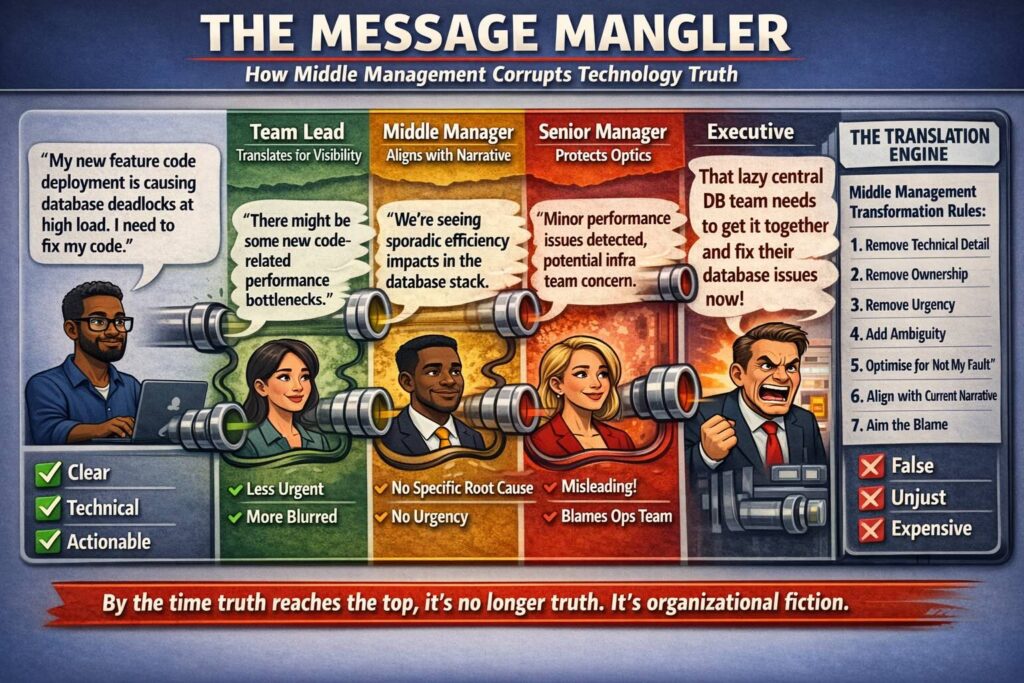
The Message Mangler: And why your business is making decisions on fiction
There’s a silent killer sitting in most large organisations. It doesn’t appear on any risk register, it doesn’t show up in your sprint velocity charts, and it certainly won’t announce itself in your next all-hands. It operates quietly, in the gap between what actually happened and what gets reported upward.
Meet the Message Mangler.
1. Two Ways the Truth Gets Killed
Before we go further, it’s worth being precise about what the Message Mangler actually is, because it comes in two distinct forms and conflating them leads to the wrong diagnosis and the wrong fix.
The first is structural. Information degrades as it passes through layers of management, each layer adding its own interpretation, softening a difficult truth, emphasising what reflects well and omitting what doesn’t. Nobody in the chain is necessarily lying, but by the time the message reaches the top, the accumulated effect of a dozen small editorial decisions has produced something that bears almost no resemblance to reality. This is the telephone game at enterprise scale, and it is almost always a symptom of too many layers, too little technical grounding at each one, and a culture where delivering bad news feels dangerous.
The second is deliberate. A single person, or a small group, has learned that misinformation has currency and is actively mining it for personal gain, whether that is headcount, budget, influence, or simply the removal of scrutiny from their own delivery failures. They are not reaching for deflection as a coping mechanism. They are constructing a narrative with intent, designed to land well upstairs, engineered to redirect scrutiny, and built in the careful absence of the people it is designed to blame. This is not a management failure. This is manipulation.
Both produce the same output at the top of the organisation: decisions made on fiction. But the causes are different, the risk profiles are different, and the fixes are different. The structural version calls for better leadership, better goal design, and better information architecture. The deliberate version calls for all of those things, and also for the organisation to be willing to name what it is and deal with it accordingly.
2. The Telephone Game at Enterprise Scale
The structural version starts innocuously. A message begins as something like: “We underestimated the complexity of the integration, our team made some poor architectural decisions early on, and we’re now paying down that debt.” By the time it reaches the business head, it has become: “The central platform team had resource constraints, and team X was pulled onto other priorities. We were blocked.”
It sounds plausible, it sounds specific, and it is largely fiction, but it is fiction dressed in the language of accountability.
This is the ABM (Anything But Me) pattern, and it is one of the most corrosive behavioural anti-patterns in technology organisations. It isn’t always malicious, and sometimes it’s a survival instinct. Managers in high-pressure environments learn quickly that admitting failure invites scrutiny, and scrutiny can feel existential. So they develop a sophisticated deflection toolkit. The Dependency Shield tells us we were waiting on the central team. The Priority Fog explains that team X got pulled into higher-priority work. The Resource Alibi argues there wasn’t enough headcount to absorb the work. The Process Blame points to governance cycles slowing everything down. Each of these may contain a grain of truth, but when they become the default narrative, when your team is never the cause and always the victim, you are no longer in a delivery conversation. You are in a theatre production.
3. The Deliberate Manipulator
The ABM (Anything But Me) pattern operating through layers of management is damaging enough on its own, but when it is being driven deliberately by a single actor it is an entirely different order of threat.
The most dangerous Message Manglers present as confident, commercially minded, and across the detail. They are fluent in the language of urgency and risk, and they know how to make a senior leader feel informed while ensuring the one thing that would unravel the story never makes it into the room. This shows up most visibly at the executive level in what might be called executive bubble wrap: a self-serving narrative so cushioned in urgency and competitive anxiety that the person receiving it feels reckless for asking questions. Statements like “we are losing market share because our competitors are breaking the rules” or “I need this team to report to me as they aren’t following the strategic direction”, may carry partial truths, but they arrive wrapped in enough executive-friendly framing to prevent anyone from squeezing them too hard. The higher up the organisation the deflection lands, the less likely it is to meet anyone with the grounding or the appetite to challenge it.
Beyond the narrative manipulation, deliberate Message Manglers have a second and equally destructive mode of operation. They table proposals that nobody else supports, that have not been socialised with the people affected, and that solve problems nobody has been consulted on or even agrees exist. They produce long, densely argued papers written in isolation, dropped into the organisation without warning, and framed in the language of improvement and strategic necessity. The people on the receiving end of these papers are then forced to spend significant time and money commissioning counter-analyses, running alignment sessions, and producing their own documentation simply to re-establish a reality that was never actually in dispute. The proposal typically rests on two claims: that the current state is substandard, and that the author’s preferred alternative would be better. In the organisations where this pattern is most entrenched, the evidence consistently fails to support either point, but by the time that becomes clear a great deal of organisational energy has been consumed in the process of demonstrating it.
The organisations that tolerate deliberate Message Manglers longest are usually the ones most convinced they don’t have any. Their one structural weakness is that their entire operation depends on data flowing independently and without validation. They need the platform team’s version of events to arrive separately from the product team’s version. They need the incident report to land before the engineer who wrote it can be questioned. They need the business head to consume a summary rather than a source. Interrupt that flow and the architecture of the deception falls apart, because the story built for one audience cannot survive contact with the other.
4. How Business Leaders Get Fooled Into Deepening Silos
Whether the distortion is structural or deliberate, the effect on business leaders follows the same pattern and it compounds over time.
Business heads are smart, experienced people, but they are often not technically fluent and they are consuming mangled messages through layers of interpretation. When they repeatedly hear that cross-team dependencies are the root cause of delays, they do what any rational leader would do and try to eliminate the dependency. The answer becomes hire more, build it in-house, become self-sufficient. And so the business unit bloats with more engineers, more product managers, and more layers. The logic is sound on the surface, since reducing external friction should in theory accelerate delivery, but the diagnosis was wrong. There was never a dependency problem. There was a delivery accountability problem, and adding headcount to a team that hasn’t reckoned with its own failures doesn’t fix anything. It simply gives the Anything But Me machine more fuel, producing richer deflection narratives, more complex internal politics, and an ever-widening distance between reality and the boardroom.
Consider what this looks like in practice. One organisation suffered rolling outages for over a year. After every incident, business leaders demanded an investigation into what had changed, operating on the reasonable but flawed assumption that if something worked yesterday it should work today unless someone had tampered with it. The reality, which never made it cleanly into those conversations, was that the service had received almost zero maintenance for years. It was running on unsupported software and unsupported hardware, and the teams responsible were too afraid of failure to do the work required to fix it. The outages weren’t caused by change. They were caused by the prolonged, fearful avoidance of it, and that distinction never reached the people making decisions because the Message Mangler was doing its job. The business leaders kept deepening their investment in a team whose core problem was never resource or dependency but accountability, and every additional hire made the real diagnosis harder to reach.
5. The Decisioning Trap
There is a particular moment that plays out repeatedly in large organisations, and it is worth naming precisely because it looks like leadership but often isn’t.
An executive eventually receives both sides of a story. The product team says they are blocked by dependencies and need more people, while the platform team tells an entirely different story. The two accounts are so asymmetric, with different facts, different emphasis, and different villains, that the truth is somewhere neither version is willing to go. That executive now faces a choice with limited time to make it. The first option is to investigate the asymmetry, challenge the narratives, and find out what actually happened, but given their seniority this is genuinely difficult work that requires time they don’t have, technical depth they may lack, and a willingness to make powerful people uncomfortable. The second option is far simpler: take away the excuses, give the product team what they are asking for, add headcount, remove shared dependencies, and move on.
This is the decisioning trap, and the second option is nearly always chosen. It feels decisive, it demonstrates responsiveness, and on the surface it removes friction. What it actually does is reward the louder, more persistent, and frequently less honest party, which is the organisational equivalent of giving the naughty sibling what they want to stop the noise, and as any parent will tell you, that behaviour has consequences that compound over time.
The most dangerous consequence isn’t the budget wasted or the empire quietly built around a false diagnosis. It is the signal that decision sends to everyone watching. When asymmetric information consistently produces favourable outcomes for the side that shouts loudest, misinformation acquires currency and people learn quickly that there is more value in controlling the narrative than in telling the truth. Once that lesson is learned it spreads, and the executive who believed they were solving a delivery problem has actually funded a cultural arms race in which the Anything But Me pattern becomes the dominant survival strategy at every level.
6. Am I Enabling a Message Mangler? A Checklist for Leaders
The uncomfortable truth is that Message Manglers do not operate in a vacuum. They exist because the environment around them makes it possible, and that environment is usually maintained, however unintentionally, by the leaders above them. If several of the following feel familiar, the problem may be closer to home than expected.
- You receive updates through one person rather than from the teams doing the work. If a single manager is your primary source of truth on delivery, you have created the perfect conditions for a curated narrative.
- Platform or dependency teams are rarely in the room when their work is being discussed. If the people being blamed are consistently absent from the conversation, the blame has never been tested.
- You have resolved the same inter-team conflict more than once by adding headcount. If the answer to blocked delivery is always more people, the diagnosis has never actually been made.
- Your “best performing” managers are also your most polished communicators. If the people who present most confidently are also the ones who rise fastest, you may be rewarding storytelling over delivery.
- Teams escalate to you rather than resolving issues laterally. If conflicts between teams consistently travel upward instead of being worked out between them, information is being managed rather than shared.
- You have never heard a manager in your organisation say their team got something badly wrong without a qualifying “but”. If accountability always comes with a footnote, the culture has already been captured.
- Urgent competitive threats regularly arrive without supporting data. If executive bubble wrap is the normal packaging for strategic risk, the analytical layer has been bypassed by design.
- You feel well informed, but decisions keep producing unexpected outcomes. If the confidence of your information does not match the quality of your results, the information was not what it appeared to be. You will feel as if you can never quite understand what the real problem is.
If more than three of these are true, the organisation is not just tolerating Message Manglers. It is funding them.
7. The Red Flag You’re Probably Ignoring
Here is a diagnostic question every business leader should ask about their technology teams: when did your team last own a failure, fully, clearly, and without a “but”?
If the answer is uncomfortable silence, or a list of caveats, or a pivot to what someone else did wrong, you have a problem. Teams that believe they are perfect and that the world around them is the perpetual source of their problems are not high-performing teams. They are masking and projecting. They have built an identity around invulnerability, and that identity is now the primary obstacle to growth. This isn’t a performance management footnote; it is a cultural emergency. A team that cannot diagnose its own failures cannot improve, and a team that cannot improve will keep failing with increasingly polished excuses. The difference between a team in the grip of structural Anything But Me and one being steered by a deliberate manipulator can be hard to read from this diagnostic alone, but either way the answer to the question tells you everything you need to know about where to start looking.
8. The Fixes
8.1 Make Dishonesty Expensive, Works for Both Forms
When two teams present asymmetric accounts of the same events, the instinct is to adjudicate between them and pick a winner, but you should resist it. Instead, impose a disconnection tax: send them back together with a mandate to produce a single shared version of the truth before any decision is made, any resource is allocated, or any dependency is removed. The disconnection tax is a single mechanism that addresses both forms of the problem simultaneously. Where the distortion is structural, meaning two teams with genuinely different perspectives on a complex problem, they can reconcile their accounts and what comes out the other side will be a diagnosis both parties own. Where the distortion is deliberate, the manufactured story will not survive contact with the people it was designed to blame, because the deflection was constructed in their absence and depends entirely on remaining there. The same principle applies to the unsolicited paper dropped without consultation: rather than commissioning an expensive counter-document, require the author to produce a revised version that has been developed in genuine collaboration with the teams it affects. If the problem it describes is real, that process will surface it. If it isn’t, that process will make the fact impossible to ignore. The process will be slower and considerably more awkward, but it does something no governance framework or performance review can replicate by making dishonesty expensive.
8.2 Put the Right People in the Room, Works for Both Forms
When a central or platform team is being cited as the reason for a failure, they need to be in the room, not represented by a summary slide and not paraphrased by the person doing the blaming, but present with a voice and the right to challenge the narrative. It can be an argument, and that is fine. Visible, honest disagreement between teams is considerably healthier than a clean story manufactured in a corridor beforehand and arriving at the meeting fully formed. Whether the distortion is happening through layers or through a single actor, the deflection only survives when the people it targets are absent. The same applies to proposals: nothing that materially affects another team should reach a decision-maker without the affected team having been part of shaping it.
8.3 Build Open Platforms Internally, Addresses the Structural Form
Central platforms should operate as open source internally. If a business unit needs something added or changed and the central team cannot prioritise it, the business unit should be able to do it themselves and contribute it back. This removes the most common and often legitimate complaint about central teams, that they move too slowly and don’t prioritise the right things, and it removes it structurally rather than through governance. It also makes the “we were blocked waiting on the central team” argument much harder to sustain, because either the business unit fixed it or it wasn’t actually the priority they claimed it was. This fix addresses the structural form of the problem directly, since it removes the dependency narrative at source rather than adjudicating it after the fact.
8.4 Put Technically Grounded Leaders in Charge, Addresses Both Forms
The antidote to the Message Mangler is not a new framework, not a reorganisation, and not another layer of programme governance. It is technically competent, fearless leadership at the business unit level, and it is worth being precise about what technically competent actually means.
It does not mean a finance head who has sat through enough sprint reviews to know the vocabulary. It means someone who has written and shipped code, who has debugged a production incident at midnight, who has felt the weight of an on-call rotation and understands viscerally what it costs a team to carry unsupported infrastructure. That background gives a leader something no dashboard training can replicate, which is a finely tuned nonsense detector. When a deflection narrative doesn’t add up technically, they know it and they can say so with enough specificity to make it collapse. This matters for the structural form because it interrupts the degradation at the point closest to the leader. It matters even more for the deliberate form because the manipulator’s entire model depends on their audience lacking the technical grounding to question the story, and on business leaders being too time-poor and too removed from delivery to challenge a paper that has been written specifically to be difficult to refute quickly.
Many organisations deliberately place non-technical leaders over technology teams, viewing them as safer and more commercially aligned, but this is precisely the choice that creates fertile ground for both kinds of Message Mangler. It is also worth noting that someone who coded fifteen years ago and hasn’t been close to delivery since can be just as susceptible as someone with no technical background at all. The experience matters, but so does staying current enough to ask the right questions and recognise when the answers are incomplete.
8.5 Redesign the Goals, Addresses the Structural Form
Poorly designed goals are the mechanical root cause of the structural Anything But Me pattern. When every goal must be met, you have built a system that manufactures defensive behaviour and teaches people to offload blame onto others, and that is not a personality flaw that emerges in that environment but a rational response to a structure that leaves no safe alternative.
The fix is to stop treating goals as tasks. A goal should land you in a city, not on a postage stamp. Design for multiple legitimate paths to success rather than a single binary outcome that is either hit or missed, actively encourage stretch goals, and celebrate the attempts that fall short provided they are backed by genuine lessons learnt. That last condition matters, because risk-taking without reflection is just recklessness, and the lessons-learnt requirement is what separates a healthy stretch culture from one that simply tolerates chaos. The moment your organisation starts rewarding honest, well-documented failure as a sign of ambition and learning, the structural incentive to deflect and protect begins to weaken. It will not on its own stop a deliberate manipulator, but it removes the cultural cover they depend on.
8.6 Model Radical Honesty, Addresses the Structural Form
The most powerful thing any leader can do to dismantle the structural version of the problem is model radical honesty themselves. When leaders say “we got this wrong, here’s what we learned” consistently and visibly, it gives everyone permission to do the same and removes the fear that makes the Anything But Me pattern feel like the only safe option. Ironically, organisations drowning in that pattern often compensate with more planning ceremonies, more checkpoints, and more status decks, creating the illusion of rigour while consuming the energy that should go into actual delivery. Streamlining that overhead and trusting people to deliver is itself a powerful signal of cultural intent.
8.7 Deal with Deliberate Manipulators Directly, Addresses the Deliberate Form
Everything in sections 7.1 through 7.6 will shift the structural form of the problem significantly. None of it will be sufficient to stop someone who has been operating deliberately and has been profiting from it. A Message Mangler who has been structurally contained but not confronted will simply find another channel, and the longer the organisation waits to act the more embedded the behaviour becomes.
Misinformation with currency is a far bigger problem than a late delivery, because late deliveries are recoverable whereas a culture in which the most successful people are the most sophisticated storytellers is not. The structural fixes create the conditions in which deliberate manipulation becomes visible and harder to sustain. Once it is visible, the organisation has to be willing to act on what it sees.
9. Delivery Is Hard. Pretending It Isn’t Is Harder.
Technology delivery is genuinely, stubbornly difficult, and anyone who tells you otherwise is either working on trivially simple problems or is already deep in the Anything But Me pattern. The best teams in the world fail regularly. They fail fast, they fail transparently, they extract everything they can from the failure, and they move forward better than before. They don’t need a perfect track record. They need an honest one.
The team from section 4 that eventually fixed the outages made changes almost every night for three months. Some went badly and most went well, and they owned the failures without deflection and celebrated the successes without exaggeration. By the end of it, the narrative around change had been fundamentally rewritten: change is essential, it must be done well, lessons must be learnt, and failures cannot be repeated. That rewriting didn’t happen in a boardroom. It happened through sustained, unglamorous, high-stakes work that nobody else had been willing to pick up. That is what it looks like when a team stops managing the message and starts owning the problem.
The Message Mangler doesn’t just distort information. It distorts strategy, investment, culture, and trust, and left untreated it turns a technology organisation into an expensive, well-staffed machine for producing very convincing reasons why nothing is ever anyone’s fault. The structural version of that problem is solved through better leaders, better goals, and better information architecture. The deliberate version is solved through all of that, and through the willingness to look clearly at what is happening and act on it. Build leaders who have been in the trenches, who can tell a real problem from a managed narrative, and who are brave enough to demand reality even when the people around them have invested heavily in something else.