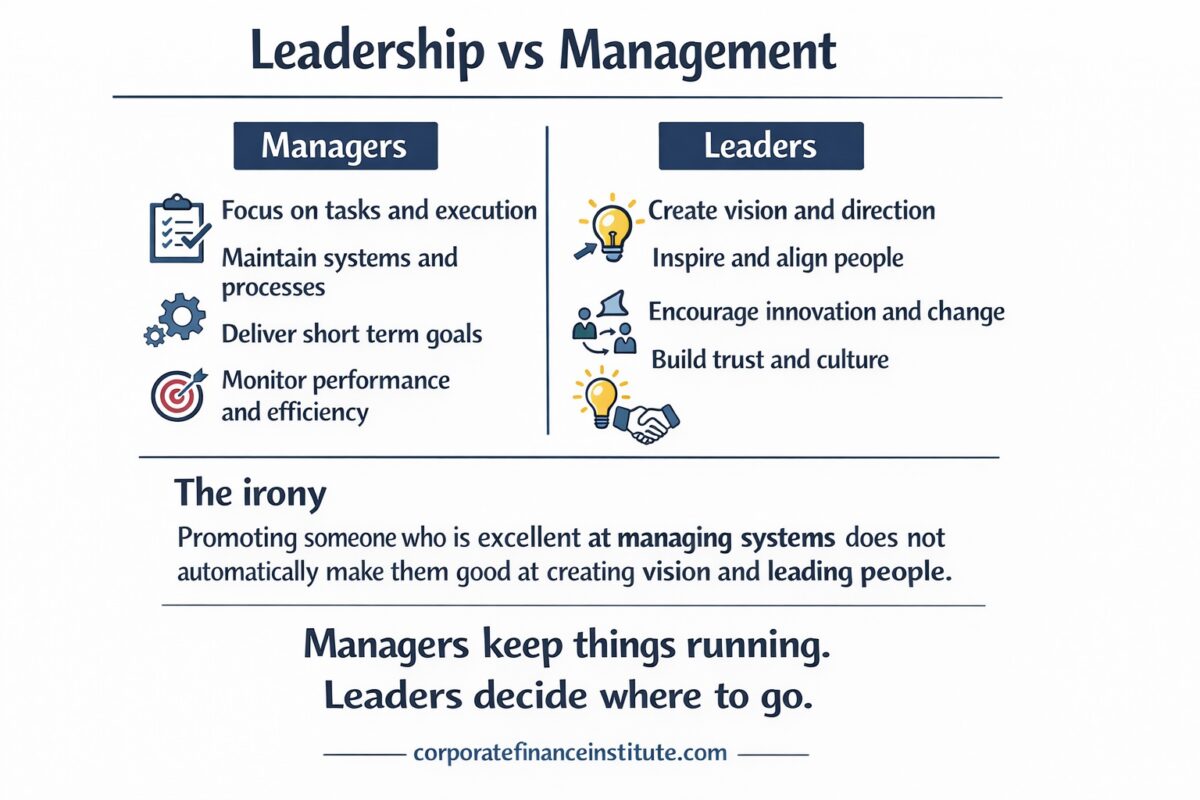
Management and leadership sound so similar that they are often used interchangeably. True, they are both a sport. But details matter when you want to win.
Nowhere is this more visible than in financial services. Banks today do not compete inside a known, stable competitive set. The threat landscape runs from a two-person fintech with a single brilliant product insight to a global technology platform with distribution at a scale no bank has ever matched. The competitive horizon is not quarterly. It shifts continuously, and the organisations that navigate it successfully are not the ones with the best execution machinery. They are the ones with genuine leadership capability, people who can see around corners, reorient the organisation before the corner becomes a wall, and build the kind of teams that remain effective when conditions change faster than any plan anticipated. In that environment the distinction between leadership and management is not an academic one. It is the difference between an organisation that adapts and one that optimises itself into irrelevance.
Most organisations have not built leadership capability. They have built something that resembles it closely enough to feel satisfied with, a hybrid of leadership and management that does the job of neither particularly well and leaves everyone quietly frustrated without being able to name why.
The frustration is real and it is widespread. Organisations promote their best managers into leadership roles and then watch, puzzled, as the same problems keep recurring. The promoted individual works harder than ever, attends every meeting, answers every escalation, drives every initiative forward with visible energy and effort, and somehow the organisation does not change. It moves. It does not change. There is a difference and it matters enormously.
The reason sits in a truth that is simple to state and genuinely difficult to act on. You cannot grow people by over nurturing them. Growth requires tension. It requires ambiguity. It requires the specific discomfort of being in a situation that exceeds your current capability and having to find your way through it without someone removing the difficulty on your behalf. Management, at its most well intentioned, does exactly that. It removes the difficulty. It resolves the tension. It fills the ambiguity with instruction. And in doing so it produces people who are entirely dependent on the continuation of those conditions, people who have been cared for rather than developed. Leadership understands this. It holds the tension deliberately. It resists the impulse to resolve what should remain unresolved long enough to do its work. Everything that follows is an attempt to explain what that difference looks like in practice and why so few organisations manage to sustain it.
1. The Rudder and the Propeller
A ship needs two things to go somewhere useful. It needs propulsion and it needs direction. The propeller pushes. The rudder steers. You can have an extraordinarily powerful propeller and still end up somewhere you never intended to go if the rudder is unattended. You can have perfect steering and go nowhere if the propeller stops. Both matter. They are not the same thing.
Management is the propeller. It converts energy into forward motion. It coordinates, it prioritises, it holds people accountable, it ensures that the agreed plan is executed with sufficient rigour that it actually happens. Good management is genuinely valuable and organisations that romanticise leadership while tolerating poor management usually pay a significant price for that indulgence.
Leadership is the rudder. It determines direction. It reads the water ahead. It makes the quiet, continuous adjustments that keep the ship on course as conditions change. And here is the problem that conflating the two creates: you cannot effectively tend the rudder while you are down in the engine room. The two activities require different positions on the ship, different attention, different awareness of what is happening around you.
Most organisations have unwittingly pulled their rudder operators into the engine room and are now wondering why the ship keeps drifting.
2. What Management Actually Is
It is worth being precise about this because management has been unfairly maligned in an era that fetishises leadership. Management is not a lesser discipline. It is a distinct one.
Management is predominantly task oriented work. It answers the question of what needs to happen next and who is going to do it and by when. It thrives on clarity, structure, and decisiveness. A good manager removes ambiguity from execution. They tell people what they need to do, ensure people have what they need to do it, and follow up when things fall short. This is not trivial. Organisations that lack management discipline leave talented people flailing in confusion, duplicating effort, and losing momentum on things that genuinely mattered.
But management operates from authority. The manager’s ability to direct is derived from their position in the hierarchy. When a manager says do this, the implied complement is because I am responsible for this area and I am telling you it needs to happen. That authority is legitimate and necessary. Without it, coordination collapses.
The limitation of authority is that it cannot create genuine understanding. It can create compliance. It can create movement. It cannot create the kind of shared comprehension that allows an organisation to navigate genuinely novel problems without constant direction from above. An organisation that runs entirely on authority is an organisation that stops thinking the moment the authority figure leaves the room.
There is one more quality of management that is worth naming clearly because it is often misread as a weakness when it is actually a feature. Management is contextual and isolated. A management decision that is entirely correct for one team in one situation may be completely wrong for a different team facing a superficially similar one. Management does not need to be universal. It needs to be right here, right now, for these people, on this problem. That specificity is what makes it effective. The mistake is assuming that because management works locally it can be scaled into something that substitutes for the broader, travelling thinking that leadership is supposed to provide.
There is also a gravitational relationship between management and the status quo that deserves to be named because it is almost never discussed honestly. Management naturally favours what already exists. It optimises the current system. It indexes heavily on how things feel in the present moment, on whether people are comfortable, whether the temperature in the room is manageable, whether the current equilibrium can be preserved. This is not incompetence. It is rational behaviour within the management frame, because management’s job is to make the current state work. The problem is that this instinct, left unchecked, produces precisely the outcome it was trying to prevent. Teams managed entirely for current comfort develop no tolerance for disruption. They are not safe. They are anaesthetised. There is a meaningful difference between the two and organisations that mistake one for the other pay for it the moment reality stops being polite.
3. What Leadership Actually Is
Leadership operates from content rather than authority. A leader’s ability to influence is derived from what they understand, what they can articulate, and what they can help others see that they could not see before. When a leader speaks, the implied complement is not because I said so but because here is how I understand this situation and here is why I think this matters and here is the question I think we are not yet asking.
This is a fundamentally different kind of influence and it requires a fundamentally different kind of work to produce.
Leadership requires thought. It requires reflection. It requires the willingness to sit with a problem long enough that you develop a genuine point of view about it rather than simply inheriting the conventional wisdom of the organisation. It requires reading, conversation, observation, and the kind of quiet processing time that does not appear productive in any visible sense but is in fact where leadership capacity is actually built.
Telling someone what to do is management. Helping someone think differently is leadership. Giving all the answers is management. Helping someone look in different places for better answers is leadership. Pushing is management. Changing the direction people are oriented toward is leadership.
The distinction sounds clean on paper. In practice it is enormously difficult to maintain because organisations are structured to reward the former in ways that are immediate and visible, while the returns on the latter are slow, diffuse, and hard to attribute.
There is a further dimension to leadership that management does not require and cannot replicate. A leader has to be able to speak with multiple voices. Not multiple personalities, multiple registers. The same understanding of a situation has to be translatable into the language of the engineer, the language of the commercial team, the language of the board, the language of the person who is frightened about what the change means for them specifically. This is not spin. It is the opposite of spin. It is the discipline of caring enough about your audience to meet them where they are rather than expecting them to come to where you are.
This requires empathy as a functional capability, not as a personality trait. A leader who can only articulate an idea in one way is a leader who can only include one kind of person in the narrative they are building. Everyone else is expected to translate for themselves, and many will not bother. Empathy in leadership is the work of genuinely understanding what someone else needs to hear in order to be included in a direction of travel that you already understand. It is the bridge between the leader’s comprehension and the organisation’s participation. Without it, leadership becomes a broadcast that most people receive as noise.
There is a discipline of sequencing that sits underneath all of this that separates leaders who genuinely develop thinking from those who merely perform the appearance of listening. Leaders go last. Not because their view is less important but because the moment a leader speaks first, the room recalibrates around that position. People who disagree quietly revise their answers. People who were uncertain find sudden agreement. The quality of thinking in the room collapses toward the leader’s starting point and the leader learns nothing they did not already know. Going last keeps the room honest. It surfaces the actual distribution of thinking rather than a polished reflection of the leader’s own.
But going last does not mean speaking softly when you finally do speak. When the leader contributes, the contribution should lead and correct. It should take what has been said, name what is being avoided, challenge the assumption underneath the apparent consensus, reorient the group toward a question nobody has asked yet. This is fundamentally different from censoring or instructing. Censoring shuts thinking down. Instructing replaces it. Leading and correcting extends it, challenges it, and points it somewhere more honest. A leader who goes last and then merely summarises what the room already said has wasted the only moment that required genuine leadership.
4. The Asymmetry
There is an important asymmetry here that most organisations get backwards. Managers can lead. Leaders should never manage.
A manager who, in a particular moment, helps a team member think differently about a problem, who asks a question instead of giving an instruction, who creates space instead of filling it, is doing something valuable and healthy. They are exercising a leadership instinct within a management role and the organisation is better for it. The direction of travel from management toward leadership is always available and always welcome.
The reverse is not true. A leader who collapses into management is not being helpful in a pinch. They are making a structural error that compounds quietly over time. Every time a leader answers the question that the organisation should have answered for itself, they are making the organisation slightly more dependent and slightly less capable. Every time a leader steps into a management vacuum rather than asking why the vacuum exists, they are deferring the real problem. The real problem is never the specific decision that needed making. It is the condition that produced an organisation unable to make it.
This is why the phrase servant leadership, popular as it is, requires careful handling. Service to an organisation does not mean doing whatever the organisation asks of you. Sometimes the most important service a leader can render is the refusal to rescue. The willingness to let the organisation sit with its own difficulty long enough to develop the capacity to resolve it.
Here is what actually happens when you promote a strong manager into a leadership role. For the first few weeks, perhaps the first few months, they attempt to operate at the level the role requires. They think about strategy. They have the bigger conversations. They ask questions rather than giving answers.
Then something breaks. An escalation arrives that nobody else is handling. A decision gets stuck in a committee that needs someone to break the deadlock. A team member is struggling and needs specific, concrete guidance right now. A project is drifting and the deadline is real. Each of these is legitimate. Each of these genuinely needs attention. And so the newly promoted leader handles it, because that is what they are good at, because it feels responsible, because the organisation visibly benefits in the short term, and because sitting with the discomfort of not intervening requires a kind of tolerance for organisational inertia that very few people have been taught to develop.
The organisation has natural inertia. Left alone, problems often resolve themselves, teams often find their own equilibrium, decisions often get made by the people closest to the information. Leaders who cannot sit with that inertia, who reach instinctively for management tools every time the organisation slows down, are not leading. They are preventing the organisation from developing the leadership capacity it needs below them.
This is the gravitational pull. Every escalation, every urgent decision, every visible problem is pulling the leader back toward the engine room. And the engine room is comfortable. It is familiar. It produces immediate, attributable results. It feels like doing something. Reflection feels like doing nothing, right up until the moment the ship runs aground.
5. The Organisation’s Role in All of This
It would be convenient if this were purely a personal failure, a matter of individual leaders lacking the discipline to stay at the rudder. The reality is more uncomfortable. Most organisations actively construct the conditions that produce it and then spend considerable energy being puzzled by the results.
The pattern is consistent and almost universal. Organisations ask their leaders to lead, once they have finished all the management tasks that are perceived to need doing by the most competent person in the room. The senior leader is the most capable, therefore the most urgent problems flow to them, therefore their time is consumed before the leadership work begins, therefore the leadership work never begins. The organisation has not asked someone to lead. It has asked someone to manage everything first and lead with whatever is left, which is nothing.
This is not malice. It is the logical output of low trust combined with high complexity. Organisations that do not trust the layers below them to handle difficulty will always route that difficulty upward. And the higher it routes, the more completely it consumes the people who should be doing something else entirely.
The consequences are visible to everyone and diagnosed by almost no one. Strategy disconnects from execution. The leadership appears preoccupied and remote. Initiatives stall at the point where senior judgment is required because senior judgment is perpetually occupied elsewhere. People mistake the symptom, a leader who seems unavailable or strategically vague, for a character problem rather than a structural one.
The organisation has sent someone to a football match in ice hockey gear. Even if they are an outstanding footballer, you will not see it in their performance. The kit is wrong, the conditions are wrong, and everyone is standing on the sideline wondering why the football looks so disappointing. The answer is not a better footballer. It is the right conditions for the one you already have.
6. The Gift of Silence
Leadership must embed discomfort. Not tolerate it. Not manage it. Embed it as a structural feature of how the team operates, because discomfort is the medium through which genuine growth moves. A leader who is not personally comfortable with discomfort cannot create the conditions for it in others. They will flinch at the last moment, soften the edge, rescue the feeling, and the team will learn from that flinching far more than from anything said explicitly. The leader’s relationship with discomfort is contagious in both directions.
There is one leadership capability that is almost impossible to develop inside an organisation that has confused leadership with management, and it is the one that builds the most durable teams. The ability to stay silent when everything in you wants to speak.
When a team loses badly, and every team loses badly eventually, the managerial instinct is to intervene immediately. To reframe the loss as a learning opportunity. To identify the positives. To motivate. To protect people from sitting too long in the discomfort of having failed. This feels like care and sometimes it is dressed as care. What it actually is, most of the time, is the leader’s own discomfort being managed at the team’s expense.
If you lose a game ten nil, it is entirely appropriate to be sad. It is appropriate to be frustrated. It is appropriate to sit with the specific, named feeling of having been comprehensively beaten and to let that feeling do its work. That feeling is not a problem to be solved. It is information. It is the emotional data that, if you allow it to land and be processed rather than immediately smoothing it away, produces the kind of honest assessment that actually improves performance.
Leaders who rescue feelings produce fragile teams. The team learns, not from any explicit instruction but from repeated experience, that difficulty will always be softened before it becomes too uncomfortable. They develop an expectation of rescue. They lose the tolerance for sitting with ambiguity, with failure, with the particular tension of a problem that has no clean resolution yet. When the rescue does not come, because eventually it cannot always come, they shatter rather than flex.
Leadership that allows people to feel what they feel, including the difficult and the dark, produces something entirely different. It produces teams that have an honest relationship with their own performance. Teams that can look at a ten nil loss without needing to explain it away, identify exactly where they fell short, carry the discomfort of that honestly, and then use it as fuel. Those teams are durable in a way that protected teams never are, because their resilience was built in conditions that resembled the conditions they will face again, rather than in a carefully maintained environment of managed comfort.
The gift of silence is not indifference. It is the deepest form of respect a leader can offer. It says I believe you are capable of holding this. It says I am not going to take this away from you because it is yours and it matters. It says I trust you to come through this without my intervention. That trust, communicated not through words but through the deliberate absence of rescue, is one of the most powerful things a leader can give.
7. Reflection as a Discipline
The reason most leaders end up doing management work is that reflection is not treated as a professional discipline in most organisations. It is treated as a luxury, something you do when you have cleared the backlog, which means you never do it because the backlog never clears.
Genuine leadership requires protected thinking time. It requires the willingness to disappear from the urgent for long enough to understand the important. It requires reading things that are not directly related to the current quarter’s objectives. It requires conversations with people outside your organisation, outside your industry, outside your usual frame of reference. It requires the occasional long walk with no agenda.
None of this appears on any project plan. None of it generates a status update. All of it is what allows a leader to develop the content that leadership actually runs on. A leader with no content has nothing to lead with. They fall back on authority, which means they are now managing, which means the organisation loses the directional thinking it actually needed from them.
The leaders who maintain genuine leadership capacity are the ones who treat reflection not as self indulgence but as a core professional responsibility. They protect the time. They explain why they are protecting it. They model, for the people around them, what it looks like to think before you act rather than acting to avoid having to think.
8. What This Confusion Costs You
The cost is not visible on any dashboard. It shows up slowly, in the texture of organisational life, in the kinds of problems that keep recurring, in the conversations that never quite happen.
Organisations where leaders have been pulled into management have leaders who know a great deal about what is happening and very little about why it keeps happening. They have sophisticated execution machinery pointed in directions that were chosen years ago and never genuinely revisited. They have talented people who have learned to wait to be told what to do next because the leader always arrives with the answer before anyone has had a chance to think. They have a kind of institutional learned helplessness that looks, from the outside, like a culture problem but is really a leadership problem.
Above everything else, they have fragile teams. Teams that have been protected from difficulty so consistently that they have never developed the emotional and cognitive calluses that durable performance requires. When something genuinely hard arrives, and it always does, these teams look to the leader for the rescue that has always come before. When the leader cannot provide it at the scale the moment requires, the whole system wobbles in ways that seem disproportionate to the triggering event. The fragility was always there. It was just never stress tested until it mattered most.
This is the deepest irony of all this and it is worth sitting with. Management optimises for safety. It protects people from discomfort, shields teams from hard feedback, smooths over the friction of failure, keeps the emotional temperature in a manageable range. And in doing all of that, it produces the least safe teams imaginable. Teams with no exposure to the conditions they will inevitably face. Teams whose apparent stability is entirely dependent on the continued presence of the person managing it. Remove the manager, change the conditions, introduce genuine adversity, and the safety turns out to have been a performance all along. Leadership that embraces discomfort, that builds unsafe teams in the deliberate sense, produces something that survives contact with reality because it was trained in conditions that resembled it.
They also have leaders who are exhausted. Doing two jobs simultaneously, neither as well as either deserves, is genuinely depleting. This trap does not just cost the organisation. It costs the individual carrying it.
9. Can You Actually Cultivate Leadership Culture?
This is the question underneath everything else and it deserves a straight answer rather than another framework.
The instinctive organisational response to a leadership deficit is to layer. Bring in more senior people. Create new leadership tiers. Assemble a broader set of voices in the hope that the aggregate of many opinions will somehow produce the clarity that individual leaders have failed to generate. It rarely works, and the reason is everything this piece has already argued. If the conditions that prevent leadership from operating are structural, adding more people to those conditions produces more people caught in the same trap. You have not grown leadership culture. You have grown the management overhead required to coordinate a larger group of people who are too busy managing to lead.
The honest answer is that you cannot install leadership culture. You cannot buy it, hire it in bulk, or mandate it into existence through a values framework on a wall. You can only grow it, and growing it requires creating the conditions in which it can develop and then trusting that the people you already have are capable of rising into those conditions if you stop filling all the space.
This means building organisations that tolerate silence after failure rather than rushing to reframe it. It means protecting thinking time as a non-negotiable rather than a reward for clearing the backlog. It means routing fewer problems upward and sitting with the discomfort of watching layers below work through difficulty rather than resolving it on their behalf. It means hiring for the capacity to think rather than the capacity to execute and then actually letting people think. It means going last when you speak and meaning something when you do.
For banks specifically, this is not optional. The bootstrapped fintech does not have a management hierarchy to navigate. The global platform does not ask permission before it enters your market. The competitive asymmetry is real and it is accelerating. The only meaningful response is an organisation that can see clearly, adapt quickly, and develop the next layer of leadership before it needs it rather than after. That organisation is not built through better management. It is built by leaders who understand the difference, protect the conditions that make it possible, and resist the gravitational pull of the engine room long enough to actually steer.
The ship will keep moving. Ships with good engines tend to do that. The question is whether anyone is steering, and whether the organisation has created the conditions for someone to learn how.