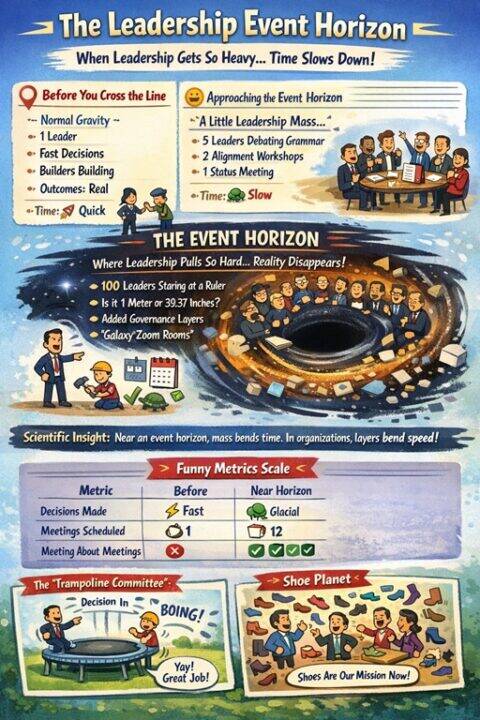
1. The Shoe Planet Problem
In The Hitchhiker’s Guide to the Galaxy, there is a planet where the inhabitants become so obsessed with shoes that the shoes eventually take over. The civilisation does not collapse because it lacks intelligence. It collapses because something peripheral accumulates mass until it dominates everything essential.
Leadership bloat is the corporate equivalent of that shoe event horizon.
Leadership is necessary. Direction matters. Coherence matters. But beyond a certain density, leadership stops orbiting the work and begins consuming it. The organisation crosses an invisible boundary where supervising value creation becomes more important than value creation itself.
That boundary is the leadership event horizon.
2. The One Metre Ruler
Imagine hiring one hundred leaders to stare at a one metre ruler.
How long is it?
One metre.
Will they agree?
Eventually. After workshops. After alignment sessions. After someone reframes the definition of measurement. After governance confirms the interpretation of length. The ruler does not change. Reality does not move. What expands is the interpretive machinery around it.
What did the hundred leaders change? Not the length. They changed the cost base. They changed the latency of decision making. They changed how long it now takes to say something obvious.
Near an event horizon, mass bends time. In organisations, layers bend speed. The more leadership mass you add, the slower information travels. By the time clarity moves up and back down the hierarchy, the market has already moved.
3. When the Shoes Take Control
In the Hitchhiker universe, the tipping point is subtle. People are still discussing shoes, improving shoes, optimising shoes. Only later does it become clear that the accessories are now in charge.
In business, we hire leaders to coordinate teams. Then we hire leaders to coordinate those leaders. Then we create forums to align the coordinating leaders. Each step feels responsible. Collectively, they create gravitational pull.
At some point, the business exists to sustain its leadership ecosystem rather than to win in its market. The org chart becomes the product. Ritual replaces output. The shoes are no longer worn. They are curated.
4. Sectionalising the Galaxy
To manage complexity, we subdivide the business into smaller domains. Each segment gets its own leader. Each leader builds a reporting structure. Each structure develops language, metrics, and boundaries that reinforce autonomy. Internally, this feels like precision. Externally, it feels like fragmentation.
The client does not experience your segmentation model. They experience one product, one service, one brand. Internally, multiple leaders debate which micro domain owns the button the client just pressed. Every boundary introduces a negotiation. Every negotiation introduces delay. The galaxy becomes a federation of guarded territories rather than a coherent competitive force.
Sectionalisation increases interfaces. Interfaces increase friction. Friction reduces speed.
5. Comfort as Gravity
Leaders often hire people they feel comfortable with. People who speak the same conceptual language. People who understand the politics. People who can sit in a room and have sophisticated conversations about alignment and transformation.
But filling rooms with people you enjoy conversing with is not a business model. It is a social structure with a payroll.
Comfort attracts more comfort. The organisation gradually optimises for internal fluency rather than external performance. The gravitational mass increases. Escaping becomes harder.
6. The Fifty Metre Paradox
There is a particular species of gravitational collapse that deserves its own classification.
An executive hires a business head to prioritise and align what a team is doing. That team sits less than fifty metres from the executive’s office. The team already has a leader. That leader already has a mandate. That mandate was, in most cases, given by the same executive who just hired the business head.
What follows is predictable. Two structures now orbit the same work. Both need to understand it. Both need to articulate it. Both need to feel heard. Workshops are convened. Alignment sessions are scheduled. Vocabulary is negotiated. And after weeks of structured convergence, both sides arrive at exactly the same conclusion the team started with.
The executive feels comfort. Two independent hierarchies have validated the same direction. This feels like rigour. It feels like governance. In reality, it is the organisational equivalent of asking someone to confirm that the clock on the wall matches the clock on your wrist.
But the real cost is hidden below. The teams responsible for serving both structures now maintain dual reporting formats, synchronised decks, parallel status updates. Builders become translators. Engineering hours evaporate into PowerPoint. Every sprint loses capacity not to delivery, but to the overhead of proving to two audiences that the same thing is still the same thing.
The work does not move faster. The team does not gain clarity. What grows is the administrative mass required to keep two gravitational centres from visibly contradicting each other.
Fifty metres. Same floor. Same building. Two reporting lines. Zero additional insight.
7. The Trampoline Committee
There is a governance structure so perfectly circular that it deserves a name. Call it the trampoline committee.
A group of senior leaders convenes to review and debate decisions. The decisions were made by their subordinates. Their subordinates are the subject matter experts. They built the systems, analysed the data, assessed the risk, and arrived at a recommendation based on years of domain knowledge the committee does not have.
The committee examines the decision. They do not understand it. This is not a criticism of their intelligence. It is a structural inevitability. They were not hired to understand the detail. They were hired to lead at a level above it.
So they ask questions. Reasonable questions. Probing questions. Questions that feel like oversight. And who answers those questions? The same subordinates who made the decision in the first place. The experts explain the decision. The committee listens. The experts explain it again in different words. The committee nods. The decision is approved. Unchanged.
The decision bounced up, hit the committee, and bounced back down exactly where it started. A trampoline. Energy expended, altitude achieved, net displacement zero.
Nothing was improved. Nothing was caught. Nothing was redirected. The only measurable output is that delivery slowed by whatever elapsed time the committee cycle consumed. Two weeks. Four weeks. Sometimes longer, if the calendar gods are unkind and the committee only sits monthly.
Trampoline committees exist because they feel like control. Executives feel they have exercised judgement. Governance frameworks can point to an approval step. Auditors can see a signature. But the signature confirms what was already confirmed by the people who actually know.
The most telling sign of a trampoline committee is this: if you removed it entirely, nothing downstream would change. The same decisions would be made. The same outcomes would follow. The only difference is they would arrive faster.
8. Less Than Nothing
Beyond the leadership event horizon, adding another leader does not increase clarity. It increases drag.
Decision cycles lengthen because authority is distributed across more layers.
Accountability diffuses because responsibility becomes collective and abstract.
Cost compounds because senior salaries require disproportionate impact to justify their existence.
Layering leaders on leaders achieves less than nothing when it slows the builders. It is not neutral overhead. It is competitive disadvantage.
9. Escaping the Event Horizon
The problem is not leadership. The problem is inversion of priorities.
Competitive organisations are ruthless about identifying the real constraint. If the constraint is engineering throughput, hire engineers. If the constraint is product clarity, hire product thinkers. If the constraint is distribution, hire market makers. Do not reflexively hire supervision when the bottleneck is production.
Strong leadership often manifests as fewer layers, clearer mandates, wider spans of control, and a bias toward builders over commentators. The aim is not to eliminate gravity. The aim is to prevent collapse.
Markets reward output, speed, and coherence.
No number of leaders staring at a one metre ruler will make it any longer.
Andrew, such insighful writing and food for thought. Your angle removes so many layers. Great teachings too, I reckon you could masterclass a number of your messages haha.
I thoroughly enjoy your refreshing content and celebrate Capitecs creativity, smart design, calculated tech adoption and customer centric product. Old age ‘what a time to be alive!’ A technologists dream!
One day I will catch the hand held payment receipt.
All the best in your role as the CIO.
Staying tuned!