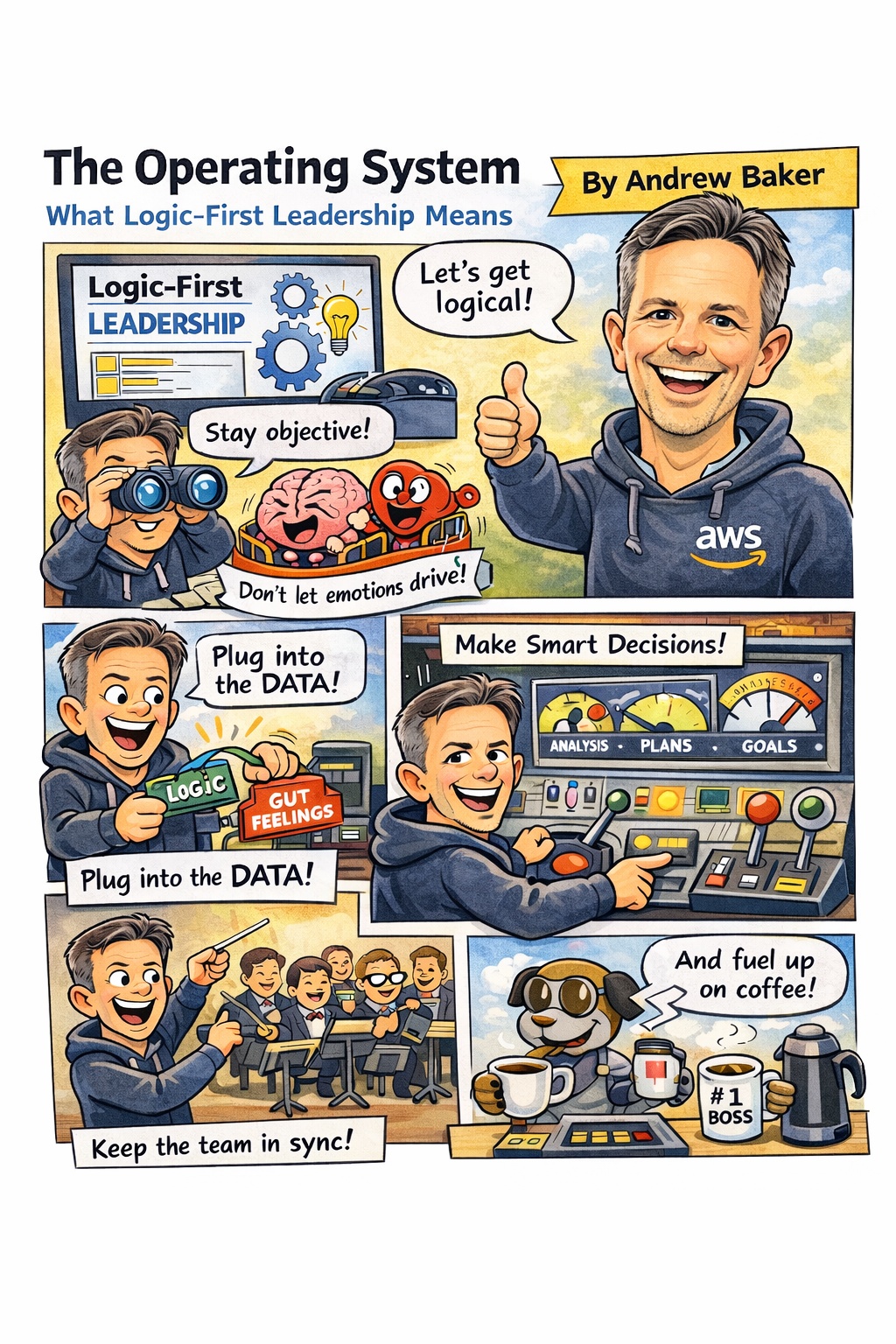
1. The System That Built Everything
I have spent my entire career inside a single operating system. Logic first. Reality over narrative. Strip the problem down, find the root cause, fix it, move on. Do not waste time on feelings that will resolve themselves once the facts are clear. Do not slow down for comfort when speed determines survival. Do not invest in relationships that might not last when the work is more important than the warmth.
This operating system built everything I have professionally. It is why I can walk into a team that has been failing for years and diagnose the problem in hours. It is why I can strip away defensive process without flinching. It is why I can take on twelve teams in eighteen months and produce results that border on miraculous. It is why I survived algorithmic trading floors, banking crises, and 40 hour production outages without losing my nerve.
It is also why it has costs beyond work.
This article is the one I have been avoiding. It is not about teams, architecture, or corporate culture. It is about the cost of being the person who fixes those things, and about discovering, very late, that the system I relied on was never a choice. It was the only way my brain knew how to work.
2. Logic as Armour
I dealt with significant difficulties in my childhood. The details are not relevant here, but the consequence is. I learned early that emotions were a vulnerability, that the world did not care about your feelings, and that the people who survived were the ones who could see reality clearly and act on it without hesitation. Harden up. Process the facts. Move forward.
This became more than a coping mechanism. It became my entire operating model for life. At work, it was devastatingly effective. I could sit in a room full of politics, blame, and fear, and cut straight to the problem because I was not distracted by any of it. I could make unpopular decisions quickly because I was not weighed down by the social cost of making them. I could be direct, honest, and relentless because I had trained myself to believe that directness was a gift, even when it landed like a weapon.
And there is the first lie you tell yourself as a direct person. You badge it as honesty. “I speak my mind.” “I tell it like it is.” But what you are actually saying, if you are honest about the honesty, is “I do not care how this lands. Deal with it.” That is not strength. That is the absence of something, dressed up as a virtue.
The trouble is that it works. People who operate this way get results. They get promoted. They get brought in to fix things that are broken. And every success reinforces the system, making it harder to see the damage that runs quietly underneath it.
3. The Universal Application Problem
I sincerely believed, for most of my adult life, that logic was the highest order primitive. That feelings were downstream of facts, and that if you could help someone see reality clearly, the emotional turbulence would resolve itself. You would not need to manage emotions if you could manage truth.
I am the same person everywhere. I do not have a work persona and a separate persona outside of work. What you see in a boardroom is what you get everywhere else.
This consistency, which I considered a virtue, created its own set of problems. When someone is in pain and your response is to explain why the pain is not logical, you are not helping them see reality. You are telling them that their reality does not count. I did not understand this distinction for a very long time.
The operating system that made me effective professionally turned out to have significant limitations in contexts where different skills were required. Getting this wrong in personal relationships hits differently from getting it wrong at work. There is no retrospective clever enough to make this feel like a lesson rather than a wound.
4. The Capitec Chapter
When I joined Capitec, the organisation needed a radical shift in how it managed technology. There were rolling outages, significant risks, and an urgency that was impossible to overstate. I was more than happy to drop the niceties and get stuck in.
But I need to be honest about what was happening underneath the urgency. I did not invest in relationships deliberately, and the reason was not purely strategic. Part of me calculated that if it did not work out, if I left or was asked to leave, it would hurt less if I had not built connections. You can walk away from a job. Walking away from people you care about is a different thing entirely. So I kept the distance, told myself it was necessary, and used the crisis as justification for something that was actually self protection.
What we achieved in that period was extraordinary. But it was totally unsustainable. I cared deeply about the outcomes, but I did not allow my feelings to influence my behaviour at all. I operated as pure logic with a human body attached, and I paid for it with my health.
There was a second driver that I have never written about. I had unresolved feelings of disappointment about how a previous employer had treated me, and part of what fuelled the intensity at Capitec was a desire to build something so good that it would serve as a repudiation. I wanted to prove a point. That is an extraordinarily powerful fuel source and it is also poison, because the work stops being about the work and starts being about winning an argument with people who are probably not even watching.
Revenge dressed as ambition will get you further than almost any other motivator. It will also hollow you out if you let it run too long.
5. The Discovery
Late in life, I discovered that my brain is wired differently from most people. It explained everything. The logic first processing. The difficulty understanding why emotional responses did not simply resolve when presented with facts. The ability to hyperfocus on complex problems for sustained periods while struggling to divide attention across competing demands. The strong sense of fairness and rigidity that makes me exceptional at analytical problem solving and genuinely difficult in certain contexts.
What sounds obvious from the outside was invisible from the inside. I never felt different. I felt like the one person in the room who could see clearly while everyone else was being inexplicably emotional, irrational, and strange. I thought everyone else was weird. It never occurred to me that from their perspective, I was the one who was different. This, I now understand, is a Theory of Mind problem, and recognising it was liberating. Things that never made sense suddenly did, and with a fuller framing of the bigger picture it became much easier to adapt.
When I was twenty, a girlfriend’s mother nicknamed me “Android.” Not the phone. The robot. I carried that for over thirty years as an amusing anecdote, a slightly harsh but basically affectionate observation. It was not an anecdote. It was a diagnosis delivered three decades early by someone who could see what I could not.
I had spent decades assuming this was a personality I had built, a set of choices I had made, a system I had designed through discipline and experience. It was not. It was architecture. And like all architecture, it has strengths that are inseparable from its constraints.
The logic first approach got extraordinary results, and those results reinforced the system so completely that I stopped being able to distinguish between my thoughts and my feelings. My feelings became the sum of my thoughts. If the logic was sound, the feeling was correct. If the logic was clear, the emotional response was settled. This worked for decades, and it produced a person who was extraordinarily effective and almost entirely opaque to the people who needed something different from him. If your feelings are fully defined by logic, what are you? The answer that “Android” nickname was reaching for turns out to have been uncomfortably precise.
The directness that makes me effective in a crisis is the same directness that causes harm when the situation calls for patience rather than clarity. The ability to detach from emotion during high pressure events is the same detachment that does not work in contexts that require different skills. The relentless focus that lets me transform twelve teams in eighteen months is the same focus that made me unable to see the cost accumulating in every other part of my life.
These are not different traits. They are the same trait, producing different outcomes in different environments. The operating system does not have a mode switch. It runs the same way everywhere. And when you do not know that, when you believe you are choosing to be this way rather than being built this way, you cannot see the edges where the system fails because you assume you can simply choose differently when it matters. You cannot.
6. What Directness Actually Is
I want to return to directness because it is the trait I am most known for and the one I understand least honestly.
People who are direct often frame it as a service. I am giving you reality early enough that you can respond before it is too late. I am protecting you from a world that treats failure ruthlessly. I am not being cruel. I am being kind in a way that does not feel kind yet.
Some of this is true. Some of it is rationalisation. The honest version is that directness, the way I practice it, contains a core of “I do not care how this lands” that I have spent years dressing up as courage. Nobody ever bemoans winning in the long run. But there is always harm in the process of survival, and ignoring that harm, telling yourself it was necessary, treating the people who were hurt as acceptable collateral in a larger mission, makes you an arsehole. I say this with full understanding that I am describing myself.
The best leaders I have observed are direct and aware of the damage simultaneously. They do not choose one or the other. They hold both. I am still learning to do this, and I am learning it much later than I should have.
7. Logic Is Not Enough
I was recently given a piece of advice that is probably obvious to everyone else, but it caught me off guard.
If you have a strong logic bias, you explain the facts. You listen to responses. You refine the model. Eventually you arrive at a shared understanding of the problem. That feels sufficient. Clarity achieved. Alignment earned.
The assumption underneath this approach is simple: present the facts and let rational adults decide how to feel about them. But here is what I learned. If you want people to feel safe, clarity alone is not enough. It is not sufficient to present the facts and allow everyone to independently derive their emotional response. You have to be intentional about the emotional frame. You have to decide how you want them to feel about the facts.
Without that framing, ambiguity creeps in. Is this a crisis? Is this blame? Is this opportunity? Is this threat? If the leader does not shape that interpretation, the room will.
I had never consciously considered helping people choose the appropriate feeling before. I assumed reason would be enough. But helping people anchor emotionally is not manipulation. It is leadership. It removes unnecessary ambiguity. It builds trust. It increases signal and reduces noise.
Logic first leadership does not mean emotionless leadership. It means sequencing correctly. Lead with reason. Then anchor the emotional posture from which the team should act. Calm. Focused. Accountable. Curious. Determined. This level of intentionality is an upgrade to the operating system. Not a retreat from logic, but a completion of it.
8. We Bleed First
There is a principle I have operated by for a long time that I have never named publicly until now. We bleed first.
Most organisations, when something goes wrong, find a way to make the client absorb the cost. It is rarely explicit. It is structural. It happens through the architecture of pricing, through the age of the technology stack, through a culture that has normalised operational failure as someone else’s problem.
Look at how most banks price their products. The margin is built to cover inefficiency. The organisation cannot control its headcount, cannot rationalise its cost base, cannot decommission the systems that are running their operational risk into the ground, so it prices the gap away. The client pays for the dysfunction they cannot see. The organisation calls this sustainable business practice. It is not. It is a slow extraction dressed as a service model.
Look at fraud. The scammers move faster than almost every institution because the scammers have no legacy. They wake up every morning with a clean sheet. Most banks wake up every morning with a stack of vendor dependencies, upgrade cycles measured in quarters, and a security posture that was designed for a threat landscape that no longer exists. When the client gets hit, the institution absorbs some of the loss and calls it a fraud write off line. The rest lands on the client. The real cost, the experience of being defrauded, the hours trying to recover, the erosion of trust, that never appears on any balance sheet. The organisation has externalised its technical debt directly into the lives of the people it is supposed to serve.
Look at outages. If your systems go down at midnight on a Friday and your clients cannot access their money, you have not had an operational incident. You have had a betrayal. The conversation that follows internally, the post mortem, the root cause analysis, the executive update, that entire apparatus exists to process the event as a business problem. The client processed it as a personal emergency. These are not equivalent experiences and we should stop pretending the paperwork makes them equal.
The logic first version of me wants to frame all of this as a systems problem. And it is. But the deeper issue is one of will. The organisations that let clients absorb the cost do so because the internal incentive structures do not punish it sufficiently. Nobody loses their bonus because a client had a terrible week. The pain is distributed outward and the metrics look acceptable.
If you actually want happy clients, you have to reverse the direction of the pain. You take the hit first. Your pricing reflects your efficiency, not your inefficiency. Your fraud prevention moves faster than your roadmap cycle because you have made it structurally impossible to fall behind. Your systems are modern enough that an outage is a genuine surprise rather than a scheduled embarrassment.
This posture creates significant internal tension. The moment you start arguing that the client should not absorb the organisation’s cost failures, you will be told that this is how it has always worked. You will be told the numbers do not support it. You will be positioned as unreasonable, as someone who does not understand the commercial realities, as a person who is making simple things complicated. These conversations are not comfortable and you will not be popular while you are having them. You are opening hot topics that have been deliberately left closed because closing them was easier than solving them.
Stay in it. The friction is not a signal that you are wrong. It is a signal that you are threatening something that has worked well enough for a long time and that the people who built it do not want to see it restructured. That is a different thing entirely.
What you have to be careful about is the season. The period of fighting for your clients, of absorbing the cost, of taking the weight that should never have been passed to them in the first place, that is not a permanent operating mode. It is a transitional one. You do it until your clients are being properly served. You do it until the pricing reflects genuine value, the fraud controls are ahead of the threat, and the systems are stable enough that reliability is expected rather than celebrated. Once you get there, you transition out of the season. You cannot run an organisation indefinitely on the energy of fighting for what should have been baseline. You normalise it and you move on.
But you have to go through the season first. And most organisations never do, because the people who would have to absorb the cost internally are the same people deciding whether to absorb it. That conflict of interest is the real reason clients keep bleeding.
We bleed first is not a slogan. It is a test of whether the organisation’s loyalty runs in the direction it claims. Most of the time it does not, and the gap between the stated values and the structural reality is where client trust goes to die quietly over many years.
9. Things I Carry
There are decisions from earlier in my career that I carry silently and will probably never explain publicly. They are not lessons. They are not stories with clean endings. They are weights that sit in a place where analysis cannot reach them.
I mention this not to be mysterious but to be honest about something that leadership literature almost never acknowledges: some experiences do not convert into wisdom. They do not become anecdotes for a keynote or frameworks for a blog post. They just stay with you, unresolved, and the best you can do is make sure they inform your judgment without consuming your identity.
The pressure to turn every difficult experience into a narrative with a redemptive arc is immense, especially for people with public profiles. Resist it. Some things are just hard, and pretending they made you better is its own kind of dishonesty.
10. What I Would Tell a Younger Version of Myself
I do not allow retrading. I made the best calls I could each day with the information I had, and I trust that the version of me who woke up each morning did the same. I would not change a thing, because changing anything requires a crystal ball, and if I had one of those I would not need to work in the first place.
But if I could whisper something to the version of me who was building his career and building his identity around the conviction that logic would solve everything, it would be this: the system works brilliantly and it has edges you cannot see yet. The things it cannot process are not weaknesses in other people. They are gaps in you. And by the time you discover them, the cost will already be significant.
You are not choosing to be this way. You are built this way. That does not excuse the damage, but understanding it earlier would have let you build compensating structures sooner, not for work, where the system performs beautifully, but for the contexts where logic alone is insufficient.
11. Why I Am Writing This
I write about corporate culture, leadership failure, and organisational dysfunction with a confidence that borders on contempt. I have torn apart frameworks, methodologies, and leadership archetypes with precision and, if I am honest, with enjoyment.
It would be dishonest to continue doing that without turning the same lens on myself. Not in the charming, self deprecating way of asking ChatGPT to write about why I am the world’s worst CTO. That was fun and it was also armour. This is different.
This is an acknowledgment that the operating system that built my career did not work everywhere I applied it. That the logic first worldview which makes me effective in a crisis is not what is needed in the places where effectiveness is the wrong metric. That directness, stripped of empathy, is just aggression with better vocabulary. And that discovering, very late, why I am wired this way has not fixed anything, but it has given me a framework for understanding the failures that no amount of intelligence could prevent.
Intelligence asks can we do this. Wisdom asks should we do this. I wrote those words in a previous article and believed them completely. What I did not say is that I spent most of my life trapped in the first question, and the second question only became visible after the cost had already been paid.
12. The System Still Runs
I have not totally changed the operating system, I do not know if I can. Logic is still the first thing that fires. Directness is still my default. Hyperfocus still consumes me when a problem is interesting enough, and the people around me still have to wait until the focus releases.
What has changed is that I know the system has edges. I know that what feels like clarity to me, can feel like dismissal to someone else. I know that the ability to detach from emotion is a tool, not a virtue, and that deploying it in every context is not the same as deploying it in a war room. I know that some people need to be heard before they need to be fixed, and that hearing them is not a waste of time even when the fix is obvious.
I am not good at any of this yet. But I am aware of it, and awareness is the precondition for change, even if change is slow, uneven, and nowhere near complete.
The operating system still runs. It still builds extraordinary things. And it still has a cost. The difference is that I can see the invoice now, and I am no longer pretending it does not exist.
Andrew Baker / 11 February 2026 / Corporate Culture