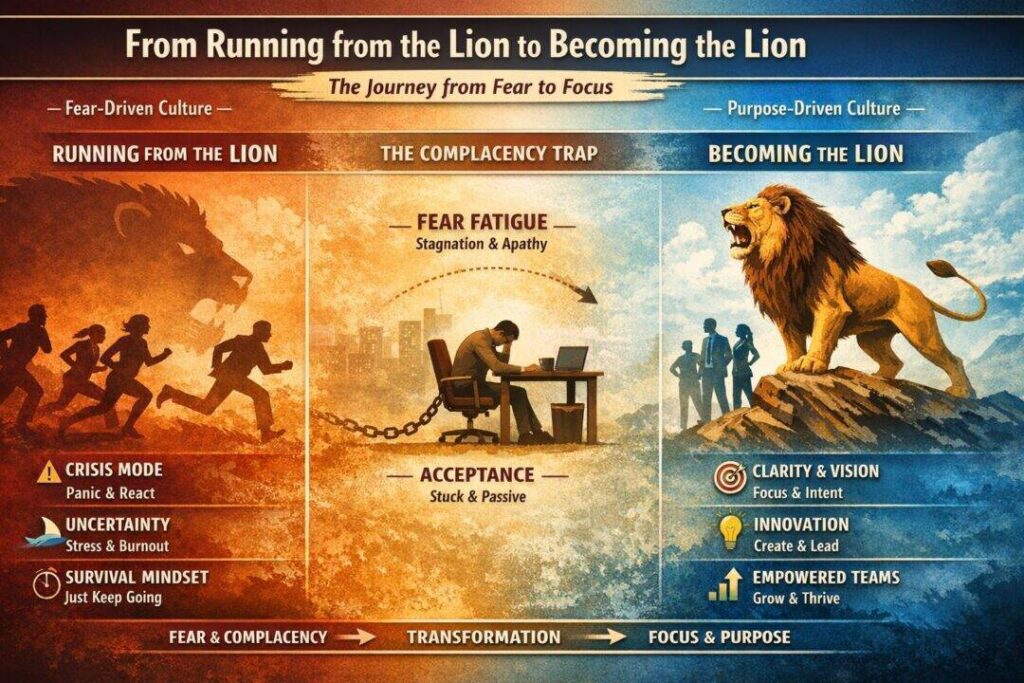
Corporate Culture: From running from the Lion, to becoming the Lion
1. Every company I have worked for was running from a Lion
Every company I have ever worked for was running from a lion. Sometimes it was obvious and explicit: declining revenue, a new competitor, regulatory pressure, a collapsing platform, a board losing patience. Sometimes it was quieter and more personal: a role under threat, a team being “restructured”, a mandate with a six month half life. But the pattern was always the same. There was an existential threat somewhere in the room, even if nobody wanted to say it out loud.
Fear became the background radiation of the organisation. Decisions were framed as survival moves. Roadmaps were rewritten to “buy time”. Strategy decks were really just elaborate ways of explaining why today would not be the day the lion finally caught us. When you live like that for long enough, you stop questioning whether this is a healthy way to operate. You just assume this is what work feels like.
2. Fear is a finite motivator
Fear is powerful, but it is not infinite. It works exceptionally well in short bursts. If you jump into the ocean and a shark starts circling you, every neuron in your body lights up. You will paddle, kick, scream and invent new muscle groups you did not know you had. Fear sharpens focus and compresses time.
But fear has a shelf life. If you have been in the water for two weeks and the shark has not eaten you, something changes. The terror dulls. You start naming the shark. You learn its patterns. It stops being an immediate threat and starts becoming part of the environment. At that point the shark is no longer your executioner. It is your pet.
This is where many companies quietly break. They do not escape the lion. They simply get used to it. Fear mutates into resignation, then into ritual. Status reports, steering committees and “transformation programmes” become coping mechanisms, not solutions. People stop asking how to win and start asking how to survive without being noticed.
3. Trauma or acceptance: the two dominant corporate states
Once fear runs out, organisations tend to fall into one of two states.
The first is trauma. Everything feels urgent, but nothing is coherent. Decisions are reactive. Leaders shout about agility while adding layers of approval. Teams are burned out but still told to “push harder”. The lion is always seconds away, even if it has been chasing the company for five years and never quite closing the gap.
The second is acceptance. This is quieter and more dangerous. People accept that decline is inevitable. Innovation becomes cosmetic. Metrics are chosen to flatter rather than inform. The lion is no longer discussed because everyone has already made peace with being eaten, just not today.
Most large organisations oscillate between these two states, mistaking motion for progress and endurance for strategy.
4. The uncomfortable truth about your competitors
Here is the part most companies miss: even the organisations threatening your existence are running from their own lions. The market leader fears disruption. The disruptor fears regulation. The startup fears running out of cash. The giant fears becoming irrelevant. There is no finish line where the lion disappears forever.
The difference is not whether a lion exists. The difference is whether the organisation defines itself as prey or predator. Prey organisations optimise for escape. Predator organisations optimise for strength, position and intent. One is reactive by design. The other is deliberate, even under pressure.
Becoming the lion does not mean becoming ruthless or reckless. It means shifting from fear driven movement to purpose driven action. It means choosing where to run, who to chase and, critically, when to stop running altogether.
5. Seasons, not strategies
The hardest thing to do in any company is to transition between seasons. To run when you need to run, hunt when you need to hunt, laugh when you need to laugh and cry when you need to cry. Too many companies have institutionalised fear. Even when the season shifts around them, they do not acknowledge it and they do not react to it.
When it is your turn to be the lion, be the lion. When it is your turn to run, then run. Do not confuse bravery with stubbornness or caution with cowardice. The most amazing companies in the world can spin on a dime, moving from reacting to risk to chasing revenue, from dominating competition to enduring compression.
Whatever your leadership does, it needs to be able to shift. In the world we are moving into, you may be running from a lion in the morning and chasing impalas in the evening. Strategy that cannot change tempo is not strategy at all, it is inertia with better branding.
6. From running to choosing
The real transition is psychological, not structural. It is the moment an organisation stops asking “How do we avoid dying?” and starts asking “What game are we actually trying to win?” That shift changes how strategy is formed, how people are rewarded and how risk is understood. Survival is no longer the goal; it is merely the baseline.
If you are in a fear driven company, there is one thing you should understand clearly: compression is coming. It always does. It will not stop until leadership is durable and wise enough to respond to the waves of volatility that are now a permanent feature of the world.
Most companies never make this transition. They stay fit enough to keep running, but never strong enough to turn around. And in doing so, they condemn themselves to a lifetime of being chased by increasingly imaginary lions.
The irony is brutal but simple: the lion you are running from is probably just as scared as you are. The moment you realise that, you have a choice. Keep running until fear turns into numbness, or stop, turn around, and decide to become the lion.