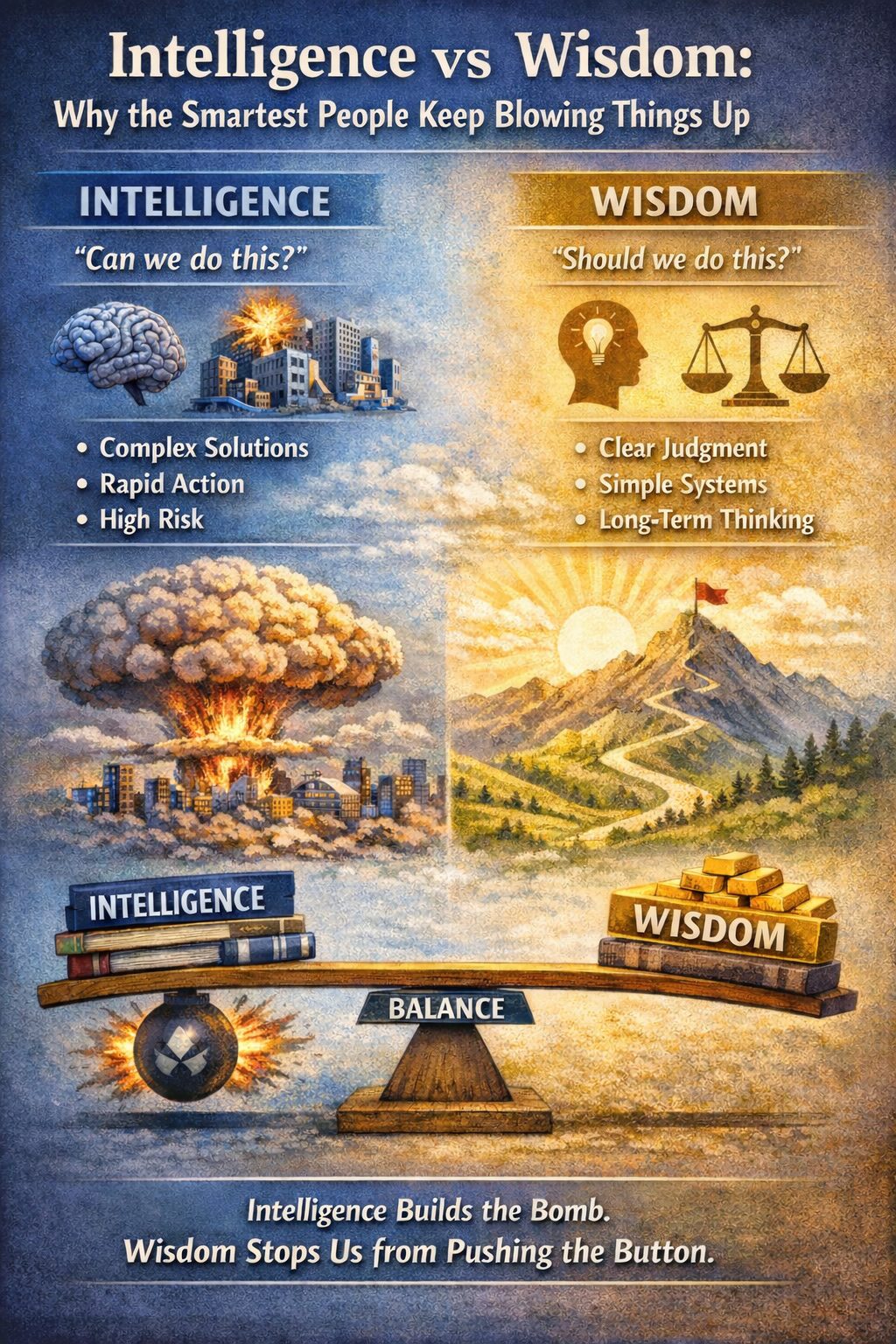
Intelligence vs Wisdom: Why Smart Systems Keep Failing

Intelligence answers "can we do this?" while wisdom answers "should we do this?" Smart systems fail when they optimise for capability without judgment. The 2008 financial crisis exemplifies this: brilliant engineers built instruments too complex to fully reason about. High intelligence without wisdom produces sophisticated mistakes at scale, not better outcomes.
Intelligence vs Wisdom: Why Smart Systems Keep FailingAndrew Baker's Technology Blog Posts, 29/Jan/2026
https://andrewbaker.ninja/2026/01/29/intelligence-vs-wisdom-why-smart-systems-keep-failing/
1. Definitions First (Because This Matters)
Intelligence is the ability to acquire knowledge, process information, identify patterns, and solve problems. It answers the question: Can we do this?
Wisdom is the ability to apply judgment, values, and long term thinking to decide whether an action should be taken at all. It answers the question: Should we do this?
That distinction is not academic. It is structural. Confusing the two is how complex systems fail.
2. Intelligence Built the Subprime Nuclear Warhead
The global financial crisis was not caused by stupidity. It was caused by intelligence in excess. Some of the most mathematically gifted people on the planet engineered financial instruments so complex that even their creators struggled to reason about their full consequences. Mortgage backed securities, collateralized debt obligations, synthetic derivatives layered on top of synthetic derivatives, all justified by models that quietly assumed tomorrow would behave like yesterday. These intellectual heavyweights invented the NINJA loan (No Income, No Job, No Assets). NINJA loans were a major component of the subprime mortgage pools that were eventually repackaged into AAA-rated CDOs. This process, often called “recycling risky debt,” allowed Wall Street to transform low-quality loans into top-tier investment assets. Pure genius, right.. what could possibly go wrong?!
The smartest people in the room created a financial nuclear warhead and then seemed genuinely surprised when it detonated. The models worked. The math was elegant. The intelligence was extraordinary. What was missing was wisdom. No one paused to ask whether concentrating systemic risk, disguising fragility as diversification, and separating lending from human reality was a good idea in the first place.
Intelligence asked can we price this risk. Wisdom would have asked what happens when we are wrong. Intelligence was genuinely shocked by correlation risk that played out during 2008. Intelligence could not imagine a world where house prices stopped going up.
3. Enron and the Myth of the Smartest Guys in the Room
“The smartest guys in the room” became inseparable from Enron because it perfectly captured the failure mode. Enron did not collapse because it lacked intelligence. It collapsed because intelligence became a substitute for judgment, restraint, and ethics. Financial engineering was used to obscure reality, manufacture profits, and intimidate anyone who questioned the structures being built.
Inside Enron, complexity became a weapon. If you did not understand a deal, the assumption was that you were not smart enough, not that the deal itself might be dangerous or dishonest. Intelligence created arrogance. Arrogance eliminated dissent. And once dissent disappears, wisdom goes with it.
The downfall was inevitable. It was the natural endpoint of a culture that worshipped cleverness and treated judgment as weakness.
4. Artificial Intelligence Has Commoditized Thinking
Artificial intelligence has now finished the job. Intelligence has been commoditized. What once required teams of highly paid specialists can now be generated by a single person with a prompt. Analysis, synthesis, pattern recognition, forecasting, even creativity are no longer scarce. Intelligence is cheap, fast, and widely available.
This is a profound shift. Intelligence is no longer a differentiator. It is infrastructure. Everyone in your company is now a compelling genius. Be afraid.
But notice what artificial intelligence has not done. It has not helped us decide whether something should exist at all. It does not tell us when to stop. It does not impose values, ethics, or responsibility. AI can tell you how to optimize a credit model. It cannot tell you whether that model will hollow out a society. It can maximize engagement. It cannot tell you whether that engagement is corrosive.
AI answers how. It does not answer why.
5. Software Engineering Is a Microcosm of the Problem
The difference between intelligence and wisdom is painfully obvious in software engineering. Highly intelligent developers often create astonishingly complex solutions. Layers of abstraction, clever patterns, dense frameworks, and intricate architectures that only a handful of people can truly understand. These systems are impressive. They are also fragile. They move slowly, break in unexpected ways, and become impossible to change once the original authors leave.
Experienced engineers do the opposite. They build systems faster, simpler, and more stable with dramatically less code and less complexity. Not because they are less intelligent, but because they are more discerning. They have learned, often the hard way, that most complexity is optional. That most edge cases never matter. That clarity beats cleverness over time.
The difference is wisdom. Experience teaches engineers what is necessary and what is indulgence. What must be solved now and what should be explicitly left unsolved. Wisdom strips systems down to their essential moving parts, making them understandable, operable, and resilient.
Intelligence adds features. Wisdom removes them.
6. Intelligence Enables Action, Wisdom Governs It
We now live in a world saturated with intelligence. Everyone has access to it. Everyone can optimize, accelerate, and scale. The bottleneck has moved. The scarce resource is no longer thinking power. It is judgment.
Intelligence enables action. Wisdom governs action.
When intelligence runs ahead of wisdom, systems become fast, brittle, and dangerous. When wisdom leads, intelligence becomes a multiplier rather than a destabilizer. The problem is that wisdom is slow. It is uncomfortable. It requires acknowledging uncertainty, accepting tradeoffs, and sometimes choosing restraint over growth.
That slowness is precisely what makes it valuable.
7. Wisdom Is the New Gold of Decision Making
In a world where intelligence is abundant, wisdom becomes the true differentiator. The leaders who matter going forward will not be those who can generate the most analysis or deploy the most advanced tools. They will be the ones who can say no. The ones who recognize when optimization has crossed into exploitation. The ones who see second and third order consequences before the blast radius becomes visible.
The next systemic failures will not come from a lack of intelligence. They will come from an excess of it, unguided by wisdom. The future will not be decided by who can think the fastest, but by who can judge the best.
Intelligence gave us the power to build the bomb. Wisdom is the only thing that stops us from pressing the button.
I love this article. It summarizes what I’ve been mulling over but from a systems engineering perspective. I have been creating some unique solutions as a hobby and for my start-up but realised how they can easily be turned into weapons. I’m now debating whether it is even worth introducing into the public domain. And whether ethics trump survival (currently self employed) or whether I pass down the dilemma to another group of people. I would definitely love to have your insights if you are open to it.
Thank you for writing this. The Lawyers, Guns and Money blog posted on this topic earlier this week, on the anniversary of the Challenger shuttle explosion: https://www.lawyersgunsmoneyblog.com/2026/01/disasters-of-politics-and-technology.
They extrapolate it to the (ongoing) state of political analysis in government and in USA media, which I have seen manifest itself time and again: “to take action x would be disastrous and madness; I’m not a fool, so the notion that action x will actually be taken is foolish.” And not only does action x take place, but the cabinet members, column-writers and talking heads all keep their jobs and continue burnishing their resumes.
I look forward to your next post.