Why Technology Planning Is Fundamentally Dishonest

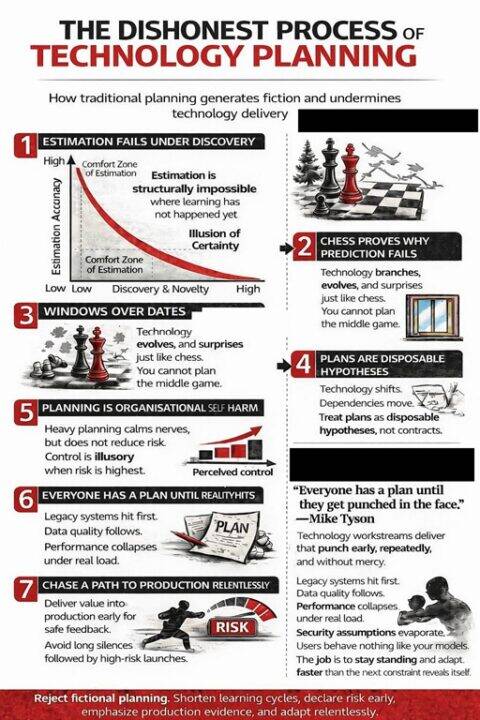
Technology planning demands precision most loudly in exactly the contexts where precision is structurally impossible. Estimating high discovery, high uncertainty work requires predicting unlearned lessons, unsurfaced risks, and nonexistent constraints. The resulting numbers are not forecasts but rituals of reassurance, converting genuine unknowns into false confidence that serves organisational comfort rather than operational reality.
Why Technology Planning Is Fundamentally DishonestAndrew Baker's Technology Blog Posts, 28/Jan/2026
https://andrewbaker.ninja/2026/01/28/why-technology-planning-is-fundamentally-dishonest/
1. Estimation Fails Exactly Where It Is Demanded Most
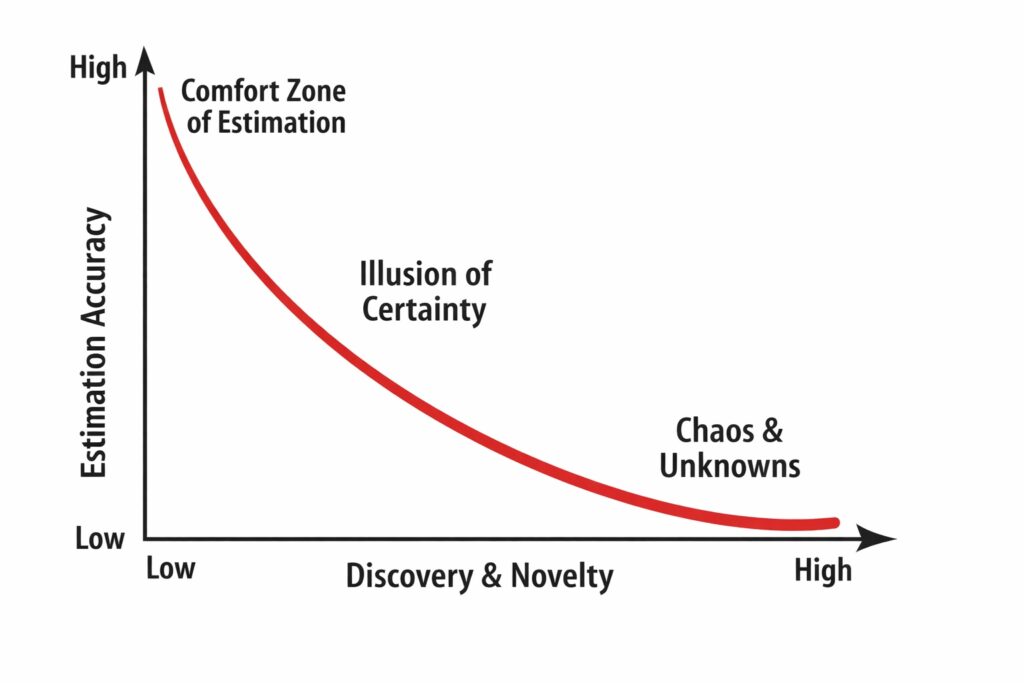
Estimation is most aggressively demanded in workstreams with the highest discovery, the highest uncertainty, and the highest intellectual property density. This is not an accident. The more uncomfortable the terrain, the more organisations reach for the false comfort of numbers. In these environments, estimation is not just wrong, it is structurally impossible. You are being asked to predict learning that has not yet occurred, risks that have not yet surfaced, and constraints that do not yet exist. This is not planning. It is numerology.
High discovery work is, by definition, about finding the problem while solving it. High IP work is about creating something that did not exist before. Estimation assumes a known path. Discovery assumes there is no path. These two ideas are incompatible.
2. Chess Is the Simplest Proof That Estimation Is Nonsense
Try estimating how long a game of chess will take. You cannot. The number of possible games exceeds any tractable search space. Two players, same rules, same board, radically different outcomes every time. You can window the opening because it is memorised. You can vaguely reason about the endgame because the state space has collapsed. The middle game, where real thinking happens, is unknowable until it is played.
Planning a game of chess in advance takes longer than actually playing it. To plan properly, you would need to analyse millions of branches that will never occur. This is exactly what technology programmes do when they insist on detailed delivery plans upfront. Months are spent modelling futures that reality will immediately invalidate.
The more time you spend estimating, the less time you spend learning. Learning is the only thing that reduces uncertainty.
3. Windows, Not Dates. Risk, Not False Precision
Dates create the illusion of certainty. Windows acknowledge reality. In high discovery work, the only honest outputs are windows, complexity signals, and risk indicators. Anything else is theatre.
No estimates should exist until the work is at least thirty percent complete. Before that point, you do not understand the shape of the problem, the resistance in the system, or the real integration costs. Early estimates are not conservative. They are random. Worse, they anchor expectations that will later be enforced as if they were commitments.
A window communicates intent without lying. A risk indicator communicates maturity without false confidence. This is not weakness. It is professional integrity.
4. A Proper Plan Is an Oxymoron
There is no such thing as a proper plan in technology. All plans are improper. Some are merely less wrong than others. Technology shifts underneath you. Dependencies move. Assumptions expire. What was optimal yesterday becomes harmful tomorrow.
Plans are snapshots of ignorance taken at a moment in time. Treating them as commitments rather than hypotheses is how organisations accumulate failure. The correct posture is not adherence to plan, but continuous replanning based on what you have learned since the last decision.
If your plan cannot survive daily contact with reality, it is not a plan. It is a liability.
5. Technology Planning Is Organisational Self Harm
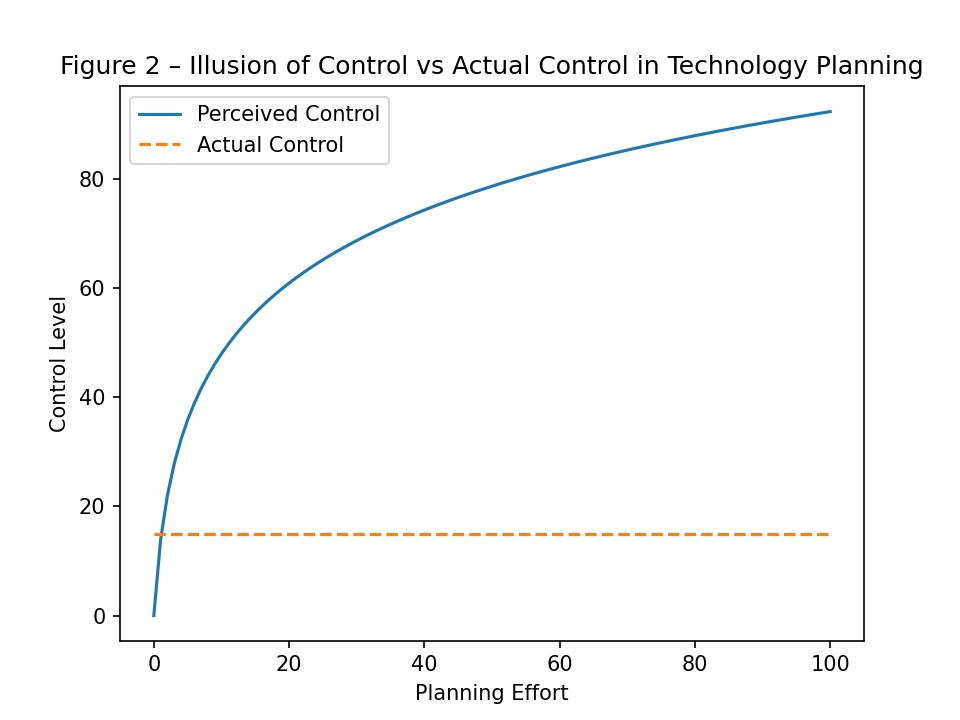
Heavy investment in technology planning is a form of self harm. It is indulgent, expensive, and emotionally motivated. Its primary purpose is not delivery, but the calming of executive nerves through the illusion of control.
Planning artefacts grow precisely when control is lowest and risk is highest. Roadmaps thicken. Gantt charts multiply. Governance forums expand. None of this reduces uncertainty. It simply diverts energy away from learning and into defending a narrative.
This is the lie at the heart of technology planning. Control is low. Risk is high. Pretending otherwise does not make it safer. It makes it slower and more fragile.
Accept your reality. Put your energy into conquering the truth, not defending a lie. Every hour spent polishing a plan that reality will invalidate is an hour stolen from building, testing, integrating, and learning. Planning feels productive. Learning actually is.
6. Everyone Has a Plan Until Reality Hits
“Everyone has a plan until they get punched in the face.” — Mike Tyson. Technology workstreams deliver that punch early, repeatedly, and without mercy.
Technology workstreams are not a single surprise. They are a sustained confrontation with reality. Legacy systems hit first. Data quality follows. Performance collapses under real load. Security assumptions evaporate. Users behave nothing like your models. Every one of these moments is a correction. None of them appear on the plan.
This is why planning confidence collapses so quickly once real work begins. Technology does not negotiate. It does not respect roadmaps. It reveals itself incrementally and relentlessly, one constraint at a time. The job is not to defend the plan after reality intrudes. The job is to stay standing and adapt faster than the next constraint reveals itself.
7. Interdependencies Are the Real Enemy
Most delivery failure is not caused by individual team performance. It is caused by interdependencies between teams, systems, environments, and decision makers. Estimation does not solve this. It hides it.
The only real remedy for interdependencies is to break them. Mocks, stubs, contracts, simulators, and fake services exist so that teams can move independently while reality catches up later. Waiting for another team to be ready is not coordination. It is organisational paralysis.
If your critical path depends on another team, your plan is already broken. Break the dependency or accept the delay. There is no third option.
8. Chase a Path to Production Relentlessly
You must chase a path to production from day one. Avoid the big reveal. Big reveals are how trust dies. They create a long silence followed by a single high risk moment where reality finally gets a vote.
Technology must deliver production value early, even if that value is small, partial, or hidden behind flags. The goal is not feature completeness. The goal is proving that the system can breathe in production conditions. Latency, security, deployment friction, data quality, and operational pain surface only when real traffic exists.
Delivery anxiety is a real force. You can only hold back the dams for so long. If value does not flow early, pressure builds, shortcuts appear, and quality becomes negotiable. Early production exposure releases pressure safely and continuously.
9. Shipping Dates to Exco Is Choosing Vanity Over Your Team
When you ship a date to an exco in a high discovery, high IP environment, you are not being accountable. You are choosing vanity over your team. You are signalling confidence you do not possess in order to look in control.
Ask yourself what you are really expecting your team to do. Do you expect them to ship rubbish into production on that date to protect the narrative? Do you expect them to quietly disagree but say nothing, pretending they accepted your made up certainty? When the date slips, will you say something “unforeseen” happened?
Of course it was unforeseen. That is the nature of high IP work. Calling it unforeseen does not make it exceptional. It makes the original date dishonest.
Dates force teams into impossible ethical corners. Either degrade quality, lie about progress, or absorb blame for a fiction they did not create. All three outcomes burn trust. None of them improve delivery.
Do not burn trust by shipping a date. Instead, ship a risk pack.
A proper risk pack shows what you are in for. It shows that you understand the terrain, the uncertainty, and the commercial exposure. It shows a credible route to delivering production value early, not a promise of completeness later. It demonstrates that the work can be made commercially viable through staged value, controlled exposure, and fast learning.
What exco actually needs is confidence that you are focused on delivery, speed, quality, and risk, not that you can guess the future. Dates satisfy anxiety. Risk packs build trust.
10. No Estimates and the Discipline of Reality
Woody Zuill’s No Estimates work is often misunderstood as anti planning. It is not. It is anti fiction. The core idea is simple. Focus on delivering small, valuable, production ready slices and use actual throughput as your only credible signal.
When teams stop estimating and start finishing, predictability emerges as a side effect. Not because the future became knowable, but because feedback loops became short. Work items are refined until they are small enough to complete safely. Risk is exposed immediately, not deferred behind optimistic forecasts.
No Estimates is not about refusing to answer questions. It is about refusing to lie. When asked how long something will take, the honest answer in high discovery work is what we have learned so far, what remains uncertain, and what we will try next.
11. Technology Change Is War
All technology change is a war. There is always an opponent, even if you pretend there is not. Legacy systems resist you. Data surprises you. Performance collapses under load. Users behave in ways your models never predicted. Every move reveals a counter move.
War is painful. It is humbling. You are always wrong, just in different ways over time. The only winning strategy is speed, decisiveness, and daily engagement. Monthly steerco updates are irrelevant. By the time you present the slide, the battlefield has already shifted.
If you are not all in, every day, close to the work, give it to someone else to run. This is not a governance problem. It is a leadership problem.
12. Relentless Adaptation Beats Perfect Prediction
The strongest teams do not pretend they are right. They constantly declare what did not work and what they are going to change next. This is not failure. This is competence made visible.
Never give up quality to meet a date. Dates recover. Quality debt compounds. Once trust in the system is gone, no timeline will save you. The goal is not to look predictable. The goal is to be effective in an environment that refuses to be predictable.
Stop estimating the unknowable. Shorten the feedback loop. Break dependencies. Chase production early. Declare learning openly. Move, counter move, and stay in the fight.
That is the only plan that works.