Stop Email Threads: 5 Rules for Smarter Team Collaboration

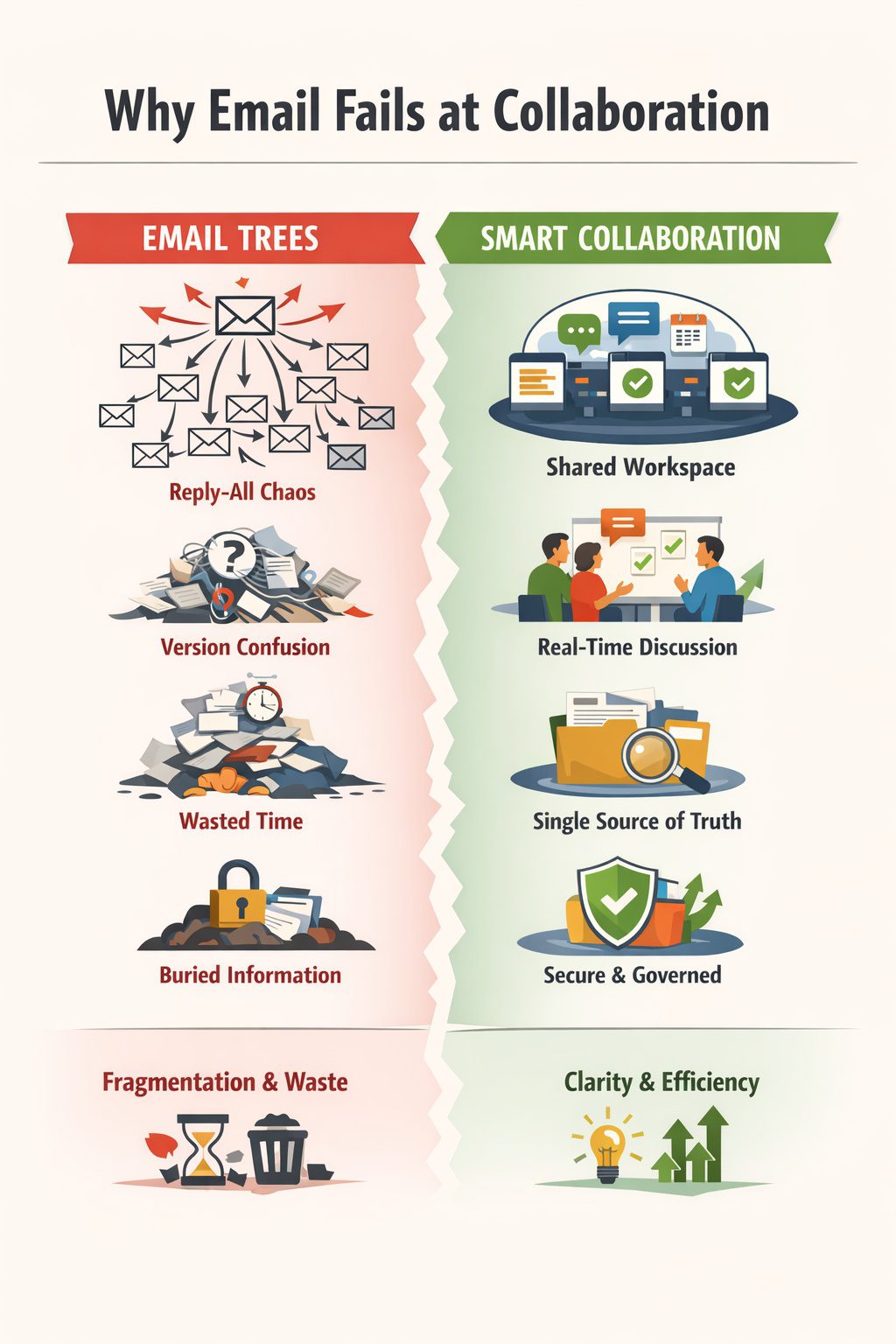
Replacing email threads with smarter collaboration tools starts by matching communication type to the right channel. Use synchronous tools like chat or calls for quick decisions, asynchronous project platforms for tracked work, and reserve email strictly for external or formal communication. Applying this discipline consistently eliminates most unnecessary threads before they begin.
Stop Email Threads: 5 Rules for Smarter Team CollaborationAndrew Baker's Technology Blog Posts, 27/Jan/2026
https://andrewbaker.ninja/2026/01/27/stop-email-threads-5-rules-for-smarter-team-collaboration/
Email trees are not an accident. They are the predictable outcome of organisations repeatedly using the wrong tool for the wrong job. Despite decades of evidence, email is still treated as a collaboration platform rather than what it actually is: a slow, lossy message delivery system. The result is wasted time, fragmented thinking, and an extraordinary amount of invisible labour.
1. The One Finger Typist Problem
Few things better capture the absurdity of corporate communication than watching someone sit at their desk, hammering out a long, verbose email with one finger, addressed to a colleague sitting directly behind them. Sentence after sentence is typed, retyped, and expanded, often explaining context that could have been resolved in thirty seconds of spoken conversation or a short chat message.
This behaviour feels productive because it looks like work. In reality, it is delay disguised as diligence. Email encourages over explanation, defers feedback, and removes the natural corrective pressure of real time interaction. The longer the email, the higher the probability that it should never have been an email in the first place.
Email trees are born right here.
2. The Five Sentence Rule
One of the simplest and most effective countermeasures to email abuse is the five sentence rule, popularised at https://five.sentenc.es/.
The rule is brutally simple:
If you cannot state your request clearly in five sentences or fewer, do not use email.
This rule forces clarity. It requires the sender to decide what actually matters, what action is required, and who truly needs to be involved. Long narratives, exploratory thinking, and collaborative problem solving do not belong in email. They belong in conversations, shared documents, or collaborative spaces where context is visible to everyone.
Five sentences is not restrictive. It is generous. Anything longer is usually a sign of unresolved thinking being offloaded onto the reader.
A particularly effective tactic is adding the five sentence rule to your email signature as a subtle hint rather than a mandate. Something as simple as:
“Emails over five sentences probably belong in a conversation.”
quietly resets expectations without confrontation. Over time, it changes behaviour.
3. TL;DR as a Discipline, Not a Courtesy
When longer messages are unavoidable, the TL;DR is mandatory.
A TL;DR at the top of a message is not about politeness. It is about respect for attention. It allows the reader to understand intent immediately and decide how deeply to engage. More importantly, it exposes weak thinking. If the message cannot be summarised in two or three lines, the sender has not yet done the work.
There is also power in replying with TL;DR only. This is not rude. It is corrective. Over time, teams learn to lead with outcomes instead of narratives.
4. Actively Prohibiting Email Discussions
High performing organisations do not merely suggest better communication practices. They explicitly prohibit using email for discussion.
Email is appropriate for formal communication, external messaging, approvals, and record keeping. It is fundamentally unsuitable for debate, iteration, brainstorming, or back and forth problem solving. When those activities are forced into email, context fragments, accountability blurs, and decisions disappear into inbox archaeology.
Leaders must say this out loud. If they do not, email becomes the default because it is familiar, not because it is effective. The cost shows up as wasted time, repeated conversations, and decisions that have to be re made because nobody can find them.
This is not inefficiency at the margin. It is systemic waste.
5. Chat Alternatives and the Governance Reality
Tools like WhatsApp and Slack demonstrate how quickly collaboration improves when friction is removed. Questions get answered in minutes instead of days. Context remains visible. Decisions emerge naturally rather than being negotiated across parallel threads.
But speed without governance is dangerous.
WhatsApp, in particular, is unsuitable for corporate collaboration beyond informal coordination. It lives on personal devices, has no enterprise grade exit controls, and should never be used for client data, financial information, or regulated discussions. When people leave, the information leaves with them.
Slack and similar platforms are more appropriate but still require discipline. Access must be revoked immediately when people exit. Sensitive topics must be explicitly prohibited. Channels must be structured and purposeful. Without governance, chat platforms simply accelerate bad habits instead of fixing them.
Collaboration tools amplify behaviour. They do not correct it.
6. Why Microsoft Teams Is So Painful in Practice
Microsoft Teams is often positioned as the answer to email overload. In practice, many organisations experience it as email with more surface area and more ways to get lost.
From a user experience perspective, Teams is cognitively heavy. Chats, channels, meetings, files, and tabs overlap in ways that are not intuitive. Users frequently do not know where a conversation should live, which thread is authoritative, or where the final decision was made. Finding information often requires training rather than intuition.
Corporate security controls frequently make things worse. In the name of risk management, organisations disable clipboard functionality, block attachments, restrict downloads, and partially or fully blank screen sharing. Each control might be defensible in isolation. Together, they break the channel. What remains is a collaboration tool that cannot collaborate.
Support burden is another hidden cost. Teams is resource intensive on client machines, sensitive to network quality, and prone to inconsistent behaviour across updates. Crashes, dropped calls, audio desynchronisation, and failed screen sharing are common enough to be normalised. Supporting Teams at scale consumes significant IT capacity simply to keep it usable.
Teams does not fail because it lacks features. It fails because complexity combined with controls erodes trust. When people do not trust a collaboration tool to work reliably, they retreat to the one thing they know will always deliver a message.
Email.
And with it, the email trees return.
7. Intentional Communication Design
The solution to email trees is not another tool rollout. It is intentional communication design.
Set clear rules about where different kinds of communication belong. Enforce brevity. Separate discussion from record keeping. Choose collaboration tools deliberately and govern them properly. Train people not just how to use tools, but when not to.
Email will always exist. The mistake is allowing it to pretend to be something it is not.
Collaboration is not about sending messages. It is about shared understanding. Email trees destroy that.