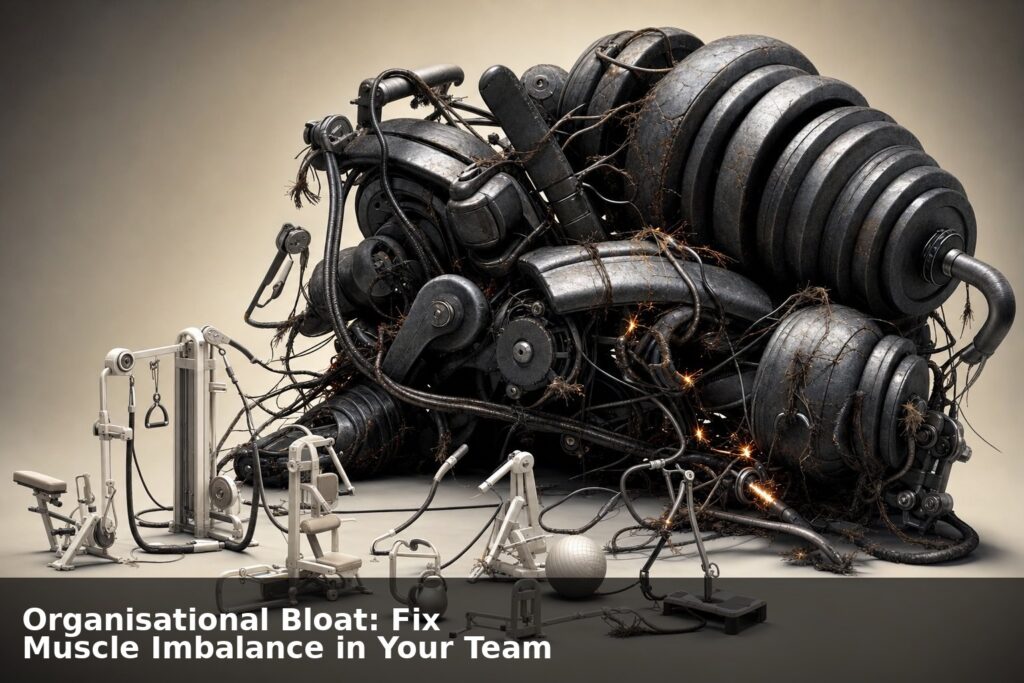
Organisational Bloat: Fix Muscle Imbalance in Your Team

Organisational bloat occurs when support and administrative functions grow faster than value delivering roles, creating structural muscle imbalance. Fix it by auditing what people actually do daily, not what their titles suggest, then deliberately redesigning team structure to strengthen output focused roles while reducing coordination overhead that exists solely to manage itself.
Organisational Bloat: Fix Muscle Imbalance in Your TeamAndrew Baker's Technology Blog Posts, 22/Jan/2026
https://andrewbaker.ninja/2026/01/22/organisational-bloat-fix-muscle-imbalance-in-your-team/
1. The Question That Exposes Everything
Walk into any large organisation and ask a deceptively simple question:
“What does everyone do?”
Not what are your job titles, not what does your org chart say, but what do people actually do all day.
The silence that follows is never accidental.
This blog is a reframing of Pournelle’s Iron Law of Bureaucracy, but instead of stopping at criticism, it moves toward organisational design. Not growth. Not scale. Design.
The uncomfortable truth is this:
Most organisations are not designed. They are accumulated. And as with all accumulated systems, organisations will typically overdevelop the wrong muscles.
2. Pournelle’s Law, Reframed for Builders
Jerry Pournelle’s Iron Law of Bureaucracy is often quoted but rarely explained properly. Pournelle observed that in any bureaucratic organisation, two groups inevitably emerge:
- Those dedicated to the goals of the organisation
- Those dedicated to the organisation itself
Over time, group two always wins. Not because they are malicious. Not because they are incompetent. But because bureaucratic systems naturally reward process management, risk avoidance, and internal justification over outcome creation.
This is usually presented as an inevitability. A law of nature. Something to be managed rather than designed against. That framing is wrong. The problem is not bureaucracy. The problem is muscle imbalance.
3. The Human Body Got This Right
The human body is not symmetrical. It is intentionally imbalanced.
- The bicep is larger than the tricep
- The quadriceps overpower the hamstrings
- The muscles responsible for action dominate those responsible for restoration
Why?
Because doing work is the primary objective.
Restoring from work is a necessary but secondary function.
If your triceps were as strong as your biceps, you would struggle to lift anything. If your hamstrings dominated your quads, you would fall over trying to walk. Balance is not symmetry. Balance is intentional asymmetry.
4. Organisations Ignore Biology
Most organisations do the exact opposite. They grow antagonist muscles without restraint:
- Risk teams grow faster than delivery teams
- Compliance expands while execution stalls
- Oversight multiplies while accountability evaporates
- Reporting increases while action decays
Soon, the organisation can review, approve, audit, escalate, and govern far better than it can build, ship, fix, or change anything. At that point, the organisation is not safe. It is immobile.
5. The Risk Team Thought Experiment
Imagine a risk function with thousands of people. Now imagine there is nobody with the authority, skills, or capacity to action the outcomes. What do you actually have?
- Risk is identified ✔
- Risk is documented ✔
- Risk is escalated ✔
- Risk is reported ✔
But risk is not reduced. This is not risk management. This is risk theatre.
A massive tricep attached to a withered bicep does not make you safer. It makes you weak in slow motion.
6. Growth Is Not a Neutral Act
Teams cannot be allowed to arbitrarily grow. Headcount is not free. Every new role changes the force distribution of the organisation.
Uncontrolled growth does three dangerous things:
- It creates internal demand for justification
- It invents work to sustain itself
- It shifts power away from execution toward process
At some point, people are no longer hired to do work. They are hired to explain work to other people who do not do it. That is the moment Pournelle’s law stops being theoretical.
7. Composition Beats Size Every Time
The question is never:
“Do we need a risk team?”
The real question is:
“How strong should this muscle be relative to the others?”
A healthy organisation has:
- A dominant delivery muscle
- A smaller but sharp oversight muscle
- A thin but highly competent governance layer
- A direct and short feedback loop between them
The moment an antagonist muscle becomes larger than the muscle it exists to protect, you have inverted the system. And inverted systems always collapse inward.
8. Designing for Intelligent Weakness
Here is the counterintuitive rule:
Some organisational muscles must be kept deliberately weak.
Not incompetent.
Not underfunded.
Weaker – relative to execution.
This forces discipline:
- Risk must prioritise, not catalogue
- Governance must decide, not defer
- Compliance must enable, not smother
- Strategy must choose, not narrate
- Management, team leaders, delivery leads etc must all have dedicated execution teams with agree ratios.
Weakness creates focus.
Strength without constraint creates entropy.
9. Ask Better Questions, Not Just More Questions
“What does everyone do?” is not a one off audit question. It is a leadership habit. But it is not enough on its own. Leaders must also ask:
- What would actually break if this person stopped doing their role tomorrow?
- And do we care?
If nothing breaks, or the only impact is that a report is late or a meeting is cancelled, you are not looking at a critical muscle. You are looking at organisational scar tissue. Closely related is an even more dangerous question:
- Who reads these reports?
- What decisions do they make because of them?
- What actions follow?
If the answers are vague, ceremonial, or deferred to another committee, the output exists to justify the role, not to reduce risk or improve outcomes.
Auditors will never find this.
Dashboards will never show it.
Only a technically and operationally competent leader will.
10. Calculating Your Bloat Ratio
Divide your organisation into two buckets.
Builders:
People who build, design, operate or fix systems.
If they disappeared and outcomes degraded, they are builders.
Everyone else:
Management, coordination, reporting, governance and oversight.
Bloat Ratio =
Non builders divided by builders.
Set targets for this. If you do not, the organisation will choose for you.
Ask the Question Regularly:
What does everyone do is a leadership habit?
Ask:
Who creates value?
Who restores the system?
Who only talks about the system?
What would break if this role stopped?
Do we care?
11. Conclusion: Build Like a Body, Not a Bureaucracy
Organisations are not machines.
They are not flowcharts.
They are living systems.
Living systems survive through asymmetry, constraint, and intent.
If everyone exists to restore, nobody builds.
If everyone governs, nothing moves.
If everyone reviews, nothing improves.
So ask the question.
Then ask what would break.
Then decide if you care.
What does everyone do?
And more importantly:
Which muscles have you allowed to grow without thinking?
Do not be misled, bloat left unmanaged will create its own connected ecosystem and slowly choke your companies life blood. It will kill you faster than your competitors ever could.