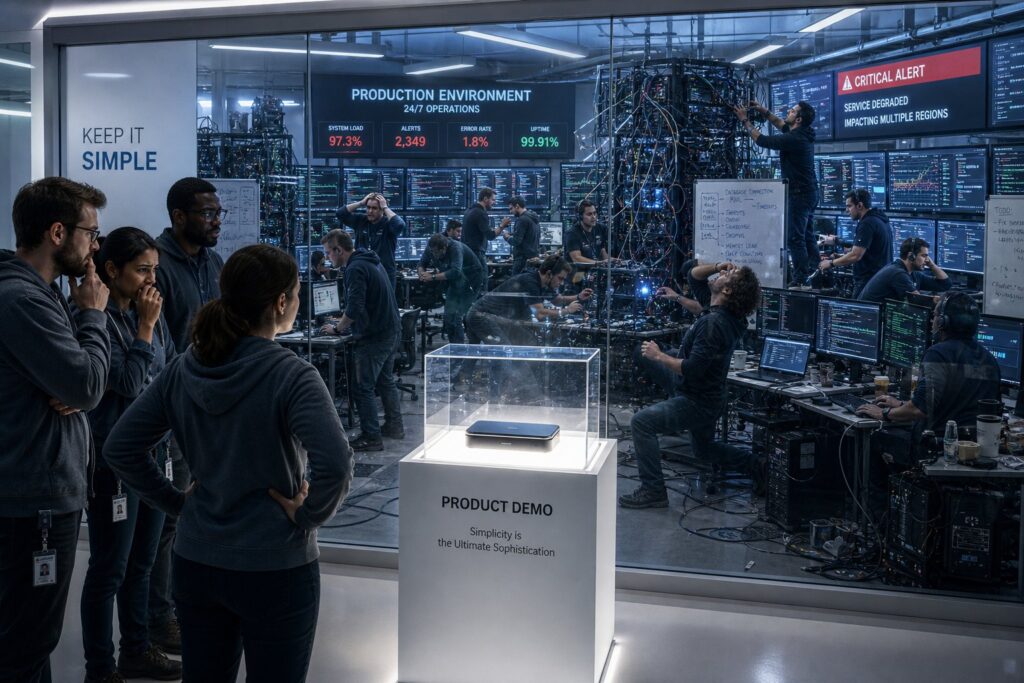
From Demo to Go Live: Why the Last Mile Is Such a Hard Journey

Demos succeed precisely because they eliminate every condition that makes software hard: the slow device, the dirty data, the concurrent users, the edge case at 2 a.m. A production system must handle all of those simultaneously, which is why the team and codebase required to sustain it will always dwarf what was needed to demonstrate it convincingly.
1. The question nobody can answer
Four developers, three months, one very convincing product demo, and then the question that makes every engineering leader wince: why does the real platform need to be so much bigger? The executives asking it are not being difficult. They genuinely cannot see the difference between what was demonstrated and what already exists in production, and the reason they cannot see it is that a demo is specifically, if unintentionally, designed to hide that difference.
2. The happy path is not the product
What got built in those three months was a proof of concept running under conditions that do not exist in production. The device was modern, the network was fast, the data was clean, nobody called support, and crucially, nothing went wrong at the worst possible moment for the worst possible customer. The demo ran on the happy path, and the happy path is a fiction that holds together just long enough to be persuasive in a meeting room.
A production platform does not run on the happy path. It runs on millions of active clients, on cheap devices with limited RAM, on weak mobile signals in areas far from the office, under active fraud attacks, during traffic spikes that arrive without warning, across app versions that stretch back years because not every customer updates promptly. The demo team never had to solve any of that, because they were never asked to. Industry data consistently shows that somewhere between sixty and eighty percent of total engineering effort on a mature platform sits outside feature code entirely, in the exception handling, the failure recovery, the compliance plumbing and the operational tooling that keeps the product trustworthy at scale.
3. The hotel that burns down
The Hotels.com comparison makes the deeper problem concrete. The visible customer journey looks genuinely simple: search, compare, book, pay, manage a reservation. A small team can reproduce enough of the visible journey to create the appearance of equivalence, and the result will be impressive enough to prompt exactly the kind of awkward questions this piece is about.
What the small team cannot rebuild is what Hotels.com actually sells. Hotels.com does not sell a booking interface. It sells a complete service relationship that extends through the entire lifecycle of the booking, including everything that goes wrong in a supply chain it does not control.
Hotels close without warning. Properties go into administration overnight. A resort floods during peak season. A family arrives at a property that has double-booked their room, the nearest available alternative is an hour away, the children are exhausted, and someone needs to fix this right now. None of that is the platform’s fault, but all of it is the platform’s problem, because the customer booked with the platform rather than with the hotel directly.
That single commercial fact transfers every supplier failure into an operational event the platform must absorb, triage, communicate around, resolve and where necessary compensate for. The trained agents, the escalation paths, the refund mechanisms, the commercial agreements with suppliers, the communication infrastructure that must hold under sustained pressure — none of it appears in any feature specification, none of it shows up in the demo, and all of it must exist before the platform can honestly be called a product.
4. Regulated products are harder still
If a travel platform with a familiar search-book-pay-manage journey requires that much hidden infrastructure, a regulated financial or healthcare product requires considerably more. A travel booking can go wrong in inconvenient ways. A banking failure can mean a client cannot feed their family on payday, cannot make a loan repayment that affects their credit record, or becomes a fraud victim because a control that looked adequate at demo scale failed at production volume.
Any product sitting in front of a regulated service carries obligations that do not appear in the demo. Every transaction that looks simple to a customer involves fraud scoring, compliance screening, reconciliation, audit logging and regulatory reporting running invisibly behind it. Post-deal servicing — amendments, reversals, disputes, collections, arrears, hardship applications, statements, certificates — often represents more engineering surface than the original acquisition journey. None of that exists in a demo. All of it has to exist in production.
5. The eighty percent illusion
The first eighty percent of visible functionality comes together quickly enough to create a genuine optical illusion of completeness. The screens exist, the core flows work, the product looks finished to anyone who is not building it, and the question becomes why the real platform requires so much more.
What the eighty percent does not contain is reliability under real load, resilience when dependencies fail, fraud controls that work at scale without destroying journey completion rates, device compatibility across the full customer estate rather than the test handsets in the office, real user monitoring that distinguishes what the team thinks is happening from what customers on constrained devices in poor signal areas are actually experiencing, and post-deal servicing infrastructure for the full lifecycle of every product already sold. Production software is not feature code plus hardening. It is accumulated exception handling wrapped around a relatively small amount of business logic, and the exception handling is where the years go.
6. Scale changes the question entirely
At significant scale, opening an app involves device validation, identity checks, session creation, fraud scoring, traffic routing, content selection, cache evaluation, telemetry generation, audit logging and recovery logic, every step of which must handle failure gracefully because at that volume some percentage of those steps are always failing at any given moment somewhere across the customer estate.
The engineering question is not whether a feature can work. It is whether the feature can keep working when dependencies are slow, stale, unavailable, misconfigured, under attack or returning data that is subtly wrong in ways that are hard to detect. A demo sidesteps that question entirely. Production cannot.
7. The gap is accumulated history
The gap between the demo and the production platform is not a measure of organisational inefficiency. It is accumulated production reality: years of failure handling, fraud pattern responses, device compatibility fixes, support tooling, regulatory evidence, reconciliation logic, operational runbooks, escalation ownership, support playbooks, on-call maturity and recovery paths that were each built in response to something that actually happened to a real customer.
A demo starts from zero. A mature production platform starts from millions of customers, years of operational learning, the tribal knowledge of teams who have been on-call through every major incident, and a regulatory framework that requires the organisation to prove not just that the product works but that it is controlled, auditable and recoverable. That is not a complexity that a small team with modern tooling can compress into a few months, because it was not built in a few months to begin with.
8. Why demos still matter
None of this is an argument against demos or prototypes. A convincing demo proves something genuinely valuable: that the user experience is achievable, that the idea is desirable, that a feature direction is technically feasible. Demos validate desirability, validate UX and validate feasibility. The one thing they cannot validate is operability, and that is precisely the dimension that determines whether the product can actually go live.
The mistake is not running the demo. The mistake is reading the demo as evidence that the production platform is overbuilt. The demo proves a feature can be shown. The production platform proves a feature can be trusted, at scale, under pressure, across every device in the customer estate, every day, without the customer ever knowing how much is running behind it to make that possible. Those are not the same proof, and confusing them is where the most expensive conversations in technology tend to begin.