The Number One Skill Every Leader Must Work On

The number one skill every leader must work on is emotional regulation. Every other leadership skill, including communication, feedback and decision making, deteriorates when a leader is dysregulated. Because a leader's mood spreads through the team and shapes coordination, safety and performance, regulating your own emotions has more leverage than any other capability.
Someone sent me a reel this morning, a clip from Lewis Howes, and it stopped me. He was describing a conversation with a brain surgeon, someone who had performed over a thousand brain surgeries and who also studies the mind, and he had asked him what one skill human beings should learn to master. The surgeon did not say intelligence, or discipline, or resilience, or any of the words you find painted on the walls of corporate offices. He said emotional regulation. His reasoning was that if we cannot regulate our feelings around a situation or an event, then that event has power over us, rather than us having power over the moment, and that when something can make us react that strongly, it is worth asking ourselves why we are so triggered and where the wound behind it sits.
I would add one thing to that. Asking “why am I so triggered?” does not replace asking what actually happened; sometimes the deadline really was missed, or the demand really was unreasonable, and that still needs dealing with. But in my experience the question about our own reaction is the one leaders skip, and it is the one that changed the most for me. This post is my argument for why emotional regulation is the number one skill any leader must work on. That ranking is my conviction rather than something a study has proven, but I have arrived at it the hard way, by spending years mistaking fear for drive.
1. The fear I mistook for drive
I grew up in an amazing family, but we had very little money, and there were things we simply had to endure. I have only recently started to understand how much of that I carried into the way I lead.
We had free school meals, which meant that we had to use a different queue from everyone else in the canteen, so every child in the room knew exactly which kids had no money. One day I left my dessert, and the PE teacher stood over me and bellowed to the whole canteen that I had not eaten it, and that everyone else had paid for the meal I was rejecting. I remember the shame of that moment with a clarity that most of my adult memories do not have. It was not really about the dessert; it was the feeling of being exposed, in front of everyone, for being poor.
Shoes were whatever my mum could find. One time she found a pair of military boots at a jumble sale, the ugliest boots you can imagine, and I wore them to school for a while because there was nothing else to wear. I was ridiculed for them, and I got into fights because of them, because when you are a child with no way of changing your circumstances, fighting is sometimes the only answer you have. There were other moments as well: cupboards that were occasionally empty of food, and a year when the five of us lived in someone’s loft because we had no home.
All of these things created an emotional energy in me that I thought, for most of my life, was simply drive. Much of that energy was fear I had not learned to regulate: fear of being found out, fear of falling behind, fear of losing, fear of ever again being the one standing in the other queue.
And for a long time that energy worked, or at least it appeared to. I spent most of my career in high frequency trading, building custom core IP stacks on FPGAs, in a world where the difference between winning and losing could come down to nanoseconds and the scoreboard was brutally clear every single day. If you were a little slower than the other firm, you lost, and nobody cared how hard you had worked. That environment rewards drive enormously, and it rewarded mine, so I had no reason to look at where it was coming from.
From the inside, drive and fear feel almost identical. Both get you up early, both make you push harder, and both make you impatient with mediocrity. One place the difference becomes visible is in how you show up for other people, and it took me a long time to see it there. When drive is the engine, you are curious about a problem, you want the best idea regardless of who it comes from, and a setback is information. When fear is the engine, a problem becomes a threat, other people’s ideas can feel like competition or like proof that you missed something, and a setback feels personal, as though it is saying something about who you are. The work output can look similar for a while. The experience of working with you does not.
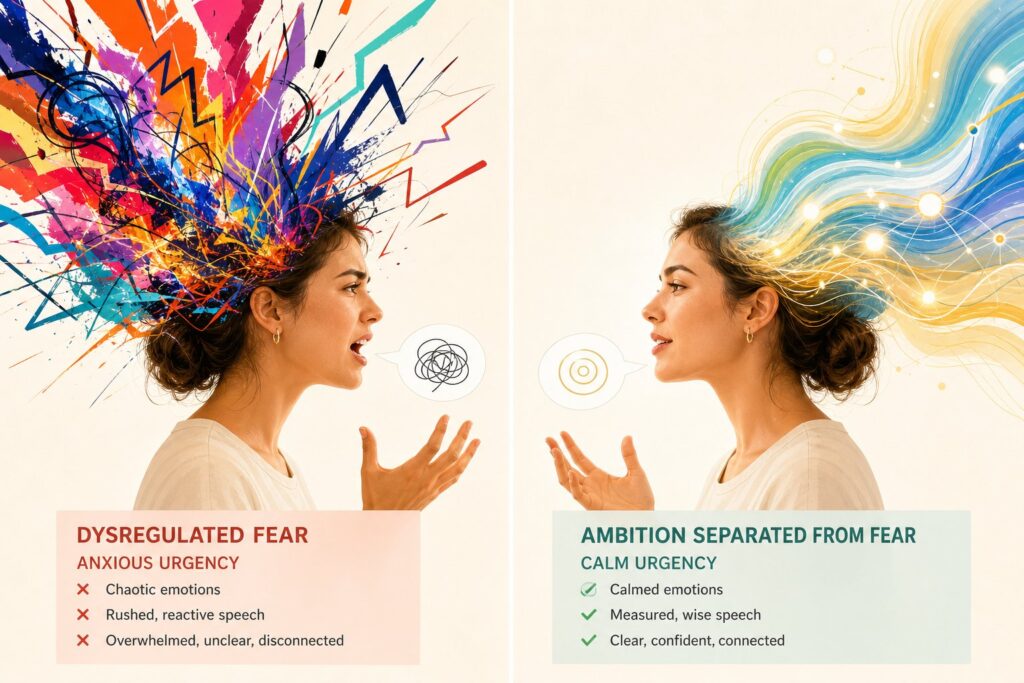
So the work for me was never to reduce my drive. I still want to win, and I still care enormously about whether what we build is the best it can be. The work was to separate the ambition from the fear, so that the ambition could stay and the fear could stop leaking into how I treated people. I do not think the fear ever fully goes away; that boy in the canteen is still in there somewhere. What has changed is that I am getting better at noticing the fear before it decides what I say next. When I feel the familiar surge of “we are falling behind”, I have learned to notice it as a feeling rather than a fact, and to ask whether it is pointing at something real. Sometimes it is, and then the right response is calm urgency rather than anxious urgency. Those two look very different from the other side of the table.
2. Why this skill sits underneath all the others
Most leadership frameworks give you a list: communicate clearly, set direction, hire well, make decisions under uncertainty, give honest feedback, build trust. I would not argue with any of them, but every one of them degrades when you are dysregulated. It is hard to communicate clearly while part of your brain is busy defending you from a perceived threat, your judgement becomes less reliable when the decision is really about relieving your own discomfort, and feedback is rarely fair when it is delivered in frustration or received while you feel exposed. Emotional regulation is not one more item on the list; it is the condition that determines how much of the rest of the list you can actually reach on a given day.
It also matters more for leaders because of leverage. Anyone’s mood can affect the people around them, but authority magnifies the effect. When a leader has a bad morning, the people around them may spend the rest of the day managing the leader’s state instead of doing their work, and they will often adjust what they say, and what they are willing to raise, accordingly. Once you are responsible for other people, your emotional state stops being a private matter.
3. What the research helped me understand
Reading the research did not tell me anything about my own life that I did not already know, but it gave me language for it, and a few studies in particular have stayed with me.
The first is Robert Vallerand’s work on passion. He distinguishes between harmonious passion, where an activity matters to you but you have taken it on freely and it sits alongside the rest of your life, and obsessive passion, where the activity has been internalised under internal or external pressure, so that you feel compelled to keep doing it. Vallerand and his colleagues proposed that obsessive passion often involves your self worth becoming contingent on doing well at the activity. In their studies, obsessive passion was associated with more negative emotion, with conflict between the activity and the rest of life, and with rigid persistence even when persisting was clearly costly. Reading that description was uncomfortable, because I recognised a lot of my younger self in it. It was not that I lacked commitment; it was that my commitment had fear wired into it.
The second is from Andrew Elliot and Marcy Church, who studied achievement goals in university students. They found that fear of failure predicted students adopting performance avoidance goals, where the aim is mainly not to look bad or fall short, and that those avoidance goals predicted lower graded performance. The interesting complication is that fear of failure also predicted performance approach goals, where the aim is to outperform others. In other words, fear did not only make people defensive; it also fed straightforward striving to win. I am wary of stretching a classroom study into a boardroom, but that complication matches my experience precisely. Fear and ambition do not sit in neat separate boxes. They braid together, which is exactly why it is so easy to mistake one for the other.
The third set of studies is about what a leader’s state does to everyone else. Sigal Barsade placed a trained actor into small groups and had the actor display different moods; the mood spread to the rest of the group, and groups with a positive actor reported more cooperation and less conflict. Thomas Sy, Stéphane Côté and Richard Saavedra then induced positive or negative moods in team leaders and found that leader mood carried over into the mood of members and of the group as a whole. Teams with positive mood leaders coordinated better, while teams with negative mood leaders actually put in more effort. That study was about mood rather than fear or regulation, so I do not want to claim it proves anything about fear based leadership. But it reminds me of what fear based leadership felt like from the inside: lots of motion, and less coordination than all that motion deserved.
There is also good evidence that a leader’s capacity to regulate is not fixed. Christopher Barnes and colleagues followed 88 leaders over two weeks and found that on days when leaders reported poorer sleep quality, they also reported lower self control, their teams reported more abusive behaviour from them, and that behaviour was linked to lower engagement across the unit. The same person can be a reasonable leader one day and a difficult one the next, depending in part on how well they slept.
The last connection I would make is to speaking up. Amy Edmondson found that teams where people felt safe to speak up engaged in more learning behaviour, which was associated with better performance. A leader who is running on fear makes that kind of safety very hard to build, because people quickly learn which messages are unwelcome.
4. Regulation is more than suppression
When many leaders hear “emotional regulation”, they translate it as “do not show emotion”. That is a narrow version of the idea, and it carries real costs.
James Gross at Stanford, whose work has shaped much of this field, distinguishes between strategies such as reappraisal, which means changing how you interpret a situation so that its emotional impact changes, and expressive suppression, which means keeping the emotion off your face while it continues underneath. Suppression is a form of regulation, but relying on it can carry interpersonal costs. In a study led by Emily Butler with Gross, pairs of strangers discussed an upsetting topic, and one person in each pair was asked to suppress, to reappraise, or to respond naturally. Suppression disrupted communication and raised blood pressure in the suppressor’s conversation partner, and in a second study it also reduced rapport and got in the way of the relationship forming. So the leader who sits through a tense meeting with a perfectly still face while seething inside is controlling their expression without necessarily addressing the emotion underneath. My own interpretation, which goes beyond what that study measured, is that people sense something is off without knowing what, and that ambiguity is its own kind of stress.
The other finding I keep coming back to is from Matthew Lieberman’s lab at UCLA. In a brain imaging study of thirty people, labelling the emotion in a picture of a face with a word like “angry” or “scared” was associated with reduced amygdala activity compared with simply matching the face to a name. I would not want to build a leadership philosophy on one laboratory task, but it fits my experience: there is a real difference between being inside a feeling and being able to name it, and naming it is often the first moment you get any choice about what you do next.
5. How to actually work on it
I am wary of turning this into a neat programme, because regulation is not something you complete. But a few practices have made a real difference for me.
The first is to name what you are feeling, specifically and honestly, at least to yourself. “I am irritated” is a start, but “I am anxious that this delay makes us look slow, and that it reflects on me” is far more useful, because it shows you where the reaction is actually coming from. Naming is not the same as broadcasting; it simply creates enough distance between you and the feeling for you to choose.
The second is to reappraise before you react. Before a difficult conversation, I try to ask what else could be true. The engineer who missed a deadline might be overloaded, might have found something that genuinely needed more time, or might have been given an unclear brief by me. Reappraisal is not pretending things are fine; it is refusing to let the first and most threatening interpretation be the only one in the room.
The third is to separate the signal from the state. Fear of falling behind is sometimes a useful signal that something needs attention. The skill is to keep the information and leave the panic behind, so that what your team receives is a clear priority rather than your adrenaline.
The fourth is to protect the foundations, which are less boring than they sound. The Barnes study is a reminder that how well you slept can shape how much self control you bring into the day, so if you are walking into a high stakes meeting after a bad night, it is worth knowing that and adjusting accordingly.
The fifth is to ask the people around you how you show up when things are going badly. Not generally, because most leaders are pleasant when things are going well, but specifically when the pressure is on. Their answers can reveal patterns that your own assessment misses.
The sixth, and probably the most important for anyone who recognises themselves in this post, is to repair when you get it wrong, because you will. Nobody catches every reaction before it lands. When I have been unfair to someone, the most useful thing I can do is go back to them, say plainly that how I reacted was not right, and apologise without attaching an excuse; “I was under a lot of pressure” explains the behaviour, but it should never be offered as the reason it was acceptable. Then I go back to the actual problem, because the issue that triggered me usually still needs solving, and solving it together is part of the repair. Teams can forgive a leader who sometimes gets it wrong. What erodes trust is a leader who never acknowledges it.
6. Freedom to act, not freedom from fear
I believe emotional regulation is the number one skill for leaders not because feelings are bad or because leaders should be calm and detached, but because every other leadership capability runs through it, and because the people you lead experience your regulation, or the lack of it, every day, whether you notice or not.
The goal is not to stop feeling fear. I doubt I ever will entirely, and I am not sure I should want to, given where it came from and what it has pushed me through. The goal is for the fear to stop deciding how you behave. For people like me, the hardest version of this work is separating the drive you want to keep from the fear that quietly rides along with it, and accepting that the fear may never leave while refusing to let it steer. Your team will feel the difference long before you can name it, and in my experience they do far better work for a leader who is chasing something than for one who is running from something.
References
Barnes, C. M., Lucianetti, L., Bhave, D. P., and Christian, M. S. (2015). “You wouldn’t like me when I’m sleepy”: Leaders’ sleep, daily abusive supervision, and work unit engagement. Academy of Management Journal, 58(5), 1419 to 1437.
Barsade, S. G. (2002). The ripple effect: Emotional contagion and its influence on group behavior. Administrative Science Quarterly, 47(4), 644 to 675.
Butler, E. A., Egloff, B., Wilhelm, F. H., Smith, N. C., Erickson, E. A., and Gross, J. J. (2003). The social consequences of expressive suppression. Emotion, 3(1), 48 to 67.
Edmondson, A. (1999). Psychological safety and learning behavior in work teams. Administrative Science Quarterly, 44(2), 350 to 383.
Elliot, A. J., and Church, M. A. (1997). A hierarchical model of approach and avoidance achievement motivation. Journal of Personality and Social Psychology, 72(1), 218 to 232.
Gross, J. J., and John, O. P. (2003). Individual differences in two emotion regulation processes: Implications for affect, relationships, and well-being. Journal of Personality and Social Psychology, 85(2), 348 to 362.
Lieberman, M. D., Eisenberger, N. I., Crockett, M. J., Tom, S. M., Pfeifer, J. H., and Way, B. M. (2007). Putting feelings into words: Affect labeling disrupts amygdala activity in response to affective stimuli. Psychological Science, 18(5), 421 to 428.
Sy, T., Côté, S., and Saavedra, R. (2005). The contagious leader: Impact of the leader’s mood on the mood of group members, group affective tone, and group processes. Journal of Applied Psychology, 90(2), 295 to 305.
Vallerand, R. J., Blanchard, C., Mageau, G. A., Koestner, R., Ratelle, C., Léonard, M., Gagné, M., and Marsolais, J. (2003). Les passions de l’âme: On obsessive and harmonious passion. Journal of Personality and Social Psychology, 85(4), 756 to 767.