Finally, an AI That Understands Money, Part Two: The Lending Market Hiding in Your Embeddings

Transactional AI models read banking event sequences to assess lending risk, measuring income durability and resilience that bureau scores miss. Bureau records are lagging, sparse and coarse, while transaction timelines are current, universal and fine grained. This changes who is lendable, not just how accurately they are scored, particularly for thin file customers.
Conventional lending has confused regularity with durability. An AI reading the transaction history directly measures what a payslip cannot, and in a market like South Africa that changes who is lendable at all.
This is the second of three parts. Part one explains what Revolut’s PRAGMA is and how it works. Part three covers fraud, mule accounts and the limits of a shared model.
Where part one left off
Revolut and NVIDIA published a transaction foundation model, meaning a single pretrained backbone that learns customer behaviour directly from banking event sequences and then serves many downstream models rather than one. It reported a lift of 130.2 percent in PR AUC on credit scoring against an internal baseline, though every figure in the paper is relative, unreproduced and offline, and should be read as directional rather than settled.
This part is about what that capability would actually change, and the argument is not really about accuracy. It is about who becomes assessable at all.
1. What the bureau sees, and what it misses
1.1 What a bureau record tells you, and what it leaves out
A bureau record is a shared summary of how somebody has serviced other institutions’ credit in the past. It is enormously valuable and it is also, structurally, three things at once: lagging, sparse and coarse. It lags because it updates monthly at best and reflects obligations that were entered into weeks or months before that. It is sparse because it only knows about credit products, so a customer who has never borrowed is close to invisible in it. It is coarse because a tradeline records that a payment was made or missed, without any of the surrounding circumstance that would tell you which of those two outcomes was a near miss and which was comfortable.
The consequence in a mass market book is that a large share of customers arrive either thin or blank at the bureau, and the traditional answer has been either to decline them or to price for the uncertainty. Both responses are expensive, and both are responses to missing information rather than to genuine risk.
A transactional timeline inverts every one of those three properties. It is current rather than lagging, since it updates the moment money moves. It exists for every customer who has ever transacted, whether or not they have ever borrowed, which is exactly the population the bureau cannot see. And it is fine grained to the second, carrying not just what happened but the order in which it happened.
1.2 The timeline as a fingerprint of the ability to service credit
The question a credit model is really asking is whether this person will still be able to meet an obligation in eighteen months’ time. A bureau score answers a proxy for that, namely whether they met other obligations before. A transactional history speaks to it far more directly, because the ability to service credit shows up in a timeline as a set of patterns that no single feature captures.
Start with income, because this is where conventional lending makes its largest and least examined mistake. Banks treat regularity as though it were durability, and those are not the same property at all. Regularity is simply what a payslip happens to evidence, so it became the thing lending policy measures, and an entire assessment framework has been built on the assumption that predictable means safe.
Look at what regularity actually describes. A salaried employee receives twelve payments a year from exactly one payer, which is to say their income is perfectly concentrated in a single counterparty. Section 2.2 argues that a trader taking the same monthly revenue from three customers rather than four hundred is carrying obvious concentration risk, and that argument applies with full force here. Somebody employed by one company has one customer. If that relationship ends, their income does not decline, it stops, and it stops in a single step with no warning visible in the timeline until the deposit fails to arrive.
Now consider a driver on a ride hailing platform putting the equivalent of two thousand dollars a month through the account. The deposits are frequent, uneven and unpredictable, so a conventional assessment scores them poorly or refuses to score them at all. Yet the underlying income is drawn from a large and continuously refreshed set of end customers, it has no single point of failure, and it possesses something a salary conspicuously lacks, which is elasticity. Faced with a shortfall, a salaried borrower can do almost nothing before the next payday. A driver can work more hours this week. That capacity to flex is genuine downside protection, it is one of the more meaningful things you could know about a borrower, and no conventional model can see it because a payslip has no dimension in which it could appear.
There is a further inversion worth sitting with. A stable salary means you have never observed the customer under stress, so you know less about their resilience rather than more, and you will not learn anything until the moment they fail. Variable income is different, because the variation is itself information. A timeline shows how a driver responded to a bad fortnight, whether earnings recovered and how quickly, whether they cut spending or borrowed to bridge the gap, and how many such episodes they have already absorbed without missing an obligation. That is revealed resilience, tested repeatedly and recorded, and it is simply unavailable for somebody whose income has never wavered.
None of this establishes that daily earners are uniformly safer than salaried employees, and it would be silly to claim so. What it establishes is that servicing capacity has several distinct dimensions, including the volatility of income, the floor set by the worst recent month, the diversification of payers, the elasticity of effort and the correlation with wider economic shocks. A payslip measures precisely one of them. A transactional timeline measures all of them, which is why the framework built around the payslip mistakes an absence of measurement for the presence of risk.
The pricing consequence follows directly and it is severe. Daily income earners routinely pay very large premiums to borrow, and often end up with informal lenders, not because anybody assessed them as high risk but because nobody could assess them at all. They are paying for the bank’s ignorance rather than for their own risk profile. This also runs in a circle worth noticing, because a driver paying punitive rates on the credit they can access has a materially worse expense base, which genuinely does weaken their affordability, which appears to confirm the original assessment. Lending to the same person at a price that reflects measured behaviour cuts their cost base substantially, which improves their affordability, which lowers their risk in fact and not merely on paper. The circle can turn in either direction.
Beyond income, the timeline carries the stability of the pay date, changes in the paying entity that suggest a change of employer or platform, and the trajectory of earnings rather than merely their level.
Buffer behaviour is visible, meaning what the balance does in the days before money arrives. Whether it approaches zero, whether it goes below zero, how many days each month are spent close to the edge, and whether that margin is widening or narrowing over the last six months. This is one of the most predictive things about a person’s financial resilience and it appears nowhere in a bureau file.
Revealed priority is visible, which may be the single most interesting signal in the whole set. When there is not enough money to go around, the order in which somebody pays things tells you what they will protect. A customer who lets discretionary spending collapse but never misses a debit order is behaving differently from one who keeps spending and lets the debit order bounce, and both of those may currently score identically.
Reliance on expensive short term credit is visible as inbound flows and their repayment, often before it ever reaches a bureau file, which makes it a leading indicator of distress rather than a lagging record of it.
None of these are new ideas, and this is worth being clear about. Analysts have built features like these by hand for years, and lenders already read bank statements to assess affordability. The change PRAGMA points at is not the discovery of these signals but the removal of the requirement that somebody think of them first. The model is trained to reconstruct hidden parts of a customer’s history, which forces it to learn the regularities in how money moves through a life, including a great many that no analyst has enumerated and some that would be very hard to write down. The paper’s credit scoring result, a lift of 130.2 percent in PR AUC over an internal baseline, is what that looks like when the target is the rare defaulter, and the ablation showing the profile branch contributing 31.8 percent on the same metric confirms that tenure and onboarding context are doing real work alongside the sequence.
1.3 Where this argument has to stay honest
Three qualifications belong with all of the above, and they matter.
The paper does not compare PRAGMA to bureau data, and it does not disclose which features its internal baselines used. Those baselines were built by a bank for credit scoring, so they very probably contained bureau signal already, in which case the reported lift sits on top of the bureau rather than instead of it. That reading is actually more useful than the alternative, but it is an inference and not something the paper states.
Bureau data also does one thing a transactional timeline structurally cannot, which is see obligations held at other institutions. Your own feed shows a debit order leaving, but it cannot tell you the size of the facility behind it, and it cannot see a loan taken out elsewhere last week and not yet drawn against. Total indebtedness is a property of the network of lenders, and a single institution’s view of one customer is blind to it in precisely the way that the third part of this series describes PRAGMA being blind to money laundering networks. The bureau is the closest thing the credit system has to that missing network view, which makes the two sources complements rather than competitors.
Finally, transaction based credit decisioning introduces governance risks that are harder to contain than those in conventional bureau scoring. This is a claim about degree rather than about category, and the distinction matters, because bureau scoring has its own well documented problems with opacity, historical bias, proxy effects and explainability. Nobody should read the argument above as suggesting that bureau based lending is clean and transaction based lending is not. The difference is that transactional inputs are more granular, more dynamic and considerably more capable of becoming proxies for characteristics a lender may not legally or ethically use. Merchant level detail can stand in for religion, health status, pregnancy, disability or sexuality without anybody intending it to, and because the sequence updates continuously the exposure changes underneath you rather than sitting still. A model free to learn any regularity in the sequence is free to learn those, and it will not announce that it has. Testing for proxy discrimination therefore has to be designed in from the start rather than added when somebody asks, and that requirement is not a reason to avoid the idea but it is a good reason not to open with credit decisioning.
2. Why this matters more in Africa than in London
Everything in the previous section applies to any retail bank anywhere. It applies with considerably more force in a market where the bureau simply does not describe most of the population, and it is worth being blunt about the scale of that gap, because the commentary around PRAGMA has treated better accuracy as the prize when the real prize is access.
2.1 The problem is not that these customers are risky, it is that they are unmeasured
Roughly 16 million South African adults have no active credit bureau profile, and globally something like one adult in three is credit invisible, holding too little bureau information for a conventional score to be calculated at all. Informal employment accounts for close to a fifth of South African jobs, alongside something in the order of 1.9 million businesses that are not registered for VAT.
The consequence is not that these people go without credit. It is that they go without regulated credit. Borrowing from informal lenders rose from about 15 percent of surveyed consumers in 2014 to roughly 37 percent by 2021, and a substantial share of South Africans borrow from mashonisas at prices that make even expensive regulated lending look reasonable. The reason is rarely that a formal assessment found them too risky. It is that no formal assessment could be completed at all.
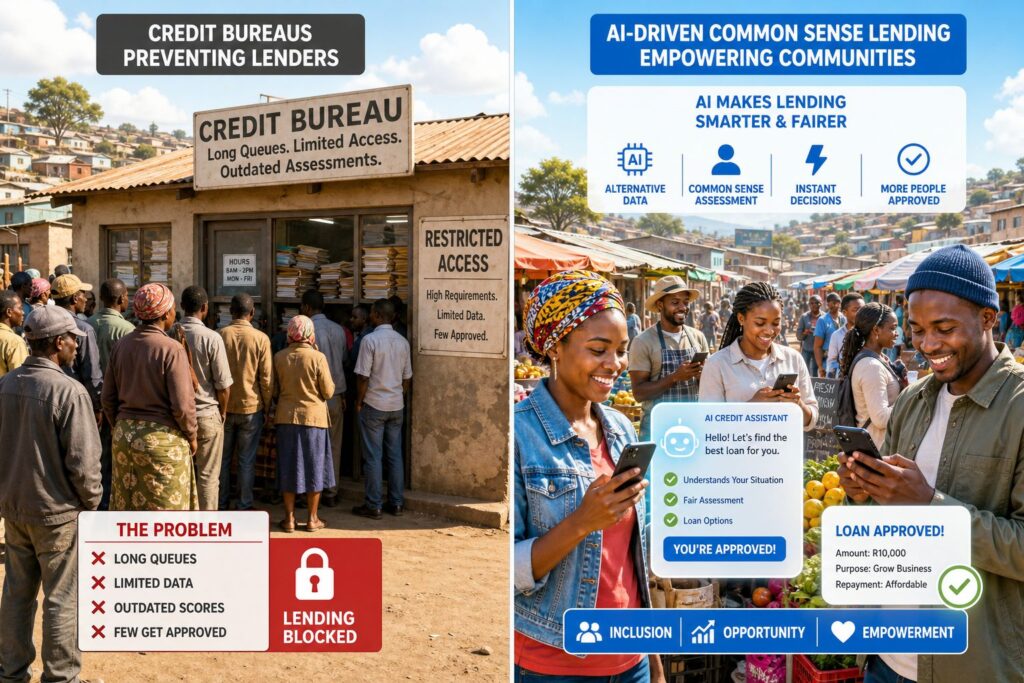
This is the distinction that matters, and traditional scoring collapses it. A bureau silence is an absence of information, but a lending policy built on bureau data is forced to treat it as though it were a signal, and the customer is declined or priced for uncertainty rather than for risk. Everyday earners, meaning traders, gig workers, informal entrepreneurs and micro service providers, are not thin on data. They are thin on the specific kind of data the bureau happens to collect. Somebody who has never borrowed but has transacted every week for four years has an extraordinarily rich history, and it is sitting inside the bank already.
A model that reads a transactional timeline therefore does not merely score these customers more accurately. It scores them at all. That is a change in eligibility rather than a change in precision, and in a mass market African book it is worth considerably more than a percentage improvement on the customers a bank can already assess.
It is worth stating the commercial consequence in the plainest available terms, because it is usually discussed as a social good when it is first of all a market sizing problem. Something close to 85 percent of employment across sub Saharan Africa is informal on ILO estimates, and even restricting the count to non agricultural work the figure sits around two thirds. A lending policy that requires evidence of regular salaried income is therefore not applying a filter to its addressable market. It is discarding the overwhelming majority of it, and then competing with every other bank for the remaining sliver, which is precisely why that sliver is over served and finely priced while everyone else pays a mashonisa.
Layer the usual additional criteria on top, whether that is minimum tenure, a bureau record, a formal address or a registered business, and a bank can comfortably reduce its own lendable population to a fifth of the people it already serves. Those customers are not absent. They are sitting inside the bank, transacting every week, generating exactly the behavioural record that would allow them to be assessed, while the assessment framework looks past all of it in search of a payslip. The institution that solves this does not win a marginal share gain. It addresses a market several times the size of the one it currently lends to, using data it already owns.
2.2 The entrepreneur whose income does not look like a salary
The clearest illustration is the class of client that has emerged around Capitec‘s Entrepreneur Account. The account was built on the published observation that more than 1.4 million clients were already running businesses through personal banking accounts, and it attracted tens of thousands of sign ups in its first months with no formal marketing. Crucially, it already offers credit facilities based on inflows, sized against daily card sales and invoices rather than against a payslip or a bureau record.
That existing design tells you the direction of travel is already settled. Credit for this segment is going to be assessed on observed money movement, because there is nothing else to assess it on. The open question is only how intelligently that movement gets read.
An inflow rule reads volume. A sequence model reads the shape of a business. It sees seasonality, so that a caterer’s quiet January is understood as a pattern rather than a deterioration. It sees the trend in the number of distinct paying counterparties, which is a leading indicator of whether a venture is growing or slowly losing its customers. It sees how quickly the business recovers from a bad month, which is close to a direct measure of resilience. It sees whether the owner is mixing personal and business flows, and whether that is getting better or worse.
Concentration is the single best example of the difference. Two traders can bank identical monthly card takings, one from four hundred customers and the other from three. Their volume based assessment is the same and their actual risk is not remotely comparable, because one is running a business and the other is one lost relationship away from having no income. A threshold cannot see that distinction. A model reading the sequence of counterparties can hardly miss it. Apply that same test honestly to a salaried applicant, as section 1.2 argues you should, and the ranking that conventional policy produces starts to look rather difficult to defend.
2.3 From a decision at one moment to a relationship that reprices
Retail credit is priced once, at origination, using the worst information about the customer the bank will ever hold. From that day forward the bank learns something new about them every single day and uses almost none of it, except to collect when things go wrong. The asymmetry is strange when stated plainly, and a model that reads financial health continuously is what makes the alternative possible.
The interesting version of this is not surveillance. It is a two way bargain. If the model can see that a client is paying well above market for an insurance policy, or that a premium has escalated faster than inflation for three years, or that discretionary spending has crept up while the buffer before payday has thinned, then the bank can say so and suggest a remedy. If the client acts, they gain twice. They free up cash flow immediately, and because their measured risk has genuinely fallen, the spread on their existing facility can come down within the term rather than at some future application.
The reason this is coherent rather than a loyalty gimmick is that the risk really has changed. More buffer days before payday, less reliance on expensive short term credit, lower volatility in month end balances and a widening rather than narrowing margin are the same signals that predicted default in the first place. A discount earned by moving those signals is repricing to a genuinely different risk, not a discount bolted on for engagement. It closes a loop that has never closed in retail lending, because for the first time the customer’s improvement is observable, priceable and rewarded while the loan is still running.
For the entrepreneur segment the same logic extends past personal budgeting into business coaching, since the model can see when a client’s receipts are becoming dangerously concentrated, when their payment terms are stretching, or when they are funding working capital out of a facility priced for something else.
2.4 What would have to be true for any of this to be responsible
None of the previous section is in the paper, and none of it describes anything any bank has announced. It is a reasonable extrapolation from what the architecture makes possible, and it comes with four constraints that are not optional.
Repricing has to move in one direction only, and it has to be committed to in advance. A model that could raise a customer’s rate during the term on the strength of inferred behaviour is a conduct scandal in waiting, and under the National Credit Act framework the defensible design is a disclosed reduction the customer can earn rather than a penalty the bank can impose. Restricting movement to downward also happens to remove most of the incentive for customers to conceal their behaviour.
Which leads to the second constraint, because customers who know that spending patterns affect their price will change their spending patterns, and some will simply move discretionary spend to cash or to a second bank. The signal degrades precisely where it is being used, which is the oldest problem in applied measurement. Downward only pricing softens this considerably but does not eliminate it, and any business case should assume some decay.
Third, gambling deserves separate and careful treatment. Gambling outflows are among the strongest risk signals available in transaction data and also the most fraught to act on, because the activity is legal, the spending is the customer’s own choice, and for a minority of people it reflects a health condition rather than a budgeting habit. There is a very large difference between offering somebody a route to support and quietly pricing their disorder into a spread. A bank that treats this as just another expense category will eventually have to explain itself, and rightly so.
Fourth, the inclusion case has to survive the proxy testing described earlier, and arguably faces a higher bar rather than a lower one. Models built with the explicit aim of serving underserved customers can still end up encoding neighbourhood, ethnicity, gender or health status through merchant level patterns, and good intentions provide no defence at all. Inclusion is the objective here, never the argument for skipping the controls.
3. What comes next
The credit case is the one with the largest social consequence, and it is also the one carrying the heaviest governance burden, which is why the sensible sequencing is to prove the idea somewhere else first.
Part three does exactly that. It covers fraud, where the same fingerprint answers a question no threshold can, and mule accounts, where a precomputed posture can hold an inbound payment before it arrives and protect somebody who is not even your customer. It also covers where the architecture fails outright, what the paper stays silent about, and why a shared representation creates a failure domain that compounds for the same reason its benefits do.
4. Sources
- PRAGMA: Revolut Foundation Model, Revolut Research and NVIDIA, arXiv:2604.08649, April 2026
- Capitec innovates to empower entrepreneurs through affordable fees and access to inflow based credit, BusinessTech, and Entrepreneur Account, Capitec Bank
- Five facts about the informal economy in Africa and the Africa informality regional statistical profile, International Labour Organization
- Open banking and financial inclusion in South Africa, South African Reserve Bank working paper, 2026
- How alternative credit models can unlock South Africa’s hidden economy, TechCentral