What Are Embeddings in AI? A Plain English Guide to Vector Search and RAG

Embeddings are numerical representations of words, sentences, or documents that capture meaning as coordinates in multidimensional space, allowing computers to measure similarity mathematically rather than by exact keyword matches. In vector search and retrieval augmented generation, embeddings let systems find conceptually related content, powering smarter search, fraud pattern detection, and accurate knowledge retrieval across large, unstructured datasets efficiently and reliably.
1. The problem nobody states plainly
Every time someone in banking talks about Retrieval Augmented Generation, vector databases, or semantic search, the word embeddings surfaces almost immediately, and most people in the room nod without actually knowing what an embedding is. That is not a criticism. It is simply what happens when a mathematical concept gets absorbed into product marketing before it gets explained properly. Once you strip the mystique away, embeddings turn out to be one of the more approachable ideas in modern AI, and understanding them properly changes how you think about search, fraud detection, and knowledge retrieval across an entire organisation.
2. Start with the library, not the linear algebra
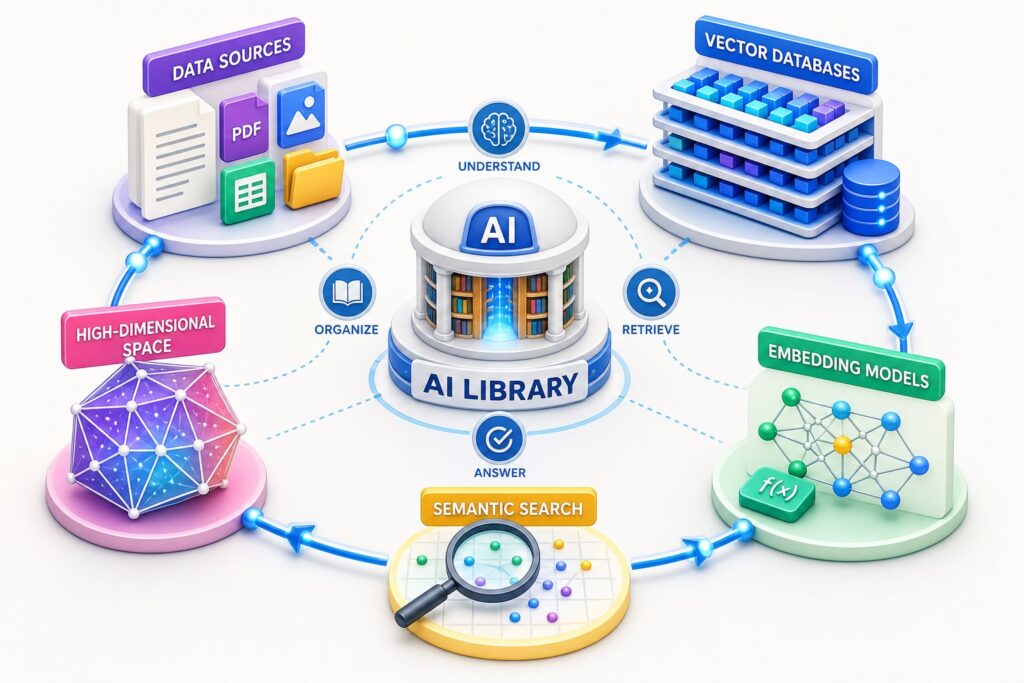
Picture a library holding hundreds of millions of documents. Someone walks in and asks for everything related to attacks on customer accounts. You have two options. The first is to open every document and read it, which obviously does not scale once you are past a few hundred pages. The second is to organise the entire library by meaning long before anyone asks a question, so that documents discussing similar ideas end up physically near each other regardless of the specific words they use. When a question arrives, you work out where it belongs on that map and walk directly to the relevant shelf. That is what an embedding model does, except the shelf is a location in mathematical space rather than a physical one.
3. Every document gets a coordinate
The analogy I keep returning to is a GPS coordinate for meaning rather than for geography. Documents about fraud sit close to documents about phishing. Documents about mortgage origination form a separate neighbourhood entirely. The model does not invent these neighbourhoods by instruction. It learns them from the patterns in the underlying language, and once every document has a coordinate, search stops being a matter of reading everything and becomes a matter of asking which documents live closest to the question.
4. The space itself is far larger than intuition expects
A normal coordinate has two numbers, latitude and longitude. An embedding typically has hundreds, and in the case of many production models over a thousand. That list of numbers is called a vector, and together those numbers describe a unique position inside a space with far more dimensions than anyone can visualise. This is where most explanations of embeddings quietly give up, so it is worth being direct about it. You are not meant to picture a thousand dimensional space. Nobody can. You are meant to trust that the geometry still works even though your intuition stops being useful past three dimensions.
5. Individual numbers mean almost nothing on their own
A common misconception is that one number in the vector represents fraud, another represents cybersecurity, and another represents finance. That is not how the mathematics works. No single value in the vector carries meaning by itself. The pattern across all the values together is what encodes meaning, in much the same way that no single facial measurement identifies a person, but eye spacing, jaw width, and cheekbone height taken together produce something unmistakably specific. Embeddings behave the same way. Collectively the numbers describe something. Individually they describe nothing at all.
6. Questions live in the same space as documents
The genuinely clever part of the design is that a question gets passed through the same embedding model as the documents it is being compared against, so the question ends up with a coordinate in exactly the same space. If one document says social engineering payment fraud, another says credential theft, and a third says account takeover, while the question simply asks about attacks on customer accounts, very little vocabulary overlaps between them. A search built on matching keywords would struggle badly here. An embedding based search does not, because the underlying concepts occupy nearby regions of that meaning space even when the words used to describe them are completely different. The system is comparing ideas rather than vocabulary, which is the entire reason this approach earned the name semantic search.
7. Closeness is measured, not guessed
Given thousands of coordinates on a map, the practical question becomes which ones sit nearest to a newly dropped pin. Systems typically answer this by measuring the angle between two vectors using cosine similarity rather than calculating physical distance. A smaller angle means a closer match in meaning, and a larger angle means the opposite. You do not need to work through the underlying mathematics to make use of it. You only need to remember that a small angle signals similar meaning and a large angle signals a different one.
8. Nobody compares against every document at query time
Vector databases such as Pinecone, Weaviate, Milvus, and pgvector exist precisely because comparing a new question against every stored document would be far too slow at any meaningful scale. These systems build specialised indexes that act as shortcuts through the space, similar to how a GPS narrows a search to the correct suburb rather than checking every house in a city. That indexing work is why searches across millions or billions of stored embeddings complete in milliseconds rather than hours.
9. The language model is rarely doing the searching
A typical Retrieval Augmented Generation pipeline follows a fairly consistent sequence. Documents get converted into embeddings and stored in a vector database ahead of time. A user asks a question, which is converted into an embedding using the same model. The vector database finds the closest matches, and only those matches get passed to the language model, which then reads them and produces the answer. The model itself never searches through the full document set. Something else has already found the relevant pages and handed them over, and this division of labour is exactly why the approach scales as well as it does across large organisations sitting on decades of accumulated documentation.
10. What embeddings are not
It is worth being explicit about the limits here, because the terminology invites overreach. Embeddings do not understand language, reason about it, or generate text. They are a way of representing meaning as mathematics so that similarity can be measured and retrieved quickly. The intelligence still comes from the language model reading what gets retrieved. The embedding simply makes sure it is reading the right material in the first place.
11. Tracing one question through the whole system
Say a bank holds half a million internal documents, each converted into an embedding and stored months earlier. An employee asks how attackers typically compromise customer accounts. That question gets converted into a vector using the same embedding model, and the vector database compares it against the stored collection, not by reading every document or matching exact phrases, but by identifying which stored vectors occupy the closest region of that meaning space. The closest matches might turn out to be documents titled Credential Theft Techniques, Social Engineering and Phishing, Multi Factor Authentication Bypass, and Account Takeover Case Studies, none of which contain the literal phrase customer account attacks. That does not matter, because they are close in the space that actually governs the search. Those documents, and only those documents, then go to the language model, which synthesises them into a coherent answer grounded in the organisation’s own material. At no point did the model search half a million documents on its own. The embedding quietly pointed it toward the correct shelf.
12. Why this matters beyond the technical curiosity
For anyone running fraud detection, knowledge management, or internal search at scale, the practical implication is that the quality of your retrieval layer now matters as much as the quality of your language model. A brilliant model reading the wrong documents will still produce a mediocre answer. Getting embeddings and retrieval right is unglamorous work compared to talking about the model itself, but it is the part of the system that decides whether the model ever sees the material it needs to reason well.