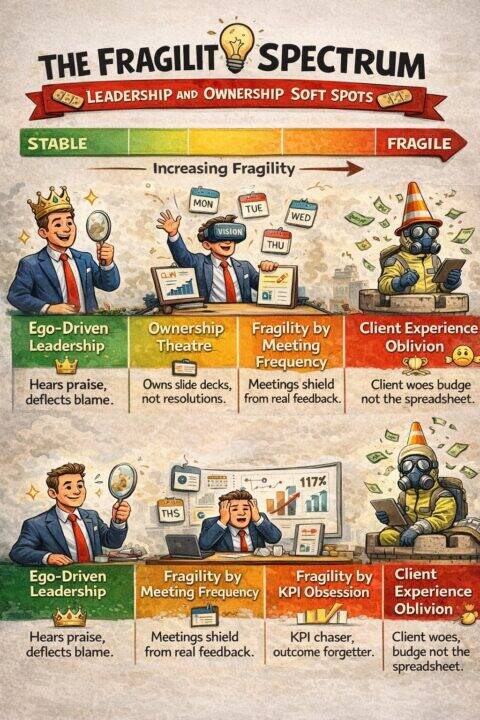
Leadership, Ownership and Fragility
Leadership failures rarely announce themselves politely. They arrive disguised as “can we just check in?” or “let’s align on a better way of working.” It sounds constructive, even mature. But scratch the surface and the origin story is almost always the same: something went wrong, and the organisation does not know how to deal with it cleanly. What follows is a predictable, energy wasting ritual. And the organisations that repeat it are fragile by design.
1. When Something Goes Wrong, Only Two Things Matter
When an issue occurs, only two things should happen. First, do we agree that something went wrong. Second, how do we fix it and make sure it does not happen again. That is it. Everything else is noise.
The first step is often stormy. That is normal. Storming is not dysfunction; it is the process of forcing a shared understanding to emerge. Different facts, interpretations and incentives collide in the open. This collision is healthy if, and only if, it is not personalised. The storm is about the problem, not the people. Fragile organisations confuse the two.
2. The Fatal Error: Personalising the Storm
Somewhere during the storm, someone inevitably says: “I perceive that you are angry” or “I perceive that you are frustrated.” This is projection masquerading as emotional intelligence.
Busy, effective leaders are rarely angry or frustrated in these moments. Both require emotional energy they are not willing to waste. What they care about is whether the room converges on a shared understanding of reality. The moment the conversation shifts from facts to perceived emotions, the entire system derails. Now the discussion is no longer about what happened; it is about managing feelings, defending intent and protecting ego. That is fragility revealing itself.
3. Blame Is Not Ownership
The next predictable move is attribution. “I just want to be clear, person A did X, Y and Z. My team did nothing wrong.” This sentence is never followed by progress. It is not ownership; it is blame wrapped in professional language.
Ownership sounds very different. “Leave this with me. I will get it sorted and I will make sure it does not happen again.” Ownership does not require seniority. It does not require proximity to the original failure. It does not require proving innocence first. Ownership is a mindset that says: whatever this is, I can help fix it, and I do not care where the fault ultimately lands.
Weak organisations are obsessed with fault lines. Strong ones are obsessed with outcomes.
4. Leadership Without Fragility
Fragile leaders need private consensus. They need side rooms, pre meetings and alignment calls to protect their image before engaging in the real conversation. They cannot say, “Sorry, I think I may have duffed this one.” So instead, they diffuse accountability, soften language and drain urgency from execution.
This does not build trust. It destroys it.
Trust is built when problems are confronted openly, owned decisively and fixed aggressively. Trust is built when leaders do not flinch during the storm.
5. After the Storm, There Is Only Execution
Once common understanding exists, discussion should end. Now we execute, with prejudice and vigour. Not cautiously. Not diplomatically. Not with endless follow ups designed to protect feelings.
Execution is the trust building mechanism. Every time ownership leads to visible action, credibility compounds. Every time blame leads to delay, fragility compounds.
Do not hide the storm. Embrace it. Do not fear ownership. Seek it. Do not mistake calmness for weakness; it is often unshakeable strength. The best leaders I have worked with all share one trait: they smile when you try to trigger them. Not because they do not care, but because they know exactly what matters next.
And it is never blame.