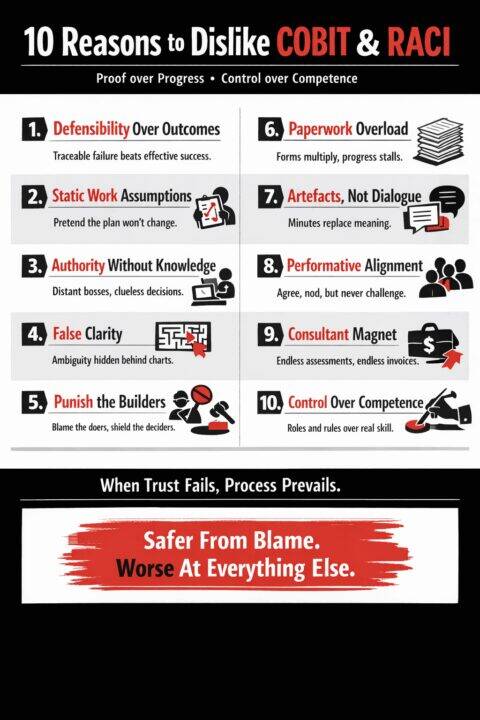
COBIT and RACI: 10 Reasons They Harm Governance
Or: How Organisations Confuse Accountability with Paperwork
1. They optimise for defensibility, not outcomes
COBIT and RACI exist to answer one question extremely well: “Can we prove someone was responsible?” They are almost entirely indifferent to the harder question: “Did anything improve?”
Both frameworks reward traceability over truth. If an initiative fails, the organisation can point to a process, a role, a sign off, or a control and say “we followed the framework.” That is not governance. That is legal cover.
Good systems reduce the need for defence. COBIT and RACI exist because the system is already broken.
2. They assume work is static, predictable, and decomposable
RACI assumes you can clearly define who is Responsible, Accountable, Consulted, and Informed before meaningful work begins. COBIT assumes risks can be identified, controlled, and monitored as stable artefacts.
Neither assumption survives contact with real software, real customers, or real uncertainty.
In discovery heavy work, responsibility moves. Accountability shifts. Knowledge evolves. Frameworks that freeze responsibility early guarantee misalignment later.
3. They separate authority from knowledge
RACI diagrams almost always assign accountability to the least informed person in the room. COBIT governance structures almost always sit furthest from the code, the customer, and the failure modes.
This produces a predictable outcome. Decisions are made by people who cannot observe the system they govern.
When authority is disconnected from understanding, frameworks rush in to fill the gap. They do not fix the gap. They institutionalise it.
4. They create the illusion of clarity while hiding real ambiguity
RACI charts look precise. COBIT process models look rigorous. In reality, they mask unresolved questions.
Who actually decides when trade offs collide?
Who absorbs risk when controls conflict with delivery?
Who intervenes when accountability exists only on paper?
The framework answers none of these. It just makes the ambiguity harder to challenge.
5. They punish the people closest to the work
When something goes wrong under COBIT or RACI, the investigation rarely asks whether the system design was flawed. It asks whether the process was followed.
Engineers and delivery teams become risk vectors to be controlled, audited, and constrained. Leadership becomes abstracted, protected, and insulated.
6. They scale paperwork faster than capability
As organisations grow, COBIT and RACI scale linearly in documents and exponentially in overhead. Every new initiative requires more matrices, more controls, more sign offs, more evidence.
What does not scale at the same rate is judgement, context, or engineering maturity.
This is how large organisations become simultaneously slow, expensive, and fragile while insisting they are “well governed.”
7. They turn conversations into artefacts
Healthy organisations resolve ambiguity through dialogue. COBIT and RACI replace dialogue with documentation.
Decisions are no longer debated, they are recorded. Disagreements are not resolved, they are escalated. Learning is replaced with compliance.
Once everything becomes an artefact, people stop thinking out loud. They start writing defensively.
8. They reward performative alignment
RACI charts encourage head nodding consensus. COBIT governance forums encourage “alignment” without challenge.
Disagreeing with a framework feels like disagreeing with governance itself. That is why bad ideas survive so long inside “well governed” organisations.
When alignment is valued more than truth, frameworks become tools for social control, not organisational effectiveness.
9. They are irresistible to consultants for all the wrong reasons
Both COBIT and RACI are abstract, adaptable, and never truly complete. This makes them perfect consulting substrates.
There is always another maturity assessment to run, another operating model to refine, another RACI to “clean up.” None of this guarantees better systems. All of it guarantees billable hours.
Frameworks that create permanent demand for interpretation should trigger suspicion, not trust.
10. They mistake control for competence
The most dangerous belief underpinning COBIT and RACI is this. If we define enough roles and controls, competence will emerge.
It never does.
Competence comes from practice, feedback, ownership, and proximity to consequences. Control frameworks can only constrain incompetence. They cannot create excellence.
Organisations that rely on COBIT and RACI are not well governed. They are afraid to trust people who know what they’re doing.
Closing thought
COBIT and RACI are not neutral tools. They encode a worldview where mistrust is rational, ambiguity is dangerous, and paperwork is safer than judgement.
If your organisation needs them to function, the problem is not missing frameworks. The problem is missing understanding.
The irony is brutal. The more you govern through abstraction, the less governable the system becomes.