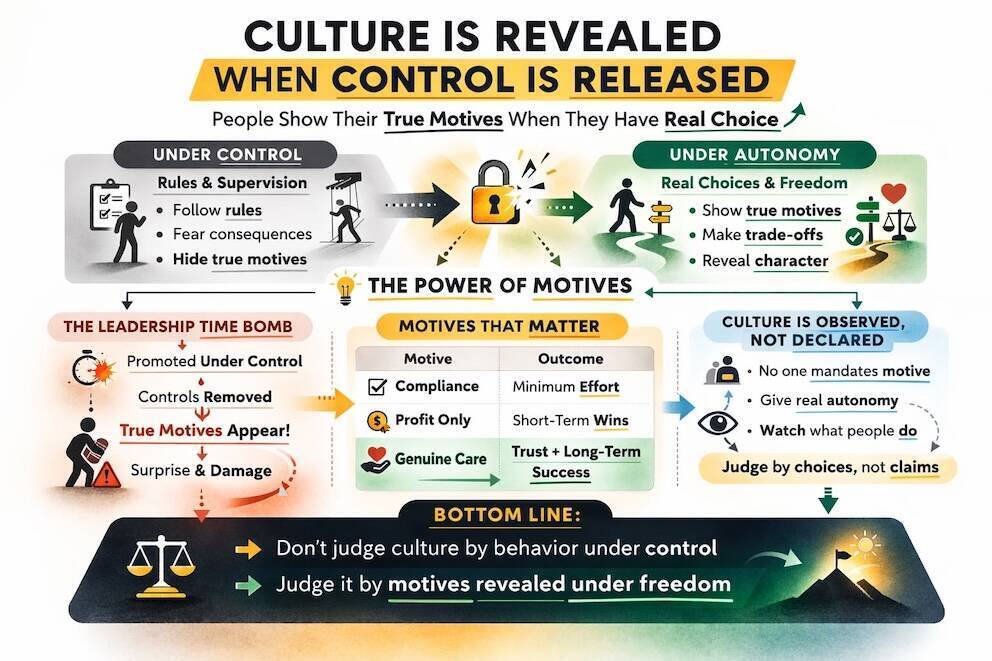
The Power of Motives: Why Culture Is Revealed When Control Is Released
Culture is not revealed by behaviour under control, but by motive under autonomy.
Highly controlled environments mask intent and allow organisations to promote leaders whose inner compass has never been tested. When controls are later removed at seniority, behaviour shocks leadership and risk materialises.
Durable outcomes, whether in fraud prevention, customer trust, or leadership quality, only occur when actions are driven by genuine care rather than compliance, optics, or profit alone. Boards should insist not only on strong controls, but on leadership systems that deliberately create space to observe motive early, before authority becomes irreversible and consequences become systemic.
Most leadership systems obsess over what people do. What was delivered. What was measured. What was complied with. What was audited. These things are visible, countable, and comforting. They fit neatly into dashboards, scorecards, and board packs. But culture does not live there.
Culture lives in why people do things. And why is internal, invisible, and deeply problematic to measure when behaviours are constrained. You can of course mandate behaviour, but you cannot mandate motive. Yet motive is the thing that determines what happens when nobody is watching, when tradeoffs get hard, and when doing the right thing becomes expensive, slow, or personally costly.
This is where most organisations fool themselves. They mistake control for character, compliance for conviction, and execution under instruction for leadership potential. As long as the system is tight, everyone looks aligned. But alignment under constraint tells you almost nothing about who someone really is.
If you want to understand your culture, and the leaders your organisation is actually producing, you have to look past what people do and start paying attention to why they do it.
1. Control Masks Motive
Highly controlled environments create a dangerous illusion. When everything is prescribed, what to do, how to do it, when to do it, who approves it, motive becomes irrelevant. People comply not because they believe, but because they are told.
In these environments, obedience looks like alignment, silence looks like agreement, and compliance looks like character. But this is a mirage. You are not observing who someone is. You are observing who someone is when constrained.
2. Autonomy Is the X Ray for the Soul
Motives only become visible when control is reduced. When there is less instruction, fewer approvals, real discretion, and real tradeoffs, people start to reveal their internal compass. Some step up, protect others, and take responsibility without being asked. Others optimise for personal safety, defer hard decisions, hide behind process, shift blame, or exploit ambiguity.
This is not a failure of governance. This is the test. If you do not allow upcoming leaders space, you never get to see their heart condition or their true motivation for doing things.
3. The Leadership Time Bomb
There is a common pattern that quietly destroys organisations. Juniors operate under heavy control. Motives are never observed. Promotions happen based on execution under constraint. Then, at seniority, controls are removed and behaviour suddenly changes. Leadership is shocked.
By that point, authority has already been granted, political capital has already been accumulated, and reversing the decision is expensive and destabilising. The problem was not that the leader changed. The problem is that you never saw them clearly before.
4. Motives Decide Whether You Will Do the Hard Thing
Consider fraud as a concrete example. Why are you investing in fraud controls? Is it because regulators compelled you? Because the media embarrassed you? Because you fear financial losses? Because auditors raised findings? Or is it because you genuinely love your clients and want to protect them?
These motivations are not equivalent. They produce radically different outcomes.
5. Love Is the Only Motivation Strong Enough
If being good at fraud requires rewriting your app, rebuilding your call centre stack, rearchitecting identity flows, retraining staff, and accepting real short term friction and cost, you will not do it for compliance, optics, or risk registers. It is simply too much effort.
Only love sustains that level of commitment.
Think about children. Even without love, you would still make sure they were fed, clothed, educated, and statistically unlikely to perish. Civilization has standards. But without love, you would almost certainly look for distance. You would outsource the problem to a boarding school, a relative, or an institution with timetables and rules, because children are exhausting, irrational, and profoundly inefficient unless you love them.
Love is what makes the sleepless nights tolerable, the mess forgivable, and the long view worth taking. Children raised without love may survive perfectly well in the short term, but they tend to return later as far more expensive problems. Organisations behave the same way. Without genuine care, leaders will meet minimum obligations, optimise for containment, and outsource discomfort. And just like neglected children, cultures raised without love do not disappear. They grow up.
6. Money as a Motive: How Clients Instantly Know
Now consider a more everyday interaction. If your primary motive is money, then every interaction with a client becomes an opportunity to sell. Cross sell. Up sell. Bundle. Close a deal.
But imagine a client who has had a problem with your company and waited 30 minutes to speak to someone. Trying to sell to them in that moment is not clever. It is inappropriate and insensitive, and the client feels it instantly and the discomfort of the consultant trying to push something at an inappropriate time, is palpable to all.
When the motive is right, the response changes completely. You let them go. You apologise properly. You fix the issue. You give them a loyalty reward. And perhaps quietly, inside that reward, you include the special offer you were hoping to sell. The sale is no longer the point; the relationship is.
When money is the motive, you optimise for extraction. When care is the motive, you optimise for trust.
7. Why Motives Trump Marketing Every Time
Without good motives, nothing is durable. Clients may tolerate you for a while. They may respond to discounts or campaigns. But they will not trust you.
Motives leak. They show up in tone, timing, tradeoffs, and priorities under pressure. They are externally visible, and they overpower whatever marketing budget you have. No amount of brand spend can hide bad intent for long.
Motives make you naked. They expose who you really are to your staff, your peers, and your clients. Which is why it is far better to understand where your team is coming from before your clients do.
8. Culture Is Observed, Not Declared
You cannot train motive, policy motive, or audit motive. You can only observe it. And observation requires reduced control, real autonomy, real responsibility, and real consequences.
Leadership development is not about preparing people to perform. It is about creating conditions where their true motivations surface.
9. The Counterintuitive Leadership Discipline
Great leaders do something uncomfortable. They release control before people are senior. They watch carefully, take notes, and intervene early. This feels risky, but the real risk is discovering too late who someone becomes when they are finally free.
10. The Choice Every Organisation Faces
You can control tightly, promote safely, and be shocked later. Or you can release thoughtfully, observe honestly, and promote with conviction.
Culture is not built by rules.
Culture is revealed by motives under freedom.