I have started writing production code again.
Not prototypes. Not proofs of concept. Real systems. Real risk. Real consequences.
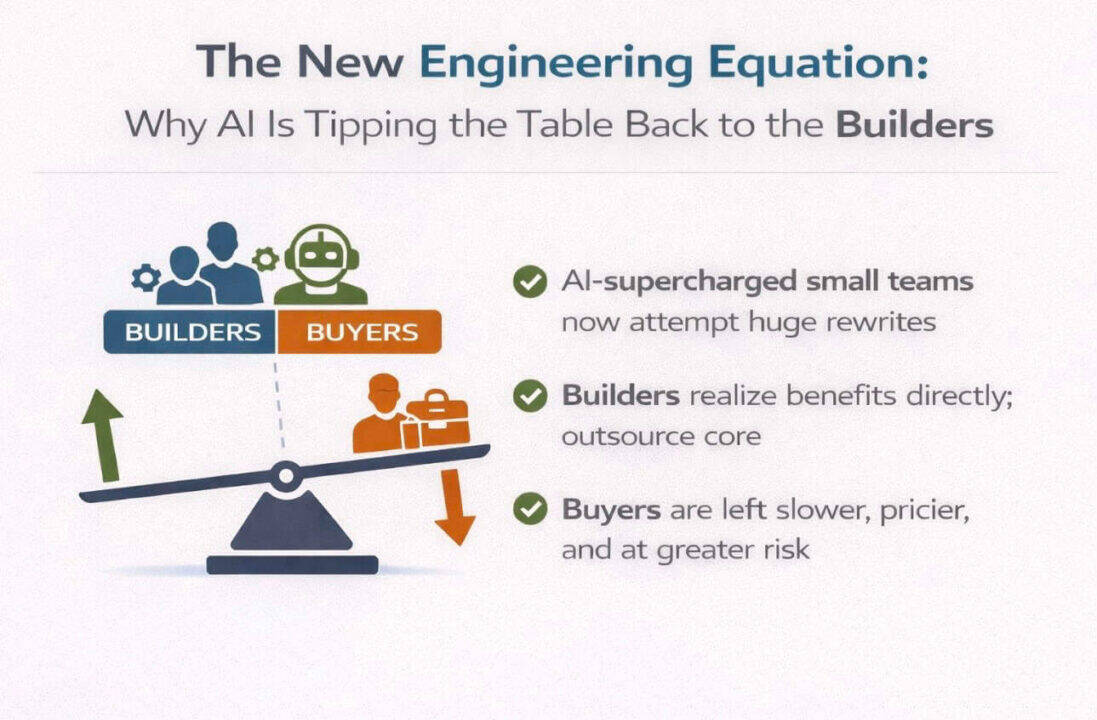
At Capitec, a very small group of engineers is now tackling something that would historically have demanded hundreds of people: large scale rewrites of core internet banking capabilities. This is not happening because budgets magically increased or timelines became generous. It is happening because the underlying economics of software engineering have shifted. Quietly. Irreversibly.
AI assisted development is not just making engineers faster. It is changing what is economically possible. And that shift has profound consequences for how systems are built, who wins, and who slowly loses relevance.
This is not about vibe coding. It is about a new engineering equation.
1. This Is Not Vibe Coding
There is a growing narrative that AI allows anyone to describe what they want and magically receive working software. That framing is seductive and dangerously wrong.
In regulated, high consequence environments like banking, blindly accepting AI output is reckless. What we are doing looks very different. AI does not replace engineering intent. It amplifies it.
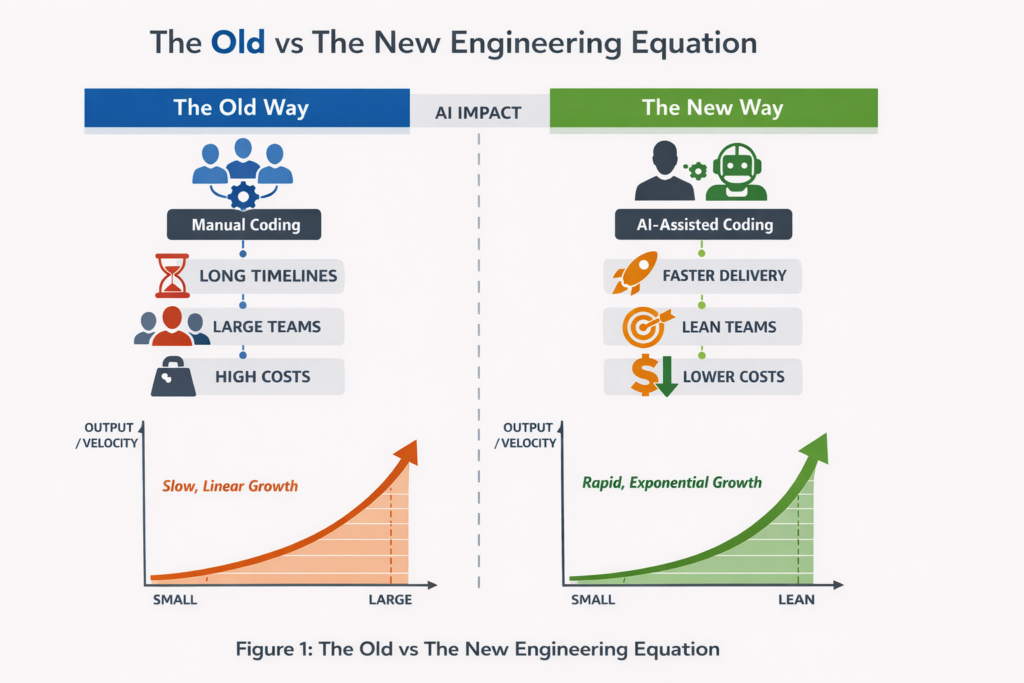
Engineers still define architecture, boundaries, invariants, and failure modes. AI agents execute within those constraints. Every line of code is still owned by a human, reviewed by a human, and deployed under human accountability. The difference is leverage.
Where one engineer previously produced one unit of progress, that same engineer can now produce an order of magnitude more, provided the system around them is designed to absorb that speed.
2. Agentic Engineering Changes Velocity and Risk at the Same Time
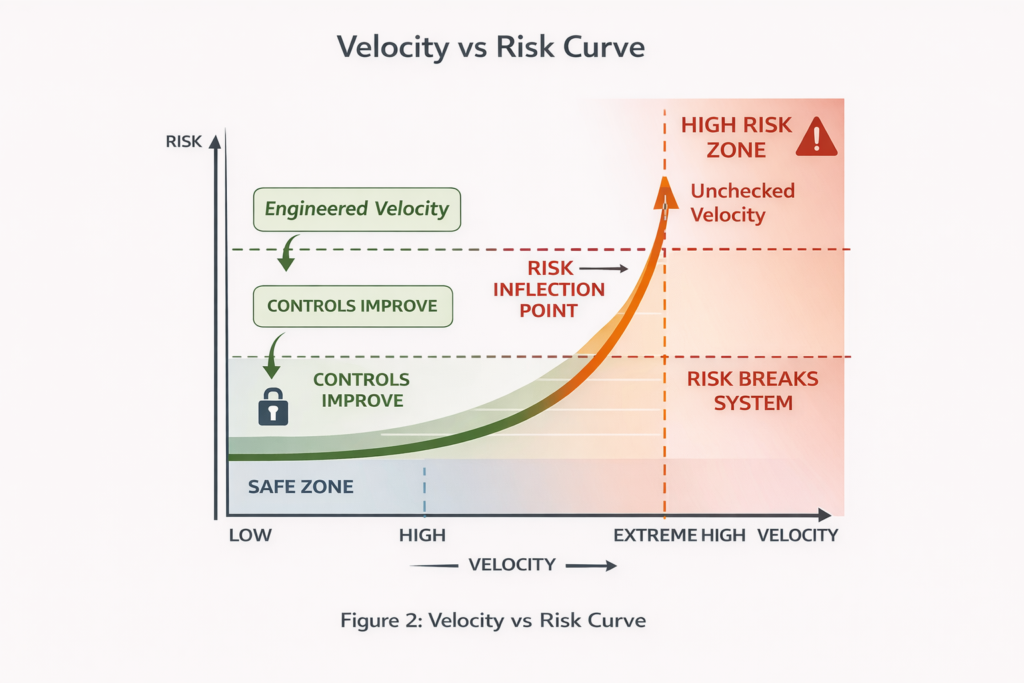
The most obvious benefit of AI assisted development is throughput. The less obvious cost is risk concentration.
When a small team moves at extreme velocity, mistakes propagate faster. Architectural errors are no longer local. Feedback loops that were “good enough” at traditional speeds become existential bottlenecks. This forces a recalibration.
You cannot bolt AI onto old delivery models and expect safety to hold. The entire lifecycle has to evolve. Velocity without compensating controls is not progress. It is deferred failure.
3. Testing Becomes a First Class Engineering Asset
At this scale and speed, testing stops being a checkbox activity and becomes a core product.
AI makes it economically viable to build things we previously avoided because they were “too expensive”:
- Full system simulations
- High fidelity fakes of external dependencies
- End to end tests runnable locally
- Failure injection under load
These are not luxuries. They are the only way to operate safely when AI is generating large volumes of code.
The paradox is that AI does not reduce the need for testing. It increases it. But it also collapses the cost of building and maintaining those test harnesses. This is where disciplined teams pull away from everyone else.
4. Feedback Loops Must Collapse or Everything Breaks
Slow feedback is lethal in high velocity systems. If your CI pipeline takes hours, you are already losing. If it takes days, you have opted out of this new world entirely.
Engineers and AI agents need confirmation quickly. Did this change break an invariant? Did it violate a performance budget? Did it alter a security boundary?
The goal is not just fast feedback. It is continuous confidence. Anything slower becomes friction. Anything slower becomes risk.
5. Coordination Beats Process at High Speed
Traditional process exists to manage scarcity. Meetings, approvals, handoffs, and documentation evolved when change was expensive. AI inverts that assumption.
When change is cheap and frequent, coordination becomes the scarce resource. Small, colocated teams with tight communication outperform larger distributed ones because decisions happen immediately.
This is not a tooling problem. It is an organisational one. The fastest teams are not the most automated. They are the most aligned.
6. Why AI Favours Builders Over Buyers
There is an uncomfortable implication in all of this. The organisations extracting the most value from AI are those who still build their core systems.
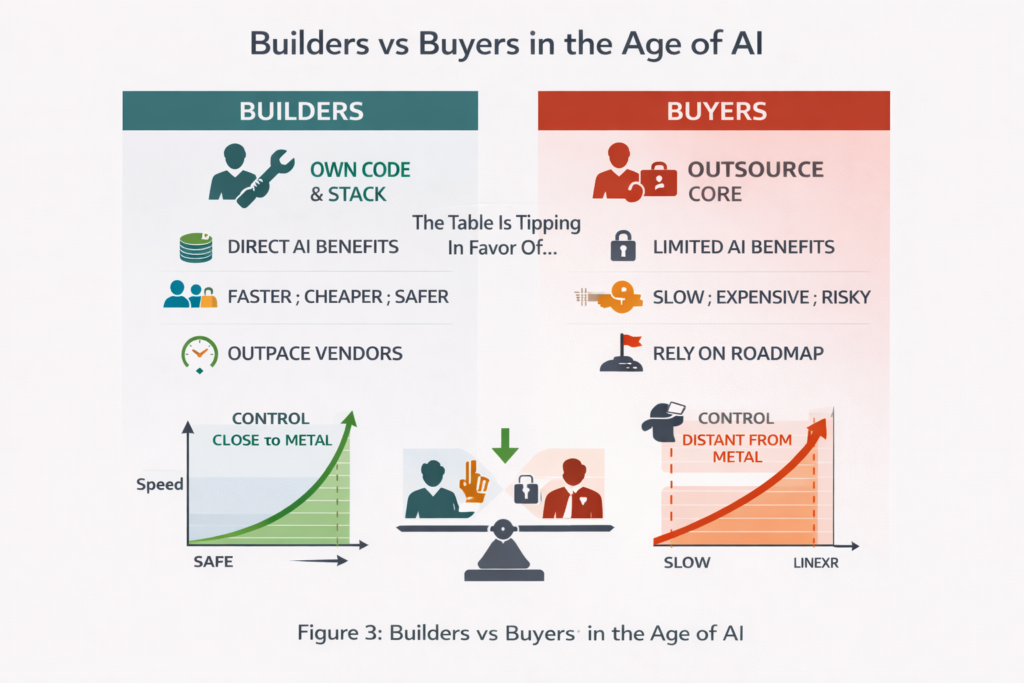
If you are deeply locked into vendor platforms, proprietary SaaS stacks, or opaque black box solutions, you are structurally constrained. You do not control the code. You do not control the abstractions. You do not control the rate of change.
Vendors will absolutely use AI to improve their own internal productivity. But those gains will rarely be passed back proportionally. At best, prices stagnate. More often, feature velocity increases while commercial leverage shifts further toward the vendor. AI accelerates the advantage of proximity to the metal.
Builders can refactor systems that were previously untouchable. They can collapse years of technical debt into months. They can afford to build safety rails that previously failed cost benefit analysis. Buyers wait for roadmaps. This is a quiet power shift.
For the first time in a long time, small, highly capable teams can out execute organisations that outsourced their core competence. The table, at least for now, is tipping back toward the builders. Buying software is not wrong. Buying your core increasingly is.
The new currency is thinking, not doing. If you’re attached to a vendor then you need to parcel up your IP and wait for it to boomerang back to you, or maybe you can buy the execution from them at $1500 per day per resource 😳
7. What This Means for Large Scale Rewrites
Internet banking rewrites used to be multi year, multi vendor, high risk undertakings. The cost alone forced compromise. That constraint is eroding.
With AI assisted development, small teams can now attempt rewrites incrementally, safely, and with far more confidence; provided they own the architecture, the testing, and the delivery pipeline.
This is not about replacing engineers with AI. It is about removing everything that prevented engineers from doing their best work. AI does not reward ownership in name. It rewards ownership in practice.
Ownership of code
Ownership of architecture
Ownership of feedback loops
Ownership of change
8. Conclusion: The New Flow of Ideas
What’s truly at stake isn’t just faster code or higher throughput. It’s the flow of ideas.
AI is not merely an accelerant. It is the scaffolding that allows ideas to move from intent to reality at unprecedented speed, while remaining safe. It creates the guard rails that constantly test that nothing has regressed, that negative paths are exercised, that edge cases are explored, and that vulnerabilities are surfaced early. AI probes systems the way attackers will, performs creative hacking before adversaries do, and exposes weaknesses while they are still cheap to fix.
None of this removes the need for engineers. Discernment still matters. Understanding still matters. Creation, judgment, and problem solving remain human responsibilities. AI does not decide what to build or why. It ensures that once an idea exists, it can move forward with far less friction and far more confidence.
What has changed is visibility. Never before has the speed difference between those who are progressing and those who are merely watching been so obvious. A gulf is opening between teams and companies that embrace this model and those constrained by vendor contracts, rigid platforms, and outsourced control. The former compound learning and velocity. The latter wait for roadmaps and negotiate change through contracts.
The table has shifted back toward the builders so structurally that it’s hard to see any other pathway to compete effectively. Ownership of code, architecture, and feedback loops now directly translates into strategic advantage. In this new engineering equation, speed is not recklessness. It is the natural outcome of ideas flowing freely through systems that are continuously tested, challenged, and reinforced by AI.
Those who master that flow will move faster than the rest can even observe.