The Frustration of the Infinite Game
1. Technology Is an Infinite Game and That Is the Point
Technology has no finish line. There is no end state, no final architecture, no moment where you can stand back and declare victory and go home. It is an infinite game made up of a long sequence of hard fought battles, each one draining, each one expensive, each one slower than anyone would like. The moment you solve one problem, the context shifts and the solution becomes the next constraint.
Everything feels too expensive, too difficult and too slow. Under that pressure, a familiar thought pattern emerges. If only we could transfer the risk to someone else. If only we could write enough SLAs, sharpen enough penalties and load the contract until gravity itself guarantees success. If only we could hire lawyers, run a massive outsourcing RFP and make the uncertainty go away.
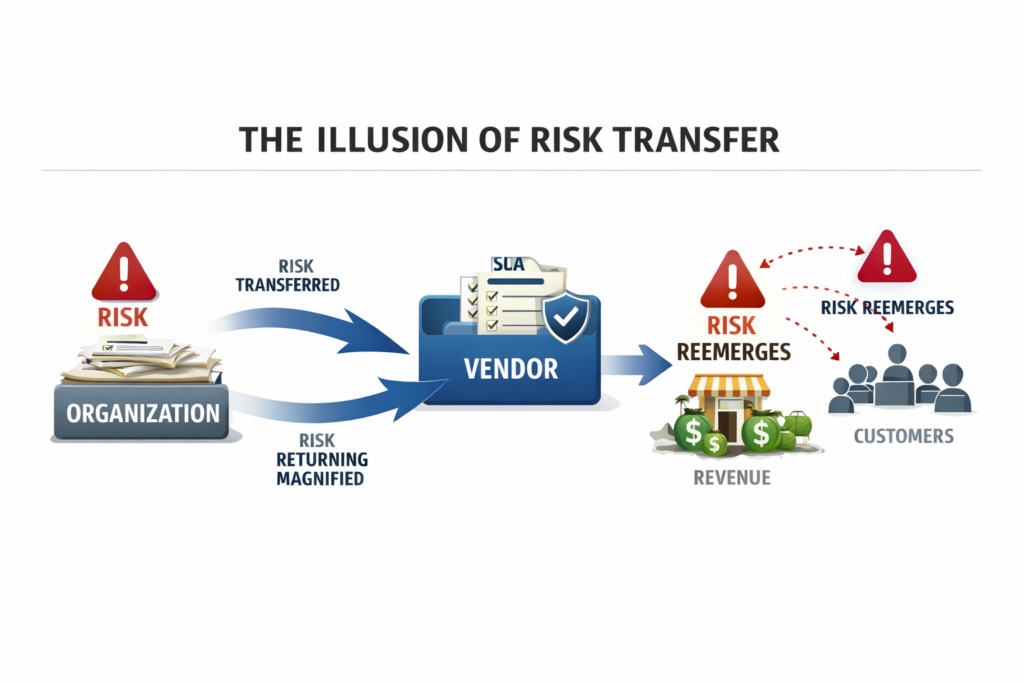
This is the first lie of the infinite game. Risk does not disappear just because you have moved it onto someone else’s balance sheet. It simply comes back later with interest, usually at the worst possible time.
2. The Euphoria Phase and the Hangover That Follows
The outsourcing cycle always begins with euphoria. There is a media statement. Words like strategic and synergies are deployed liberally. Executive decks are filled with arrows pointing up and to the right. Contracts are signed. Photos are taken. Everyone congratulates each other on having made the hard decisions. Then reality arrives quietly.
Knowledge transfer begins and immediately reveals that much of what matters was never written down. Attrition starts to bite, first at the edges, then at the core. The people who actually understood why things were built the way they were begin to leave, often because they were treated as interchangeable delivery units rather than as the source of the IP itself.
You attempted to turn IP creation into the procurement of pencils. You specified outputs, measured compliance and assumed the essence of the work could be reduced to a checklist. What you actually outsourced was your ability to adapt.
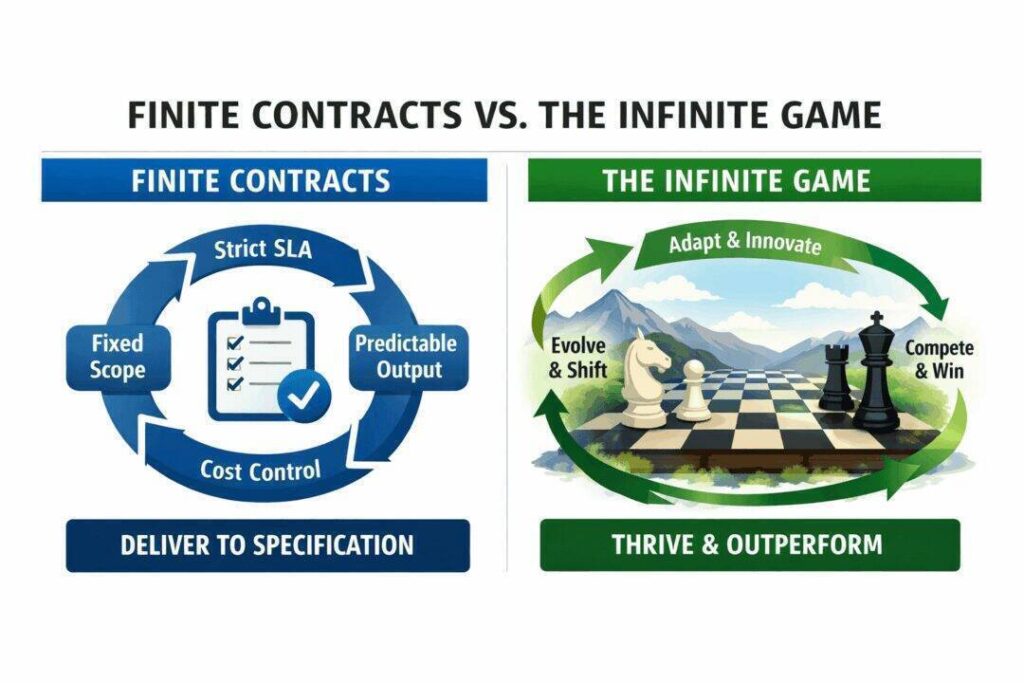
3. Finite Contracts Versus Infinite Competition
Outsourcing is fundamentally a finite game. It is about grinding every last cent out of a well defined specification. It is about predictability, cost control and contractual certainty. Those are not bad things in isolation. Competition, however, is infinite.
You are not playing to complete a statement of work. You are playing on a chessboard with an infinite number of possible moves, where the only goal is to win. To be better than the competition. To innovate faster than they do. To thrive in an environment that changes daily.
The absurdity of this mismatch is often visible in the contracts themselves. Somewhere deep in the appendices you will find a line item for innovation spend, because the board asked for it. As if innovation can be pre purchased, time boxed and invoiced monthly. Innovation is not a deliverable. It is an outcome of ownership, proximity and deep understanding.
4. When Outsourcing Actually Works
Outsourcing does work, but only under very specific conditions. It works when the thing you are outsourcing is not mission critical. When it is a side show. When failure is survivable and learning is optional.
Payroll systems, commodity infrastructure, clearly bounded operational tasks can often be externalised safely. The moment the outsourced capability becomes core to differentiation, speed or revenue generation, the model starts to collapse under its own weight.
The more central the capability is to winning the infinite game, the more dangerous it is to distance yourself from it.
5. Frameworks as a Way Down the Complexity Food Chain
There is a more subtle version of the same instinct, and it shows up in the overuse of vendor frameworks. Platforms like Salesforce allow you to express your IP in a controlled and well defined way. You are deliberately moving yourself down the complexity food chain. Things become easier to reason about, easier to hire for and easier to operate.
There is nothing inherently wrong with this. In many cases it is a rational trade off.
The danger appears when this pattern is applied indiscriminately. When every problem is forced into a vendor shaped abstraction. When flexibility is traded for integration points until you find yourself wrapped in a beautifully integrated set of shackles. Each individual decision looked sensible. The aggregate outcome is paralysis.
You did not remove complexity. You just externalised it and made it harder to escape.
6. No Strategic End State Exists
Technology strategy does not converge. There is no strategic end state. Looking for one is like looking for a strategic newspaper. It changes every day.
Mortgaging today to pay for a hypothetical tomorrow is how organisations lose their ability to move. Long term plans that require years of faith before any value is delivered are a luxury few businesses can afford. Try to operate with a tiny balance sheet. Keep commitments short. Keep feedback loops tight.
Whatever you do, do it efficiently and quickly. Get it to production. Make money from it. Learning that does not touch reality is just theory.
Anyone who walks into the room with a five year roadmap before delivering anything meaningful should be sent back out of it. Some things genuinely do take time, but sustainable businesses run on a varied delivery diet. Small wins, medium bets and the occasional long horizon investment, all running in parallel.
7. The Cost of Playing the Infinite Game
Technology is hard. It always has been. It demands stamina, humility and a tolerance for discomfort. There are no permanent victories, only temporary advantages. The frustration you feel is not a sign of failure. It is the admission price for playing an infinite game.
You do not win by outsourcing the game itself. You win by staying close to the work, owning the risk and being willing to fight the next battle with clear eyes and minimal baggage.
8. The Question Nobody Wants to Ask About Outsourcing
There is a question that almost never gets asked out loud, despite how obvious it is once you say it. How many companies that specialise in outsourcing actually lose money? The answer is vanishingly few. They are very good at what they do. Much better than you.
They have better lawyers than you. They have refined their contracts, their commercial models and their delivery mechanics over decades. They will kill you softly with their way of working. With planning artefacts that look impressive but slow everything down. With invoicing structures that extract value for every ambiguity. With change requests for things you implicitly assumed were included, but were never explicitly written down.
They do not know what your business truly wants or needs, and more importantly, they do not care. They are not misaligned out of malice, they are misaligned by design. Their incentives are not your incentives. Their goal is not to win your market, delight your customers or protect your brand. Their goal is to run a profitable outsourcing business.
They will absolutely cut your costs, at least initially. Headcount numbers go down. Unit costs look better. The spreadsheet tells a comforting story and everyone relaxes. For a while, it feels like the right decision.
Then, slowly, the cracks begin to appear.
Velocity drops. Small changes become negotiations. Workarounds replace understanding. You realise that decisions are being optimised for contractual safety rather than business outcomes. Innovation dries up, except for what can be safely branded as innovation without threatening the delivery model.
By the time this becomes visible to leadership, you are already in trouble. You have missed out on years of engagement, learning and organic innovation. The people who cared deeply about your systems and customers are gone. What remains is a brittle, over constrained estate that nobody fully understands, including the people being paid to run it.
You now have a basket case to fix, under pressure, with fewer options than before. The short term cost savings have been repaid many times over in lost opportunity, lost capability and lost time. This is not a failure of execution. It is the predictable outcome of trying to play an infinite game using finite tools.
9. Conclusion: Embrace the Reality of the Infinite Game
In the end, the frustration we feel with technology, the slowness, cost, complexity, risk, and the urge to outsource it all, is a symptom of a deeper mismatch between the type of game we are playing and the mindset we bring to it. In business and technology there is no final victory, no stable “end-state” where we can declare ourselves done and walk away. We are participating in an infinite game — one where the objective isn’t to “win once” but to remain in the game, continuously adapting, learning, and advancing.
Finite tools like contracts, SLAs, RFPs, tightly bounded outsourcing arrangements, are not evil in themselves. They work well inside a finite context where boundaries, rules and outcomes are clear. But when we try to impose them onto something that has no finish line, we almost guarantee friction, misalignment, and eventual stagnation. The irony is that in trying to control uncertainty, we inadvertently kill the very flexibility and innovation that keep us relevant.
The real lesson is not to avoid complexity, but to embrace the infinite nature of what we’re doing. Technology isn’t a project you finish, it’s a landscape you navigate. Outsourcing may shift certain operational burdens, but it doesn’t transfer the necessity to learn, to iterate, to confront ambiguity, or to sustain competitive advantage. Those remain firmly in your hands.
So if there is a single strategic takeaway, it is this:
Stop looking for an end. Start building a rhythm. Deliver value early. Learn fast. And keep forging ahead.
That is how you thrive not just in technology, but in any domain where the game has no end.