Category: Networking

MTR on macOS: Fix Traceroute Issues with Zscaler VPN
If your on a zero trust network adapter like zscaler or netskope, you will see that traceroute doesn’t work as expected. The article below shows how to install mtr (my trace route) using brew: Next we need to change the owner of the MTR package and it’s permissions (otherwise you will need to run it […]
Read more →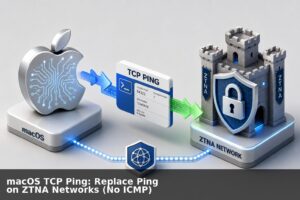
macOS TCP Ping: Replace Ping on ZTNA Networks (No ICMP)
A lot of companies are moving to ZTNA (Zero Trust Network Architecture). This is generally a good thing, it helps cyber posture and it and makes life a lot easier as you no longer need to login to VPN tunnels to manage your cloud environment/s. But one of the few downsides of ZTNA is that […]
Read more →Mac Terminal: Check DNS Nameservers in 2 Commands
To view the list of nameservers your mac is using, simply open Terminal and paste the following: Alternatively, you can copy the DNS servers to clipboard directly from the command line (using pbcopy):
Read more →How to Flush DNS Cache on MacBook: Terminal Command
I am not going to tell you why you would need to flush your DNS cache (you will know if you need to). So, to flush DNS on a mac simply fire up Terminal and run the following sudo command:
Read more →Fix SSH WARNING: REMOTE HOST IDENTIFICATION HAS CHANGED
If the fingerprint of your remote host changes you will see the following error message appear: There are many ways to fix this. The easiest of which is simply to delete your “known_hosts” file. This will mean you just need to accept new finger prints on all your SSH hosts. Yes, this is very lazy…
Read more →How to Poll a URL with Watch and Curl in Linux
If you want to quickly test a URL for changes, then the linux Watch command couple with Curl is a really simple way to hit a URL every n seconds (I use this for blue/green deployment testing to make sure there is no downtime when cutting over):
Read more →SYN Flood Testing with hping3: A Practical Guide
Getting an application knocked out with a simple SYN flood is both embarrassing and avoidable. Its also very easy to create a SYN flood and so its something you should design against. Below is the hping3 command line that I use to test my services against SYN floods. I have used quite a few mods, […]
Read more →K8GB: Cloud Native GSLB for Kubernetes Explained
Today I am a happy bunny!!!! Yury Tsarev (a very clever dude) did a presentation to one of the Kubernetes co-founders Tim Hockin. The demo was one of absa banks opensource projects called K8GB (a cloud native GSLB for K8s): https://www.k8gb.io/ Why do I like K8GB? Because it uses a single CRD that integrates to […]
Read more →qwinsta & rwinsta: Manage Remote Terminal Sessions
I regularly administer Windows 2000 Server and Windows Server 2003 machine using Terminal Services. In W2K I use Terminal Services in Administration mode and in W2K3 I use Remote Desktop. Basically this is the same thing but it’s packaged a bit differently on the two OSes. In both situations there are only 2 users allowed […]
Read more →