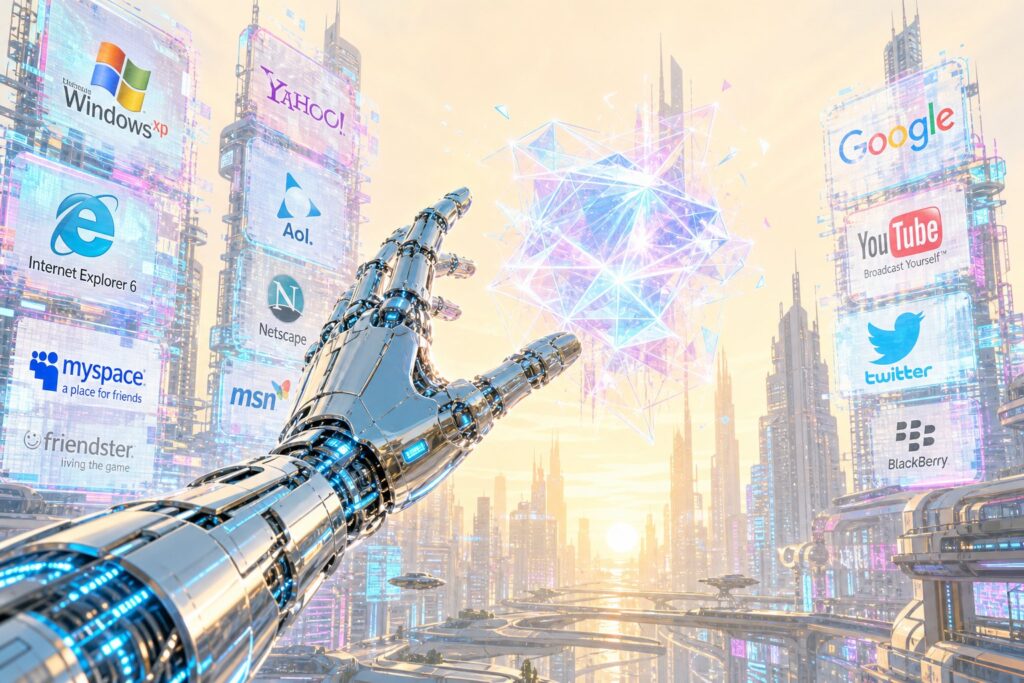
Why Nothing Is Future Proof: The Infinite Game in Technology Strategy

Companies become legacy businesses not because their technology ages, but because they lose the ability to replace what they already know. Familiarity gets mistaken for safety, so teams favour proven old platforms over untested new ones, and that status quo bias, not age, is what quietly turns innovative organisations into legacy ones.
Every vendor pitch eventually arrives at the same promise. The platform is future proof. The architecture is built to last. The investment you make today will still be paying off in ten years, so buy now and stop worrying about tomorrow.
It is a comforting sentence, and it is also completely false, and I think the reason it keeps getting said, and keeps getting believed, is that most organisations are still playing the wrong kind of game.
1. There are two kinds of games, and technology strategy keeps confusing them
The philosopher James Carse drew a distinction between finite games and infinite games that has quietly become one of the most useful frameworks in strategy. A finite game is played to be won, with fixed players, fixed rules and a defined ending, and once someone wins, the game is over. An infinite game has no such ending, because the players change, the rules evolve, and the entire point of playing is to keep the game going rather than to bring it to a close.
A quarter is a finite game, and so is a product launch, and so is a migration project, because each of those has a start date, a budget and a defined outcome. But the business you are building the platform for is an infinite game, and so is your career, and so is the market you compete in, since nobody actually wins banking or wins software engineering the way you win a quarter. The organisations that treat these as finite contests, something to be solved once and then left alone, are the ones that end up ambushed by a competitor still playing.
Future proof is a phrase that only makes sense inside a finite game, because it assumes there is a fixed set of requirements you are building against, a known finish line you are trying to clear, and once you clear it you can stop. There is no such finish line, and there is no version of the business, the market or the technology landscape that holds still long enough for a decision to become permanently correct.
2. Future proof is not a technical claim, it is a psychological one
Nobody selling future proof technology actually believes their product will never need to be replaced, and ask any vendor privately and they will tell you, quite honestly, that of course something will eventually replace what they are selling you. Future proof is not a claim about the durability of the technology at all. It is a claim about the state of your own mind.
What the phrase is really offering is relief from an uncomfortable feeling, which is the anxiety of not knowing what is coming next, and the promise behind it is that once you buy this, you can stop wondering, and the next five years become someone else’s problem, or at least a problem you no longer have to think about today. That is an emotional transaction dressed up as an engineering one, and it works precisely because uncertainty is exhausting while certainty, even manufactured certainty, feels like relief.
This is why future proof claims tend to appear most heavily around the biggest, most anxiety inducing decisions, since nobody markets a code linter as future proof but plenty of vendors market core banking platforms, cloud strategies and enterprise architectures that way, because those are the decisions large enough to keep a leadership team awake at night, and therefore large enough to be worth the emotional sale.
3. Every generation makes the same promise and every generation is wrong
Mainframes were sold as the permanent answer. Then client server architecture was sold as the permanent answer, largely by explaining why mainframes had failed to be one. Then service oriented architecture, then the cloud, then microservices, then serverless, each wave arriving with confident language about how this time the industry had finally found the durable pattern.
None of them were wrong to exist, and each of them solved real problems that the previous generation could not solve, but none of them were the final answer either, and the organisations that believed they were the final answer are the ones now sitting on platforms nobody wants to touch, staffed by engineers who were told a decade ago that they would never need to learn anything else.
This is not really a story about bad technology, since every one of those architectures was, at the time, a genuine improvement. It is a story about the claim of permanence attached to each of them, a claim that had nothing to do with the technology and everything to do with how badly organisations wanted to believe the search for a permanent answer was finally over.
4. What actually survives is not the platform, it is the capability to replace it
If you look at the technology companies and financial institutions that have genuinely lasted, what you find is never a single unchanging platform quietly humming away for forty years while everyone else’s technology gets old around it. What you find is an organisation that has replaced its core technology multiple times and kept its identity intact through each replacement.
The thing that survived was never the mainframe, the client server layer or the first generation cloud deployment. The thing that survived was the organisation’s ability to look honestly at what it was using, decide it was time to move, and actually do it without losing years of momentum in the process. That capability, the capacity to keep replacing the answer, is the only thing in technology strategy that actually deserves to be called durable.
This reframes the whole question of future proofing, because you cannot future proof a platform. You can only future proof an organisation’s relationship with change, and that is built through repetition and practice, not through a superior architecture diagram.
5. Simon Sinek’s version of the infinite game gets at exactly this in business
Simon Sinek later applied Carse’s framing directly to business strategy, arguing that companies who treat competition as a finite game, something to be won outright, consistently lose ground to companies who treat the same market as an infinite game, something to be stayed in for as long as possible. Where the finite minded company optimises for the next result, the infinite minded company optimises for its own capacity to keep adapting and keep existing.
Applied to technology, this becomes an unusually clear test for any architecture decision. A finite minded decision asks what solves the current requirement in the most complete, permanent seeming way. An infinite minded decision asks what preserves the organisation’s ability to make a different decision in three years without paying an enormous exit cost to do it. Those two questions frequently point to different answers, and the finite question is the one future proof marketing is always trying to get you to ask.
6. The lie has a very specific mechanism, and it runs through certainty
The reason future proof claims are so effective is that they attach themselves to the same psychological trap I have written about before, the one where certainty gets mistaken for evidence. An organisation choosing between an option with a confident, permanent sounding promise and an option that honestly admits the future is unknowable will very often choose the confident promise, even when the confident promise is the less honest of the two.
This is the same mechanism that keeps organisations building on the platform they already know rather than the one they need to learn. Future proof language offers the same comfort as staying on familiar technology, which is the removal of an uncomfortable admission of uncertainty, and it offers that comfort at exactly the moment a leadership team is least equipped to resist it, which is the moment they are being asked to commit serious money to a decision they cannot fully verify in advance.
7. Infinite minded organisations build for adaptability, not for permanence
Once you accept that nothing is future proof, the entire question changes shape. You stop asking which platform will last forever, because nothing will, and you start asking which platform, or which architecture, or which vendor relationship, leaves you the most room to change your mind later without an enormous cost of doing so.
This is a genuinely different design criterion. It favours loose coupling over tight integration, even when tight integration is faster to build today. It favours vendors who make it easy to leave over vendors who make switching painful, even when the painful vendor has better features right now. It favours architectures that can be replaced piece by piece over architectures that must be replaced all at once, because a big bang replacement is a finite game with an enormous, terrifying ending, while an incremental replacement is closer to the infinite game the business is actually playing.
8. Optionality is the closest thing technology has to future proofing
There is a concept from finance that translates cleanly into architecture, which is the value of optionality. An option is worth something not because you know you will use it, but because you might need to, and having it costs you very little compared to needing a capability you do not have when the moment arrives.
A technology decision that preserves optionality, that keeps your data portable, your interfaces well defined, your dependencies replaceable and your teams capable of working in more than one paradigm, is doing the only kind of future proofing that actually exists. It is not proofing the business against the future arriving. It is proofing the business against being unable to respond once the future has arrived, which is the only version of the problem that was ever solvable in the first place.
9. This is why learning debt and the infinite game are the same argument
I have written before about learning debt, the organisational cost of an engineer who could have spent three months becoming competent in tomorrow’s technology instead spending those three months deepening expertise in the technology being retired. Learning debt is what accumulates when an organisation quietly behaves as though it is playing a finite game, resting on the belief that the current platform is the answer, when the business around it is actually playing an infinite one.
The lie of future proof and the accumulation of learning debt are the same mistake wearing two different costumes. One is a claim made by a vendor about a product. The other is a habit an organisation develops about itself. Both rest on the same false premise, which is that the search for the right answer can be finished, and both produce the same outcome, which is an organisation that has quietly stopped practising the one skill that actually keeps it alive.
10. The only honest promise a platform can make is how easy it will be to leave
If I were evaluating a vendor pitch today, I would ignore every claim about permanence entirely, because none of them are true and the vendor making them almost certainly knows it. I would ask a different question instead, which is how easy this platform makes it to leave when the time comes, because that is the only claim about the future that can actually be verified in the present.
A more useful line of questioning asks whether it locks your data into a proprietary format, whether it requires years of specialised expertise that only exists inside this one vendor’s ecosystem, and whether it exposes clean interfaces that a future replacement could plug into without a rewrite of everything around it. Those questions cannot promise you a future without disruption, because no honest answer can, but what they can promise you is an organisation that stays flexible enough to keep playing, which was always the only game worth winning.
11. Nobody wins the infinite game, and that is the entire point
The organisations that eventually disappear are rarely the ones that made a bad technology choice, since every organisation makes bad technology choices repeatedly and forever. The organisations that disappear are the ones that stopped believing they would need to make another choice after this one, the ones that heard future proof and relaxed, the ones that mistook a single good decision for a permanent state of safety.
There is no permanent state of safety in an infinite game. There is only the ongoing willingness to keep playing, keep learning and keep replacing the last good decision with the next one. That willingness, not any particular platform, cloud provider or architecture pattern, is the only thing that has ever actually been future proof.
References
- James P. Carse, Finite and Infinite Games: A Vision of Life as Play and Possibility, 1986.
- Simon Sinek, The Infinite Game, 2019.