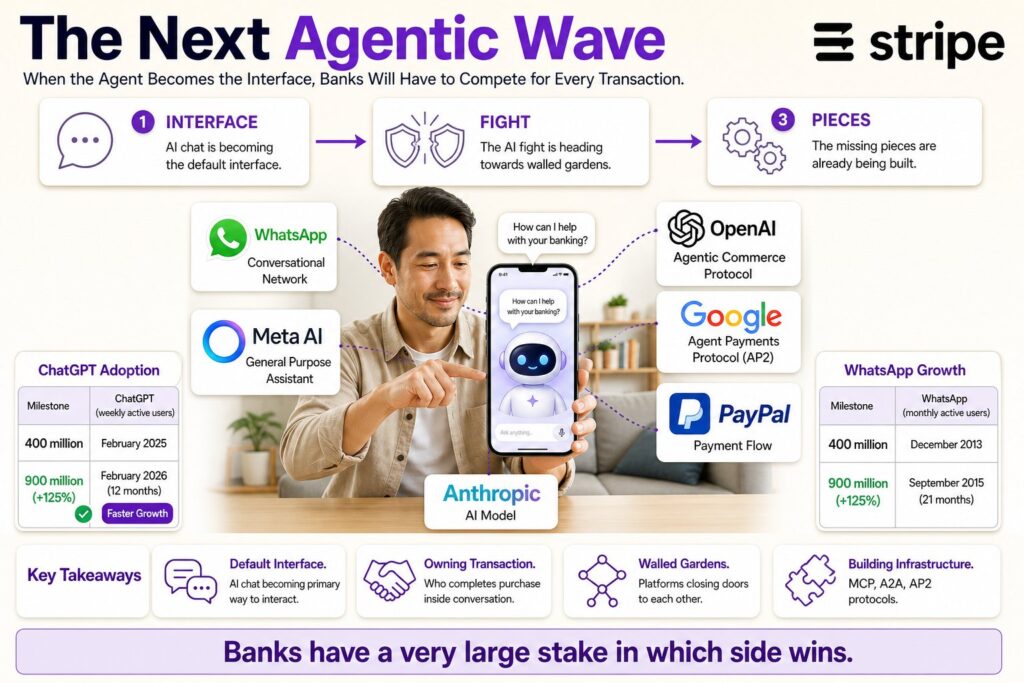
The Great Agentic Unbundling: When the Agent Becomes the Interface, Banks Will Have to Compete for Every Transaction

When AI connects people through agents that talk to each other, conversations become transactions. Agents can plan, agree and pay without anyone opening a website or app. Protocols like MCP, A2A and AP2 are already building this infrastructure, so banks can no longer rely on customers coming to them and must compete for each transaction.
The first wave of AI changed how we find information, and the second is changing how we get things done. The next wave will change where people manage their lives, including their money. The important shift is not that AI gets smarter; it is that the place where a client expresses what they want moves away from the bank’s app and into an assistant the client chooses, and once that happens every bank has to compete for every transaction.
1. AI Chat Is Becoming the Default Interface
WhatsApp did not just create another messaging app; it changed where billions of conversations happen. AI chat is doing something similar, on a far steeper curve. The table compares ChatGPT on its own with WhatsApp at the same user milestones, with the growth from 400 million in brackets and the months taken from that point:
| Milestone | ChatGPT (weekly active users) | WhatsApp (monthly active users) |
|---|---|---|
| 400 million | February 2025 | December 2013 |
| 700 million (+75%) | July 2025 (5 months) | January 2015 (13 months) |
| 800 million (+100%) | October 2025 (8 months) | April 2015 (16 months) |
| 900 million (+125%) | February 2026 (12 months) | September 2015 (21 months) |
The chart aligns both from launch. The AI line adds third party estimates of Claude’s monthly users (Anthropic does not publish them) to ChatGPT’s weekly users; Claude adds under 3% and does not change the shape.
{
  "type": "line",
  "data": {
    "datasets": [
      {
        "label": "ChatGPT and Claude combined",
        "data": [
          {
            "x": 0,
            "y": 0
          },
          {
            "x": 1.0,
            "y": 104
          },
          {
            "x": 1.75,
            "y": 213
          },
          {
            "x": 2.083,
            "y": 318
          },
          {
            "x": 2.25,
            "y": 416
          },
          {
            "x": 2.667,
            "y": 719
          },
          {
            "x": 2.917,
            "y": 819
          },
          {
            "x": 3.25,
            "y": 919
          }
        ],
        "borderColor": "#2a78d6",
        "backgroundColor": "#2a78d6",
        "borderWidth": 3,
        "pointRadius": 4,
        "pointHoverRadius": 6,
        "tension": 0.2
      },
      {
        "label": "WhatsApp",
        "data": [
          {
            "x": 3.75,
            "y": 200
          },
          {
            "x": 4.083,
            "y": 250
          },
          {
            "x": 4.25,
            "y": 300
          },
          {
            "x": 4.583,
            "y": 400
          },
          {
            "x": 4.917,
            "y": 500
          },
          {
            "x": 5.25,
            "y": 600
          },
          {
            "x": 5.667,
            "y": 700
          },
          {
            "x": 5.917,
            "y": 800
          },
          {
            "x": 6.333,
            "y": 900
          },
          {
            "x": 6.75,
            "y": 1000
          },
          {
            "x": 8.167,
            "y": 1300
          }
        ],
        "borderColor": "#eb6834",
        "backgroundColor": "#eb6834",
        "borderWidth": 3,
        "pointRadius": 4,
        "pointHoverRadius": 6,
        "tension": 0.2
      },
      {
        "label": "WhatsApp before 2013 (estimated, no published figures)",
        "data": [
          {
            "x": 0,
            "y": 0
          },
          {
            "x": 3.75,
            "y": 200
          }
        ],
        "borderColor": "#eb6834",
        "backgroundColor": "#eb6834",
        "borderWidth": 2,
        "borderDash": [
          6,
          6
        ],
        "pointRadius": 0
      },
      {
        "label": "AI chat today (3¼ years after launch)",
        "data": [
          {
            "x": 3.25,
            "y": 0
          },
          {
            "x": 3.25,
            "y": 1400
          }
        ],
        "borderColor": "#888888",
        "backgroundColor": "#888888",
        "borderWidth": 1,
        "borderDash": [
          3,
          4
        ],
        "pointRadius": 0,
        "pointHoverRadius": 0
      }
    ]
  },
  "options": {
    "responsive": true,
    "maintainAspectRatio": true,
    "aspectRatio": 1.6,
    "interaction": {
      "mode": "nearest",
      "intersect": false
    },
    "plugins": {
      "title": {
        "display": true,
        "text": "AI chat is growing roughly twice as fast as WhatsApp did",
        "color": "#888888",
        "font": {
          "size": 16,
          "weight": "bold"
        },
        "align": "start"
      },
      "subtitle": {
        "display": true,
        "text": "Users in millions by years since launch. AI line: ChatGPT weekly users plus third party Claude estimates. WhatsApp: monthly users.",
        "color": "#888888",
        "align": "start",
        "padding": {
          "bottom": 12
        }
      },
      "legend": {
        "position": "top",
        "align": "start",
        "labels": {
          "color": "#888888",
          "usePointStyle": true,
          "pointStyle": "line",
          "boxWidth": 30
        }
      },
      "tooltip": {
        "enabled": true
      }
    },
    "scales": {
      "x": {
        "type": "linear",
        "min": 0,
        "max": 8.5,
        "title": {
          "display": true,
          "text": "Years since launch",
          "color": "#888888"
        },
        "ticks": {
          "stepSize": 1,
          "color": "#888888"
        },
        "grid": {
          "display": false
        },
        "border": {
          "color": "#888888"
        }
      },
      "y": {
        "min": 0,
        "max": 1400,
        "title": {
          "display": true,
          "text": "Users (millions)",
          "color": "#888888"
        },
        "ticks": {
          "stepSize": 200,
          "color": "#888888"
        },
        "grid": {
          "color": "rgba(136,136,136,0.2)"
        },
        "border": {
          "display": false
        }
      }
    }
  }
}
ChatGPT went from 400 million to 900 million users in twelve months, a climb that took WhatsApp twenty one. The measures differ (weekly users are the stricter measure, which if anything flatters WhatsApp), and WhatsApp grew up with far lower smartphone penetration before passing three billion monthly users in 2025, but the pattern is clear. AI chat is also becoming social, with OpenAI rolling out group chats to all logged in users in November 2025.
What this proves needs care. There are really three adoption curves at very different points: adoption of AI chat, which is enormous and gives assistants distribution; adoption of agents that carry out tasks, which is growing quickly and demonstrates utility; and adoption of agents that clients authorise to move money, which demands far more trust, liability clarity and regulatory maturity and is only beginning. The first curve does not guarantee the third, and adoption is also uneven across income groups (section 9 looks at South Africa). What the first curve does establish is that the assistant is becoming the place where many clients start, and the rest of this post depends on that.
2. Where the AI Fight Is Heading
Whoever owns the assistant owns the moment a person decides what they want, before they have chosen who will provide it. The fight has moved beyond whose model is cleverest towards owning the conversation, the transaction and distribution. OpenAI launched Instant Checkout in ChatGPT in September 2025 on the Agentic Commerce Protocol it built with Stripe, PayPal adopted the protocol a month later, and Google’s answer is AP2. Whoever completes the purchase inside the conversation sits on the payment flow, and whoever decides which services an agent discovers controls distribution.
The platforms are also closing their doors to each other. From 15 January 2026, Meta’s WhatsApp Business terms barred general purpose assistants where the AI itself is the product, so ChatGPT and Microsoft Copilot left WhatsApp and Meta AI became the only general purpose assistant on it. The European Commission opened an antitrust investigation in December 2025, but the signal is clear: owners of conversational networks see rival assistants as a threat rather than a customer.
The cost of reaching customers is moving too. WhatsApp moved its business platform to per message pricing in July 2025, and from 1 October 2026 began charging for utility messages inside the 24 hour service window, which were previously free. For high volume senders of transactional messages, which describes most banks, that lands directly on the cost to serve. I think this will push companies to diversify away from WhatsApp, with some of that volume likely moving towards ChatGPT, Claude and other assistants, where a business exposes its capabilities once and the client’s own agent does the asking. At the very least, companies will start offering incentives to use cheaper channels.
Step back and a leading AI assistant starts to resemble a technology Death Star. It is search, ecommerce, a channel to customers, the integration layer to every service a person uses, the intelligence that reasons over all of it, a productivity tool and, increasingly, a place where people connect. Each of those has historically been a separate industry with its own giants. An assistant that combines them, and learns from hundreds of millions of people every week, builds a moat that would be almost unthinkably hard to bridge, because a challenger would need to match every capability at once, along with the habits and memory that keep users there. A platform in that position can choose where to dominate: which categories to enter, which partners to favour and what share of each transaction to take.
That outcome is not inevitable. Several serious companies are building these platforms at once, regulators are already intervening, and open protocols let services work with many assistants rather than one. But no bank should assume the assistant will remain a neutral pipe. The fight is heading towards a contest between walled gardens and open protocols, which will decide whether the agentic economy looks like the open web or a handful of app stores.
3. The Missing Pieces Are Already Being Built
The Model Context Protocol (MCP) gives AI applications a standard way to discover and use external capabilities, and OpenAI’s app platform is built on it with OAuth based authorisation, so connected services can act rather than just answer queries. The Agent2Agent (A2A) protocol, introduced by Google in 2025, lets independently operated agents discover each other and coordinate across organisations; for banking, think of a client’s agent asking a bank’s agent for a savings rate, comparing it with two other banks and coming back for better terms. The Agent Payments Protocol (AP2), announced by Google in September 2025, ties an agent’s actions to user authority through signed mandates: an intent mandate capturing what the user asked for, a cart mandate locking in the exact items, price and terms they approved, and a payment mandate telling the issuer whether a human was present, together creating an audit trail for disputes.
These are at different levels of maturity, they do not yet form a universal consumer agent network, and MCP does not make a banking API safe for autonomous transactions. But the direction is clear: away from applications humans operate and towards services agents can discover, understand and use.
4. The Agent Becomes the Interface and the Client Becomes Portable
Imagine every bank exposed a secure, standardised set of capabilities that an authorised agent could use, from balances and categorised transactions to payments, beneficiaries, account opening and credit applications. A client with three banks has three apps and three fragmented views of one financial life. Then they connect all three to their personal agent:
                Your personal AI assistant
     One conversation, one financial view, one set of instructions
                            |
             Authorised tools and agent orchestration
                            |
        +-------------------+-------------------+
        |                   |                   |
     Bank A              Bank B              Bank C
   Secure MCP          Secure MCP          Secure MCP
  Banking APIs        Banking APIs        Banking APIs

 Each bank independently authorises access and enforces its own transaction controls.
The client asks how much money they have, what they spent on groceries last month or which bank charges them most, and the agent answers across all three. Eventually they say “use whichever bank gives me the best deal”. At that point the bank becomes a provider of financial capabilities inside an experience the client controls. A beautiful app, a personalisation engine and a complicated rewards programme all lose value when another agent owns the conversation and can calculate the real worth of every offer. The interface becomes optional; the capabilities underneath it (deposits, credit, risk, payments and compliance) remain hard to replicate and valuable. What changes is how they are distributed.
The deeper disruption is portability. Clients have always been able to bank with several institutions, but the effort meant most consolidated around one. An agent makes those relationships operationally interchangeable:
TODAY                                  AGENTIC FUTURE

Client                                 Client
  |                                      |
Primary bank                           Personal agent
  |                                      |
Payments · Savings · Credit            +--------+--------+
(bundled in one relationship)          |        |        |
                                     Bank A   Bank B   Bank C
                                    payments  savings  credit

                 The relationship becomes portable.
                 Every product must earn its place.
The client keeps one dashboard and one financial history as providers change, and the complete picture of the client, along with the informational advantage that came from holding most of their activity, moves to the client’s agent, within whatever access the client has permissioned.
5. The New Gatekeeper
There is a tension at the heart of this future: agents may make banking far more competitive while making the distribution of banking far more concentrated. An assistant that controls discovery, comparison and routing does not just help clients choose; it shapes what they can choose from. The analogy is not only search engines but app stores, marketplaces and payment networks, all of which began as neutral intermediaries and became toll collectors.
We could replace dependence on a bank with dependence on an AI platform, and WhatsApp’s removal of rival assistants shows that platform owners will use control of a network to decide who reaches the people on it. Does the platform recommend the best product or a partner’s? Does it take a cut of each transaction, and does that influence the ranking? Can clients take their history to another assistant, and will smaller banks get equal access to discovery? The goal should not be to move ownership of the client from banks to AI companies but to give clients real control, which is why banks should back open protocols and build for many assistants rather than one.
6. Banks Will Have to Compete for Every Transaction
Today a client moves their salary across, sets up debit orders and builds their financial life around one institution, and the effort of leaving creates inertia that protects revenue. An agent working across several banks erodes that, comparing fees and rates continuously and handling the administration of moving money. The need to switch a whole relationship may disappear: Bank A can hold your salary, Bank B your savings and Bank C your credit, all behind one interface.
| Today’s banking model | Agent mediated banking |
|---|---|
| The bank owns the primary interface | The agent may own the primary interface |
| Switching involves substantial friction | Switching gets easier wherever portability exists |
| Products are bundled around the primary relationship | Products can be chosen individually |
| Client inertia protects revenue | Price, quality and reliability are compared continually |
This is not a pure price war, because agents must decide what “best” means. The cheapest payment is not always the most certain, the highest savings rate may carry withdrawal restrictions, and the lowest premium may mean weaker cover. Agents will weigh total cost alongside reliability, fraud protection and dispute handling, restrictions, suitability and the client’s own preferences. Banks that can demonstrate superior value on those dimensions, in a form an agent can verify, can win without being cheapest; what they cannot do is hide weakness behind complexity.
The economics go deeper than lost transactions. If a bank offers excellent transactional services but an uncompetitive savings rate, an agent could sweep surplus funds elsewhere every month, making deposits less sticky, funding costs more volatile and net interest margins harder to protect. A bank with expensive payments can lose volume while keeping the client. The most uncomfortable consequence is that customer numbers become a weaker indicator of success: a bank could keep millions of registered clients while losing its most profitable balances and transactions one agent decision at a time, so share of wallet by product matters far more than share of clients.
7. Imagine Getting Banks to Bid for Your Business
The next step is an agent that asks providers to compete. You tell your assistant you have R250,000 to save for twelve months and want the banks’ best offers; it collects structured offers, compares them and recommends one. The same works for a home loan whose fixed rate period is ending, insurance you only switch if you save at least R200 a month without losing important cover, or the cheapest reliable way to get R5,000 to your brother immediately.
Today banks publish prices and wait for clients to evaluate them. In this model agents request personalised offers and make banks compete for a specific client, which is a fundamentally different market structure. Agents can also be more demanding than people, asking a bank to justify a fee or match a competitor, and a bank that cannot produce accurate, structured and timely information may never make the shortlist. This requires banks to expose offers, eligibility checks and potentially negotiation capabilities, and MCP alone does not create a marketplace. But if those capabilities emerge, the bank with the best proposition for that transaction beats the bank with the biggest marketing budget.
8. Approval, Liability and the Bank’s Veto
None of this assumes agents act with full autonomy. For some time the likely model is that the agent does the legwork and the client approves the specific transaction, as they approve a payment in their banking app today. That matters because liability is the hardest objection to agentic banking. A mandate can prove a human authorised an intent, but not that the agent translated it correctly, and a valid authorisation wrapped around a misunderstood instruction is still valid. Human approval of the exact payee, amount and terms closes most of that gap: a hallucinated intent is caught before money moves, and liability sits largely where it sits today. AP2’s human present flow, with a signed cart mandate, is designed for exactly this. Fully delegated payments will come later, at small values first, as liability rules, dispute processes and insurance mature.
A fair counter argument is that banks hold a veto: a provider can refuse to deal with an agent even when the client has authorised it, and the law is still unsettled. But how effective have banks been at stopping screen scraping? In South Africa, third party payment providers scraped bank logins for years, and the SARB’s 2020 open banking consultation responded to that reality rather than to banks having shut it down. Refusing an authorised agent does not stop it; it pushes it towards scraping and driving the browser on the client’s behalf, which is worse for the client, for fraud controls and for the bank. In practice the veto mostly decides whether the door is governed or forced.
The more useful question is in whose interest this is. If something genuinely benefits the client (lower costs, less administration, better rates), it is normally a question of when rather than if. Banks can slow it down, but positioning against a client benefit is rarely a winning long term strategy. The better choice is to build the governed channel and set the rules on limits, approvals, consent and disputes, because determining how the narrative is written is far better than having it written for you.
9. South Africa: Moving, but Unevenly
South Africa is further along than most. The SARB published a consultation paper on payment system interoperability in March 2025 and, in February 2026, its Vision 2030+ consultation paper, which identifies the progressive unbundling of payments from traditional banking as a defining trend. Capitec Pay launched in 2023 as the country’s first bank specific open payment API, and pay by bank options are growing quickly. The Banking Association South Africa’s switching guidance still describes opening accounts, moving debit orders and notifying employers, which is exactly the administration an agent could coordinate, asking for approval only when needed.
Adoption, though, is uneven. Microsoft’s AI Diffusion Report found that 23.1% of South Africans aged 15 to 64 used generative AI in the first quarter of 2026, the highest rate in Africa, while a Google and Ipsos study published in January 2026 found that 70% of adults had used an AI chatbot. The gap between those figures is itself telling, since surveys of this kind tend to reach the connected, higher income segment more easily. I have not found published data on AI chat use by income or SEM segment, but data costs, device capability and electricity all point to much lower use in lower income households. Two implications follow. First, the agent mediated future will arrive in the higher income segment first, which is also where deposit balances and product margins are concentrated. Second, for many lower income clients the first AI interface may not be ChatGPT or Claude at all but Meta AI inside WhatsApp, which is already on their phones, and that makes the gatekeeper question in section 5 even more pressing in South Africa.
10. What Should Banks Do to Prepare?
1. Be cheap. Price is not the only thing agents weigh, but it is the entry ticket. Complex fees and products that rely on clients not understanding the total cost become very hard to defend, so simplify pricing and drive down the cost to serve, including channel costs. An agent will not be persuaded that a product is good value; it will calculate the value.
2. Have excellent data. Balances, transactions, fees, product terms and payment status must be reliable, structured and unambiguous, and agents need to understand what the data means. A balance that does not distinguish available from ledger funds misleads, a payment API that reports success before settlement must say so, and a headline rate without its conditions is not comparable. A bank can have excellent APIs and still be impossible for an agent to use reliably.
3. Build modern, secure APIs. Treat authorised agents as legitimate consumers, with predictable contracts, strong observability, OAuth 2.1 style authorisation, scoped tokens, explicit consent, fine grained permissions and reliable revocation, with MCP as an agent friendly layer over a properly governed API platform rather than a replacement for it. Above all, enforce the difference between an agent reading a balance and an agent moving money.
4. Make your products easy for agents to understand. Treat agent discoverability the way banks once treated search engine optimisation. Can an agent find your products, understand eligibility, calculate total cost, see your reliability and dispute record, and complete an application securely? A product an agent cannot evaluate risks becoming invisible.
5. Compete for every transaction. The right response to an agent recommending a competitor is a better proposition, not an attempt to block the choice. Manage the business by share of wallet per product rather than client numbers, and expect agents to expose weak products far more clearly than any comparison website has.
6. Make trust machine verifiable. An agent can misunderstand an instruction, be manipulated, act on stale information or touch a compromised third party. The SARB’s Vision 2030+ paper already expects authorised push payment fraud to become one of the most significant fraud risks in the system, and that risk extends naturally to agents manipulated into approving payments. Banks need transaction limits, beneficiary verification, fraud detection, confirmation for sensitive actions, auditable consent and clear disputes, and standards like AP2 are starting to provide the mandates and audit trails to support them.
11. The First Mover Advantage
It would be easy to read this post as making two contradictory claims: that agents make switching frictionless, and that the first banks to work with agents will build a lasting advantage. They are the same mechanism seen from two sides. Inertia does not disappear; it moves from the client to the agent. An agent will keep routing to a bank that has worked: its permissions set up, its transactions categorised, its payments settling when promised and its disputes resolved. The difference is how the inertia is held. Today’s version is inherited through friction and survives underperformance. The agent’s version has to be earned through reliability and is withdrawn the moment the bank stops delivering, because the agent can see the alternatives at no cost.
So the advantage is not being the first bank an agent connects to; it is being first to build a track record agents prefer. Early movers learn first how agents behave, where they misread data and how fraudsters try to manipulate them, and every fix makes the bank easier to prefer. They will shape standards and regulation while both are still open, and they are more likely to become the reference integrations that AI platforms test against and feature. Being first carries risks (changing standards, immature controls, a bet on the wrong platform), and a poor integration simply teaches agents to route around you. But waiting for the ecosystem to mature is itself a strategic decision, and probably the wrong one, because by then the track records will be established and the learning curve will belong to someone else.
12. What Comes Next?
This will not happen overnight, and the third adoption curve is the one to watch. Agents moving money at scale needs cross platform standards, identity that works across organisations, regulators confident that consumers are protected, clear liability when an agent is wrong or manipulated, and clients who trust agents with financial decisions. But the first two curves are well advanced, and they pull the third along:
1️⃣ Agents answer questions. Already mainstream.
2️⃣ Agents use tools. Agents access authorised services and complete tasks, which is already happening.
3️⃣ Agents collaborate. Personal and organisational agents coordinate and negotiate across platforms. Early infrastructure exists, but consumer interoperability is unproven.
4️⃣ Agents compete and transact. Agents compare financial providers and execute approved transactions. The foundations are still being laid.
13. The Client No Longer Belongs to You
Acquiring clients and growing share of wallet remain legitimate objectives, but the idea that a client belongs to a bank is becoming outdated. The client owns the relationship, controls their data and decides which institutions serve them, and increasingly they will delegate the work of managing those relationships to an agent. They could use five banks without seeing five banking apps, move their savings the moment a better offer appears and ask banks to compete for their next loan, all through a single conversation.
The banks that thrive will have the most competitive products, the lowest sustainable costs, the best data, the most reliable APIs and the strongest security; they will be easy for agents to discover and transact through, and prepared to earn the client’s business repeatedly rather than relying on the friction of leaving. The first wave of digital banking was about getting clients into our apps. The next wave is about making our banks available wherever clients choose to be. The client no longer belongs to you, and in the agentic economy you may have to win them back with every transaction.
Research note, October 2026: adoption figures are reported milestones rather than like for like measures; ChatGPT figures are weekly active users and the Claude figures in the chart are third party monthly estimates. WhatsApp pricing and policy details reflect Meta’s published changes up to October 2026, and their effect on channel choices is my expectation rather than an observed trend. I have not found published South African data on AI use by income segment, so the inferences in section 9 are mine. Agent negotiation, universal banking MCP access and automated competition between banks are forward looking scenarios, not capabilities I am assuming are widely available today.