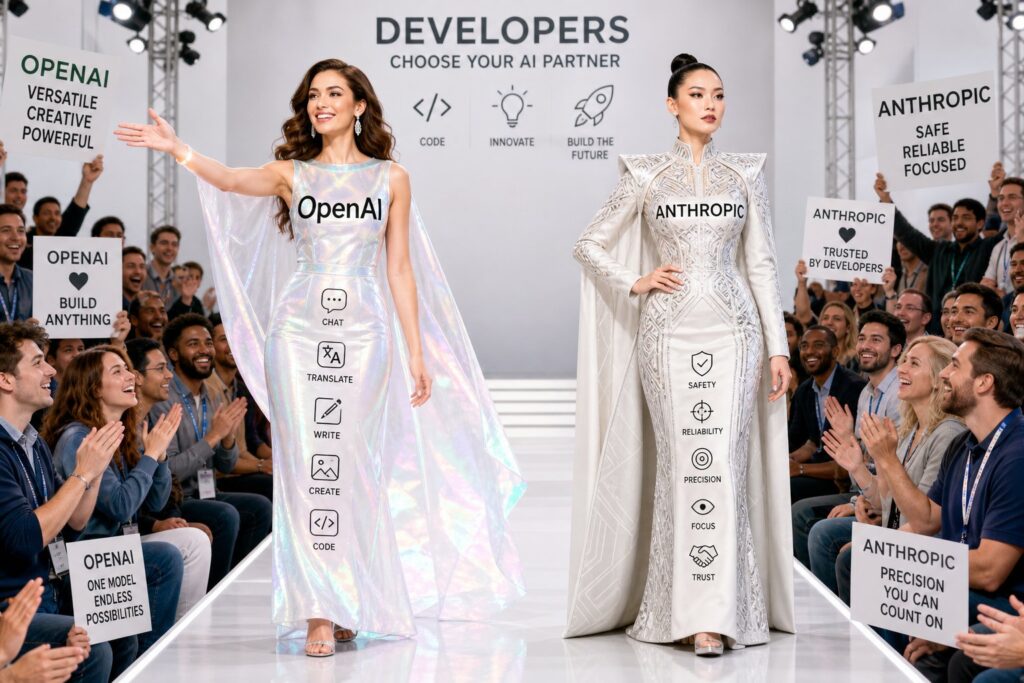
The Fight for Developer AI Spend: Where Should Your $200 Go Right Now?

If your work is deep, long horizon, terminal based coding, Claude Max 20x is the stronger buy because Claude Code remains the more battle tested agent for large refactors and its reasoning edge on the hardest tasks has been durable. If you want one subscription spanning chat, documents, research, and code, ChatGPT Pro is the safer pick right now given Codex's gains and OpenAI's cleaner reliability record.
The Fight for Developer AI Spend: Where Should Your $200 Go Right Now?Andrew Baker's Technology Blog Posts, 05/Sep/2026
https://andrewbaker.ninja/2026/09/05/the-fight-for-developer-ai-spend-where-should-your-200-go-right-now/
Anthropic and OpenAI have converged on the same number. Two hundred dollars a month buys the top consumer tier at each company, Claude Max 20x on one side and ChatGPT Pro on the other, and both are pitched in nearly identical language, promising heavy, unlimited feeling access for people who would otherwise burn through thousands of dollars in metered API costs. But the more useful way to ask this question is not which model is slightly better this week. It is what a developer is actually buying for that $200, and whether the whole $200 should even go to one company.
Here is a quick scorecard before the argument, since the two plans are easiest to compare side by side.
| Claude Max 20x | ChatGPT Pro | |
|---|---|---|
| Monthly cost | $200 | $200 |
| Coding environment | Claude Code | Codex |
| Best for | Deep, long running agentic coding | Broad AI work across coding, research, and documents |
| Flagship model included | Fable 5.1, bundled up to half of weekly usage | GPT-6 Astra, rolling out to Pro accounts |
| Long running repo work | Strong | Improving quickly |
| Model access this year | More variable, including a suspension and a tier change | More consistent so far |
| Pick for full time coding | Winner | |
| Pick for one all purpose AI subscription | Winner |
1. Don’t buy the best model, buy the best developer loop
The instinct when comparing these two plans is to compare models, since that is what most coverage does. Benchmarks move every few weeks, both companies publish their own numbers, and a bare score is easy to quote and hard to trust on its own.
For a working developer, $200 is not really buying tokens. It is buying a model plus an agent harness plus context management plus tool execution plus terminal integration plus permissions handling plus how gracefully the whole thing recovers from a mistake. Two products can run comparable underlying models and still feel completely different to use for eight hours a day, because the quality of that loop is doing most of the work. That framing matters more here than it usually does, because it is also the strongest actual argument for Claude, stronger than any single benchmark claim: Claude Code is currently the more mature end to end environment for long running software engineering work, not because Claude reasons a little better on paper, but because the whole loop holds together over a long session.
2. The scoreboard, such as it is
Neither company publishes clean, audited market share numbers, so treat the following as directionally true rather than exact.
Claude Code has been the revenue story of Anthropic’s year. The company has disclosed a Claude Code run rate in the billions, with reports of low churn even as prices moved, which suggests that developers who adopt it tend to stick with it.
Codex, OpenAI’s equivalent agent, has grown faster off a smaller base, with OpenAI reporting several million weekly active users, a number that climbed sharply once Codex got a dedicated desktop app and was folded more tightly into ChatGPT’s subscription tiers.
On head to head coding benchmarks, the honest answer is that neither side has a durable lead right now, and whoever published the number usually comes out ahead in it. Since GPT-6 Astra launched, independent evaluators have shown it beating Claude Fable 5.1 specifically on long, multi step terminal and agentic work, which used to be the category Claude was most reliably ahead on. Fable 5.1 answers back on other measures, including a broader coding agent index and SWE-bench Pro. The gap moves depending on which specific benchmark you pick, and it has moved more than once in the last few months alone. Treat any claim of a clear winner on raw coding benchmarks, including earlier versions of this argument, with real skepticism.
Read charitably, Anthropic is winning the fight for developers who tried it and stayed. OpenAI is winning the fight for developers who tried it at all, on the strength of ChatGPT’s much larger existing user base feeding people into Codex.
3. The latest models on each side, and a caveat about the Fable timeline
The lineup has moved again on both sides since earlier versions of this comparison, and one part of it deserves an upfront caveat before the details.
The Fable timeline below is pieced together from Anthropic’s own posts, its current help center documentation, and contemporaneous press coverage, since Anthropic has not published a single consolidated account of the year. Treat the dates as a reasonable reconstruction rather than a verbatim company statement, and check Anthropic’s help center directly if a specific date matters to a decision you are making.
With that said, here is the shape of it. Fable 5 launched in June 2026 and was included at no extra cost across every paid plan for a short promotional window. That window closed over the summer, and Fable moved to a split arrangement that is still in place today according to Anthropic’s current plan documentation. On Max plans, and on premium seats on Team and Enterprise plans, Fable 5 and the newer Fable 5.1 are included as a standard part of the plan, usable for up to half of the weekly usage allowance before more would need to be purchased. On Pro plans and standard Team seats, Fable is not included in the base subscription, and using it requires prepaid usage credits billed at API rates. So the practical read is that Fable was pulled out of the cheaper tiers, not out of the product. A Max 20x subscriber already has it bundled in.
On the OpenAI side, the GPT-5.6 family, made up of Sol, Terra, and Luna, launched publicly in July 2026, with Sol as the flagship. That family has already been superseded at the top. In early September 2026, OpenAI released GPT-6 Astra, describing it as a significant step up for agentic work, computer use, and coding, and it began rolling out to ChatGPT Pro and Business customers within a day or two of launch. Astra is also changing how Codex handles long sessions, moving away from pure summarization toward a persistent notes system meant to keep more detail alive across a long debugging or refactoring session instead of compressing it away. OpenAI’s own launch benchmarks show large gains over the GPT-5.6 family, and the independent comparisons that have appeared since launch back up part of that story without fully confirming it. On Terminal-Bench 4.0, the benchmark built for exactly this kind of long, messy, multi step agent work, Astra has a narrow numerical lead over Fable 5.1, 58.18 percent versus 57.88 percent, but the difference is well inside the benchmark’s confidence interval and should be treated as a statistical tie rather than a real gap. On a broader coding agent index that blends several tasks, and on SWE-bench Pro, Fable 5.1 leads instead. The fair read a few days into the rollout is that the two are close enough that the measurable differences are mostly noise, not that either one has pulled decisively ahead on coding specifically.
The fairest summary of the difference is not that OpenAI has had a cleaner reliability record in general. It is narrower than that: OpenAI has had more consistent flagship model availability this year, specifically for the models relevant to this comparison. Fable had one real availability interruption, a suspension in June tied to U.S. export controls, resolved when access was restored on July 1. What followed a few weeks later was not a second outage, it was a change to which plans include Fable at no extra cost, moving it off the free allowance on Pro and standard Team seats while keeping it standard on Max, where it remains today, usable for up to half of the weekly allowance. Astra’s rollout, by contrast, has been staged but has not involved an access suspension at any point.
4. The third option: don’t give anyone the whole $200
Before picking a side, it is worth naming an option that neither company particularly wants you to consider: not putting the entire $200 in one place.
GitHub Copilot has restructured its own pricing into a usage based model this year, with a Pro tier at $10 a month, a Pro+ tier at $39 that includes access to premium models, and a Max tier at $100 a month that comes with $200 of monthly AI credits usable across its model ecosystem. Depending on how much of your work is routine versus how much needs the absolute frontier model, a developer could plausibly run Copilot Max plus a smaller amount of direct API spend on whichever frontier model a specific task calls for, and land well under $200 a month for a lot of real engineering throughput.
There is a more radical version of the same idea, and it doubles as the clearest proof that the developer loop and the underlying model really are separable. Moonshot AI’s Kimi K2, in its coding focused K2.7 Code variant, ships an Anthropic compatible endpoint built specifically so it can be dropped into Claude Code itself. Point the same Claude Code CLI at Moonshot’s endpoint and swap the model name, and the harness, the terminal integration, and the workflow you already know keep running, just against a different model underneath. At roughly one dollar per million input tokens and four dollars per million output tokens, it runs at a fraction of what Sonnet 5 or Fable 5.1 cost on the API, which is exactly why a growing number of developers use it as a cheaper daily driver and save the Anthropic or OpenAI subscription for the hardest tasks. Moonshot has since released Kimi K3, but K2.7 remains useful here as the clearest example of how cheaply the Claude Code harness can be decoupled from Anthropic’s own models. DeepSeek remains the more recognizable name for low cost, general purpose reasoning and coding, but it does not have the same direct plug in relationship with Claude Code’s own harness, so Kimi is the more interesting data point for this specific argument. The tradeoff that comes with either one is not subtle: both are Chinese hosted models, and any regulated or proprietary codebase should not be sent to a China hosted API without going through a self hosted open weight deployment instead.
None of this is an argument to turn a two way comparison into a six way one, and most heavy, full time agentic coders will still find that a single dedicated subscription beats an assembled portfolio, mainly because switching tools mid task has its own cost. But it is worth acknowledging before concluding anything, so that the eventual answer is a genuine one: even after considering the option of spreading the spend around, this is still where a full $200 aimed at one primary coding environment should go.
5. What $200 actually buys versus metering
The reason flat rate subscriptions exist at all is that metered pricing for frontier models is not cheap once you use them like an engineer rather than a casual chat user.
Take Anthropic’s current published API rates as an illustration, not as a vendor claim about the subscription’s value. Claude Opus 5 costs five dollars per million input tokens and twenty five dollars per million output tokens. Claude Fable 5.1 costs ten dollars per million input tokens and fifty dollars per million output tokens. A single demanding day of agentic coding, the kind that reads a large repository, iterates across many files, and reruns tests repeatedly, can easily push several million tokens through a model in each direction. At Fable’s rates, a handful of heavy days can already approach what Max 20x costs for the entire month. The same math applies on the OpenAI side once GPT-6 Astra’s API pricing settles into general use.
That reframes the real question. It is not really whether $200 a month is expensive. For a developer using it like an engineer, it can be strikingly cheap relative to the metered alternative. The question is which company gives you the most productive inference for that $200 without interrupting the workflow you have built around it.
6. Where the $200 should actually go
If I were a professional developer spending my own $200 today, I would still buy Claude Max 20x.
Not because Claude wins the coding benchmarks. As of this week it does not, clearly or consistently, and treating any single number from either company as settled is a mistake. Not because Anthropic has been more reliable this year. It has not. And not because Codex is substantially behind anymore. It is not.
I would buy it because Claude Code remains the strongest complete environment currently available for long running, agentic software engineering, independent of which model happens to be ahead on this week’s benchmark table. When an agent needs to understand a large repository, modify dozens of files, run tests, recover from its own mistakes, and keep working for hours, the quality of that development loop, not the leaderboard position of the model inside it, is what determines whether the session actually finishes cleanly. Fable 5.1 being a standard, bundled part of the plan is a genuine point in the plan’s favor, but it is a pricing and access argument, not a capability one.
If that same $200 had to buy an entire AI life rather than just a coding environment, I would choose ChatGPT Pro instead, given Codex’s gains and OpenAI’s more consistent flagship-model availability this year. Coding is now only one surface of that product, GPT-6 Astra’s early results are genuinely promising for long agent sessions, and Codex has become good enough that the opportunity cost of choosing breadth over depth is much smaller than it was six months ago.
So the honest answer is a little inconvenient: Claude currently wins the developer’s $200. OpenAI probably wins everyone else’s.
7. The one caveat that applies either way
Both companies are now shipping meaningful model upgrades at a pace measured in weeks rather than years, and the specific names in this piece, Sonnet 5, Opus 5, and Fable 5.1 on one side, GPT-5.6 and GPT-6 Astra on the other, will likely be superseded again soon. The underlying decision, a deep terminal first coding environment against a broad multi surface subscription, is more durable than any individual model comparison. It is worth checking both companies’ current pricing and status pages before committing a full year of spend to either one.