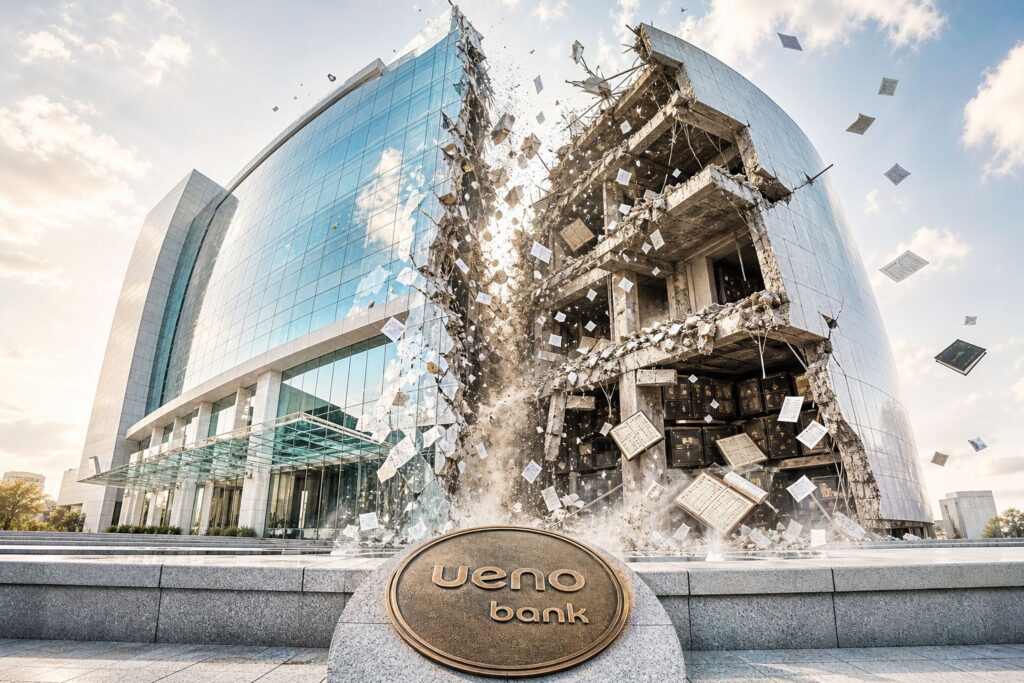
Ueno Bank Collapse: Eight Lessons Every Digital Bank Should Learn

Ueno bank collapsed because its balance sheet was not what published numbers suggested. After the Paraguayan central bank adjusted its financial statements, the solvency ratio fell below half the regulatory minimum. Linked party lending, weak credit files, unsupported IT service activations and liquidity pressure led to resolution, despite millions of customers and an excellent app.
Ueno Bank Collapse: Eight Lessons Every Digital Bank Should LearnAndrew Baker's Technology Blog Posts, 04/Nov/2026
https://andrewbaker.ninja/2026/11/04/ueno-bank-collapse-eight-lessons-every-digital-bank-should-learn/
Shortly after three o’clock on the morning of 3 November 2026, the Banco Central del Paraguay (BCP) announced that its board had voted unanimously, the previous day, to place ueno bank into resolution after its solvency ratio fell below half of the regulatory minimum. Account holders soon reported that they could not reach their money through the bank’s app, police were posted outside branches in Asunción, and by the end of the day the central bank’s own president had resigned. A bank that had been described as Paraguay’s answer to Nubank or Revolut was being wound down by the state.
The collapse matters to anyone running a digital bank, and not because it shows that digital banks are fragile. It shows how a bank can grow its customer base at a speed that would have been unthinkable a decade ago while its governance, capital discipline and risk management fail to keep pace, and how quickly the gap between the published numbers and the supervisor’s view of them can close once it is exposed.
The investigation and resolution are still in progress, so throughout this post I distinguish between what the BCP has formally stated, what the bank itself disclosed, and what the press has reported from leaked documents. Where a point rests on press reporting or on my own reading of a regulatory remark, I say so at that point.
1. What happened to Ueno
Ueno was not an obscure fintech experiment. It began as a finance company, received its banking licence in November 2023 and began operating as a bank on 1 December 2023, and then absorbed Visión Banco in a merger that its 2025 financial statements record as completed on 28 June 2024, which brought more than 70 branches to go with its digital proposition. The bank said it served more than three million people, equivalent to over 65% of Paraguay’s adult population, and claimed to have brought more than 1.2 million Paraguayans into the banking system for the first time since 2021. In March 2026 it completed a US$350 million international bond issue, described as the largest corporate issuance in Paraguay’s history.
The bank’s open letter of 21 September 2026 described a well capitalised institution. As at June 2026 it reported a total regulatory capital ratio of 14.5% against a 12% minimum, roughly US$4.2 billion in assets, US$2.5 billion in loans, approximately US$2.85 billion in deposits, a non performing loan ratio of 0.6% that it called the lowest in the banking system, and net profit of about US$37 million for the first half of the year.
The supervisor was already looking closely by then. At the press conference on 3 November, BCP president Carlos Carvallo said the central bank’s analysis of Ueno had started on 5 June, and that lending to linked parties was what first drew the regulator’s attention. A deeper inspection then traced the funds through the transactions until the regulator had what Carvallo called certainty that could not rest on indications alone. He said that deteriorating liquidity and the need for additional provisions together led to resolution, with the provisions arising mainly from weaknesses in credit files and from what he described as the activación de servicios informáticos without fully supported justification. He also said that leaks of sensitive information had accelerated the deterioration of the bank’s liquidity.
The formal BCP statement is precise about the mechanism: the solvency shortfall arose as a consequence of adjustments made to the bank’s financial statements during the regularisation process, and the procedure falls under Law 2334/03 on deposit guarantees and bank resolution. The capital did not shrink because of an arithmetic error or a sudden economic shock; it shrank because the supervisor took a different view of what the assets were worth and what provisions were needed.
The political dimension is impossible to ignore. Carvallo chaired the predecessor company Financiera Ueno from 2021 until mid 2023 before President Santiago Peña appointed him to lead the central bank. The BCP has said Carvallo recused himself from every decision involving Ueno, and both Peña and the bank deny any wrongdoing, with Peña stating that he never held shares in the bank itself and that he divested his stake in Ueno Holding in 2025. Carvallo nevertheless submitted his resignation on the day of the announcement, saying that stepping aside would help calm the controversy around the BCP.
%%{init: {'theme':'base','themeVariables':{'primaryColor':'#1e293b','primaryTextColor':'#ffffff','primaryBorderColor':'#f59e0b','lineColor':'#f59e0b','fontSize':'14px'}}}%%
flowchart TD
    A["Nov to Dec 2023<br/>Banking licence granted;<br/>bank operations begin"] --> B["28 June 2024<br/>Merger with<br/>Visión Banco completed"]
    B --> C["March 2026<br/>US$350m bond issue;<br/>15.01% total capital ratio"]
    C --> D["5 June 2026<br/>BCP review begins;<br/>linked lending flagged"]
    D --> E["21 Sept 2026<br/>Bank publishes 14.5%<br/>ratio measured at June"]
    E --> F["12 Oct 2026<br/>Press reports ~US$146m<br/>to three linked companies"]
    F --> G["16 Oct 2026<br/>Fitch moves outlook<br/>to negative"]
    G --> H["29 Oct 2026<br/>US$100m capital plan;<br/>bank cites 13.8% ratio"]
    H --> I["2 Nov 2026<br/>BCP board votes<br/>for resolution"]
    I --> J["3 Nov 2026<br/>Announced overnight;<br/>app access lost;<br/>BCP president resigns"]
    style A fill:#1e293b,color:#ffffff,stroke:#f59e0b
    style B fill:#1e293b,color:#ffffff,stroke:#f59e0b
    style C fill:#1e293b,color:#ffffff,stroke:#f59e0b
    style D fill:#1e293b,color:#ffffff,stroke:#f59e0b
    style E fill:#1e293b,color:#ffffff,stroke:#f59e0b
    style F fill:#1e293b,color:#ffffff,stroke:#f59e0b
    style G fill:#1e293b,color:#ffffff,stroke:#f59e0b
    style H fill:#1e293b,color:#ffffff,stroke:#f59e0b
    style I fill:#7f1d1d,color:#ffffff,stroke:#fca5a5
    style J fill:#7f1d1d,color:#ffffff,stroke:#fca5a5
2. The eight lessons
2.1 Customer growth is not evidence of a healthy bank
By its own account, Ueno had a customer base equivalent to most of the adult population of the country, which is the kind of reach most digital banks can only aspire to. None of that said anything about the quality of the loan book, the eligibility of the assets behind its capital, or how concentrated its funding was. Customer numbers measure the franchise, and a strong franchise is valuable, but a bank fails on its balance sheet rather than on its registration count.
The practical consequence for any growth oriented bank is that client growth has to sit on the same dashboard as risk adjusted profitability, funding quality and capital consumption, and those measures have to carry equal weight in executive conversations. A bank that can report last month’s client acquisition in real time but needs a quarter to report how much capital those clients consumed is measuring the easy thing well and the important thing slowly.
2.2 Related party lending is the oldest warning sign in banking
The most specific public allegations concern lending to companies connected to Grupo Vázquez, the group that controls Ueno. ABC Color reported in October, citing supervisory documents, that between September 2025 and May 2026 the bank disbursed around US$146 million to three linked companies, against a related party limit that the newspaper calculated at roughly US$82 million from the bank’s effective equity, and that some of those funds flowed on to other businesses in the same group. The bank’s position was that it had cured an earlier breach of the related party limits in June, within the deadline set by the regulator. These figures come from press reporting of leaked material rather than a published regulatory finding, but the BCP’s own account of having to trace the route of the money confirms the general shape of the concern.
Legal ownership checks are not sufficient on their own. If the borrower on paper is owned by employees of the group, a registry check will report it as unrelated, and that answer will be wrong. Banks need to understand ultimate beneficial ownership and, more importantly, the economic destination of funds: where the money goes in the days after drawdown, and who benefits when it arrives.
2.3 Liquidity deteriorates faster than management expects
Digital banks make it extraordinarily easy to move money, which is exactly what customers want right up until confidence starts to waver. Carvallo explicitly linked the leaks of sensitive information to the acceleration of Ueno’s liquidity problems, a reminder that with instant payments and social media the gap between rumour and outflow can be measured in hours.
The same pattern played out at a far larger scale when Silicon Valley Bank failed in March 2023: customers withdrew US$42 billion in a single day, and a further US$100 billion was scheduled to leave the following morning, according to the Federal Reserve’s vice chair for supervision. The chair of the House Financial Services Committee called it the first Twitter fuelled bank run. Stress tests calibrated to the era of branch queues and cheque clearing do not describe how a modern run behaves.
A credible liquidity stress test for a digital bank should model withdrawals at the speed of the payment rails rather than the cadence of a monthly report, and it should include the scenario in which concentrated institutional depositors leave at the same time as retail customers, because that combination is what turns a difficult week into a failure.
2.4 Technology spending is a capital question, not only a procurement question
One of the more striking items in the regulator’s explanation was the reference to the activación de servicios informáticos without fully supported justification. It would be easy to read “activation” as switching services on, but in Spanish accounting usage activar commonly means to capitalise, that is, to record an expenditure as an asset on the balance sheet rather than expensing it. Read that way, which is my interpretation and has not been confirmed by the BCP, the finding is that some IT costs had been carried as assets when the supervisor did not accept that they qualified, and that reversing them reduced equity and therefore capital.
That interpretation makes the lesson sharper than a procurement control. Capitalised software and technology services are among the most judgement heavy items on a modern bank’s balance sheet: whether a cost created a future economic benefit, how long that benefit lasts, and whether it is impaired are all matters of opinion. Under most capital frameworks intangible assets are deducted from core capital, but the distinction between an intangible, a prepayment and some other receivable is itself a judgement, and if technology spend is carried in a category that escapes that deduction, the capital ratio can look stronger than the underlying economics justify.
For a technology led bank the questions are uncomfortable but straightforward. Which technology costs are capitalised, under what policy, who outside the technology function signs off that each one qualifies, how are they classified for regulatory capital, and what would the ratio be if a sceptical supervisor reversed the marginal cases? The approval trail still matters, but the question that decides solvency is whether the asset deserves to be on the balance sheet at all.
2.5 Reported capital is not necessarily loss absorbing capital
The capital trajectory should worry every board member. The bank reported a total capital ratio of 15.01% for March, then 14.5% measured at June and published in September. On 29 October, announcing a US$100 million capital plan, it described its total regulatory capital ratio as 13.8% and its Tier 1 ratio as 11.7%, both above the minimums, without stating the measurement date. Four days later the BCP board determined that the solvency ratio was below half of the 12% minimum; it did not publish an exact figure.
It is important not to read those dates as four days of losses. The reported ratios were measured at earlier dates and disclosed later, while the BCP figure reflects adjustments, accumulated over a review that began in June, to the same underlying balance sheet. The gap is between two views of the bank’s assets, not between two moments in its trading.
{
  "type": "bar",
  "data": {
    "labels": [
      "Mar 2026 (bank, reported)",
      "Jun 2026 (bank, published 21 Sept)",
      "Cited 29 Oct (bank, date not stated)",
      "2 Nov 2026 (BCP finding: below 6%)"
    ],
    "datasets": [
      {
        "type": "bar",
        "label": "Total capital ratio reported by the bank (%)",
        "data": [15.01, 14.5, 13.8, null],
        "backgroundColor": "#2563eb"
      },
      {
        "type": "line",
        "label": "Regulatory minimum (12%)",
        "data": [12, 12, 12, 12],
        "borderColor": "#f59e0b",
        "borderDash": [6, 4],
        "fill": false,
        "pointRadius": 0
      },
      {
        "type": "line",
        "label": "Half the minimum (6%): BCP found the ratio below this line",
        "data": [6, 6, 6, 6],
        "borderColor": "#dc2626",
        "borderDash": [2, 3],
        "fill": false,
        "pointRadius": 0
      }
    ]
  },
  "options": {
    "plugins": {
      "title": { "display": true, "text": "Ueno capital: bank reported ratios vs the BCP's threshold finding (no exact BCP ratio published)" }
    },
    "scales": { "y": { "beginAtZero": true, "max": 18, "title": { "display": true, "text": "%" } } }
  }
}
According to the BCP, the difference came from adjustments to the financial statements during regularisation: additional provisions, a different view of credit quality, and items the supervisor did not accept. ABC Color has reported, again citing supervisory documents, that questions also existed around expenses held in the merger trust created for the Visión Banco acquisition and the classification of a delinquent loan portfolio, although the regulator has not formally confirmed those items.
A published capital ratio is the output of many judgements about valuation, recoverability and eligibility, and several of those judgements can be wrong at the same time. Boards and risk functions should challenge the assets that support capital rather than the ratio that summarises them, because a ratio comfortably above the minimum is reassuring only if its numerator would survive an independent revaluation.
2.6 Customer diversification is not funding diversification
Millions of retail customers sounds like the most diversified funding base imaginable, but Ueno’s own June disclosure tells a more nuanced story. Of roughly US$2.85 billion in deposits, about US$2.02 billion (71%) came from the private sector, while around US$295 million were term deposits from the IPS social security institute and roughly US$532 million came from other public sector bodies. That is approximately US$827 million, close to 29% of deposits, linked to the state.
{
  "type": "doughnut",
  "data": {
    "labels": ["Private sector deposits", "IPS term deposits", "Other public sector deposits"],
    "datasets": [
      {
        "data": [2020, 295, 532],
        "backgroundColor": ["#2563eb", "#f59e0b", "#dc2626"]
      }
    ]
  },
  "options": {
    "plugins": {
      "title": { "display": true, "text": "Ueno deposit mix at June 2026, US$ millions (bank's own disclosure)" }
    }
  }
}
Public money changes the risk profile in two ways: a small number of decision makers can withdraw it in large amounts, and it attracts political scrutiny that can itself become a source of instability. The IPS alone is now seeking to recover approximately US$380 million held in Ueno bonds and term deposits, while the 32,000 retirees who collected their pensions through the bank need to be moved to another institution.
Deposit concentration therefore has to be measured by economic relationship and by decision maker rather than by account count. Three million customers can still mean that a handful of public treasurers control close to a third of the funding.
2.7 Independence matters more than impressive governance structures
Ueno had the governance apparatus you would expect of a bank that could place US$350 million of bonds with international investors and attract a strategic investment from OTP Bank, and committees and charters were presumably in place. The questions that now matter are about independence rather than structure.
The political connections around Ueno have attracted intense scrutiny in Paraguay, and connections do not by themselves establish wrongdoing; the people involved deny it and the investigations continue. What the case does illustrate is the test every bank should apply to itself: whether risk, compliance and internal audit can challenge powerful executives, controlling shareholders and commercially important relationships without fear of consequence, and whether there is evidence that they have actually done so. A governance framework that has never produced an uncomfortable escalation has not yet demonstrated that it works.
2.8 Resolution readiness is part of the customer experience
The human cost of a resolution lands on ordinary customers. Account holders lost access through the app once the resolution was announced, and protesters gathered in Asunción within hours. The deposit guarantee is meaningful: Law 2334/03 covers deposits up to 75 monthly minimum wages per depositor per institution, which press reports put at about 228 million guaraníes, roughly US$38,000, enough to fully cover around 97% of Ueno’s depositors on the central bank’s preliminary estimate. The BCP has also announced a first payment of up to 10 million guaraníes per depositor from the Deposit Guarantee Fund.
The timing is where the protection meets reality. Article 1 of the same law requires the guarantee to be honoured within fifteen calendar days, but allows the BCP board to extend that by a further fifteen days through a reasoned resolution. Up to a month is a long time when a salary, a pension or a business float sits in a bank you cannot reach, and an interim payment helps without replacing access to the whole balance. Deposit insurance protects the eventual amount; it does not remove the disruption in between, and the larger a bank’s share of everyday payments, the larger that disruption becomes.
Digital banks should therefore treat resolution readiness as an operational capability rather than a regulatory document. That means tested mechanisms for customer communication, for portability of deposits and payment instructions to a receiving institution, for continuity of critical flows such as salaries and pensions, and for rapid restoration of access once a transfer is agreed. A plan that has never been rehearsed end to end is an assumption rather than a plan.
3. What I would take back to Capitec
Ueno is not a reason to slow down digital innovation, and anyone using it that way is drawing the wrong conclusion. The reported causes are conventional banking risks: lending to connected parties, capital that did not survive supervisory adjustment, concentrated funding and governance that may not have been independent enough. What I would do is turn the eight lessons into questions for an executive team, each paired with the evidence I would want to see rather than the assurance I would want to hear.
| Question | What I would want demonstrated |
|---|---|
| Can we independently support our capital position? | Reconciled asset valuations, provisions and capital eligibility that would survive a hostile revaluation |
| Would our capitalised technology spend survive challenge? | A clear capitalisation policy, independent sign off on each material item, and a sensitivity showing the ratio if marginal items were expensed |
| Do we know where our money ultimately goes? | Beneficial ownership and transaction tracing across related entities, including flows after drawdown |
| Is our funding as diversified as our customer base? | Deposit concentration by decision maker and economic relationship, not by account count |
| Could we withstand a digitally accelerated run? | Intraday liquidity simulations and concentrated depositor stress tests at payment rail speed |
| Can our control functions challenge power? | Direct board access for risk, compliance and audit, and a record of escalations that were raised and acted on |
| Would we detect deterioration early enough to intervene? | Leading indicators, independent escalation paths and management actions that have actually been tested |
| Could our customers keep transacting through a resolution? | A rehearsed plan covering communication, deposit portability, salary and pension continuity and restoration of access |
4. The deeper lesson: digital banking needs continuous assurance
The most instructive aspect of Ueno is the contrast between its public financial position and the findings that triggered resolution. In roughly six weeks the bank went from a confident open letter about its capital strength to resolution with a solvency ratio below half the minimum, and somewhere in that period the picture held by the market and the picture held by the supervisor diverged completely.
That creates an opportunity for technology led banks. Most bank assurance still runs on periodic committees, quarterly reviews and retrospective audits, so problems are often found weeks or months after they begin. Much of the underlying data, from ledger postings to loan drawdowns to deposit movements, is already available in close to real time, and there is no good reason for the monitoring of it to wait for the next committee cycle.
Beneficial ownership graphs can surface possible hidden related party exposures by connecting borrowers, directors, addresses and the flow of funds after drawdown. Automated reconciliations can flag capitalised or vendor spending that cannot be traced to an approved policy, an owner and a contract. Liquidity models can run continuously against live deposit data, simulating the departure of the largest depositors and the speed at which retail balances might follow.
The limits of this matter. Live monitoring is very good at surfacing exceptions quickly; it cannot by itself establish what a loan book is worth, whether a receivable is recoverable, whether a capitalised cost qualifies, or whether two apparently unrelated companies are controlled by the same people. Those still require evidence and professional judgement, and a determined management team can defeat almost any automated control if the people meant to act on its alerts are not independent. What continuous assurance can do is shorten the time between something going wrong and someone being obliged to look at it, and make it harder for a governance failure to stay invisible for long.
5. Conclusion
Ueno shows that a bank can build a successful digital proposition, claim a customer base equivalent to most of a country’s adults and raise record funding in international markets, and still fail on the fundamentals of banking. Technology did not cause the failure, but it accelerated both the growth and the consequences once confidence broke.
For Capitec, and for any bank that competes on technology, the right response is to make financial controls, governance and independent assurance as sophisticated and as responsive as customer facing systems. The next real competitive advantage in digital banking may not belong to whoever acquires customers fastest, but to whoever can provide timely, independent evidence of financial resilience.
Sources
- Banco Central del Paraguay: Banco Central inicia el procedimiento de resolución de ueno bank
- Banco Central del Paraguay: Comunicado sobre el pago de la garantía de depósitos a los ahorristas de ueno bank
- Biblioteca y Archivo Central del Congreso: Ley 2334/03, Garantía de depósitos y resolución de entidades de intermediación financiera
- La Nación: Banco Central detalló las irregularidades que definieron la disolución de ueno bank
- ueno bank: Estados financieros 2025
- ueno bank: Carta abierta a la opinión pública (September 2026)
- ueno bank: USD 100 million capital plan announcement (29 October 2026)
- El Cronista: Paraguay interviene ueno bank
- Bloomberg Línea: Banco paraguayo Ueno busca reforzar su capital
- ABC Color via Prensa Mercosur: Ueno movió US$ 146 millones hacia tres empresas vinculadas
- ABC Color via Prensa Mercosur: Empresas salvadoras le deben 153 millones de dólares a Ueno Bank
- The Paraguay Post: Regulators Take Over as Paraguay’s Ueno Bank Falters
- AP via ABC News: Paraguay seizes major digital bank tied to president
- Reuters via Bilyonaryo: Paraguay central bank chief resigns as digital lender ueno faces resolution
- Latin Times: Ueno Bank’s collapse strands 3 million customers
- Revista Plus: ueno bank llega a US$ 401 millones de patrimonio
- Revista Foco: ueno bank proyecta superar los USD 170 millones en capitalización
- CNBC: SVB customers tried to withdraw nearly all the bank’s deposits over two days
- KTVU: Americans pulled nearly $100B out of bank accounts as SVB collapsed