Open Weights: Why Would Anyone Give Away the Most Expensive Part of an AI Model?

Companies release open weights to shift value from the model itself to the ecosystem around it. By giving away the trained parameters, they encourage adoption, customisation and integration into third party systems. This builds a standard, attracts developers, and reduces the risk of customers being locked into a single provider's API, while still monetising through services and support.
1. A strange thing is happening in AI
There is something slightly strange happening in artificial intelligence. Companies are spending enormous amounts of money buying GPUs, building data centres, collecting data, employing researchers and training increasingly capable models. Training a serious frontier model is not like writing an ordinary piece of software. Much of the value is created through an expensive process that turns an initially useless neural network into something that can write software, analyse documents, reason about problems and increasingly operate tools on someone’s behalf.
Then, having spent all that money, some of these companies turn around and put a hugely valuable output of that entire process on the internet for anyone to download. They publish the weights. At first glance this sounds commercially insane. Why would you spend a fortune building something and then allow other companies, including competitors, to download it, run it themselves, modify it and in some cases build competing products with it? To understand why, you first need to understand what weights actually are.
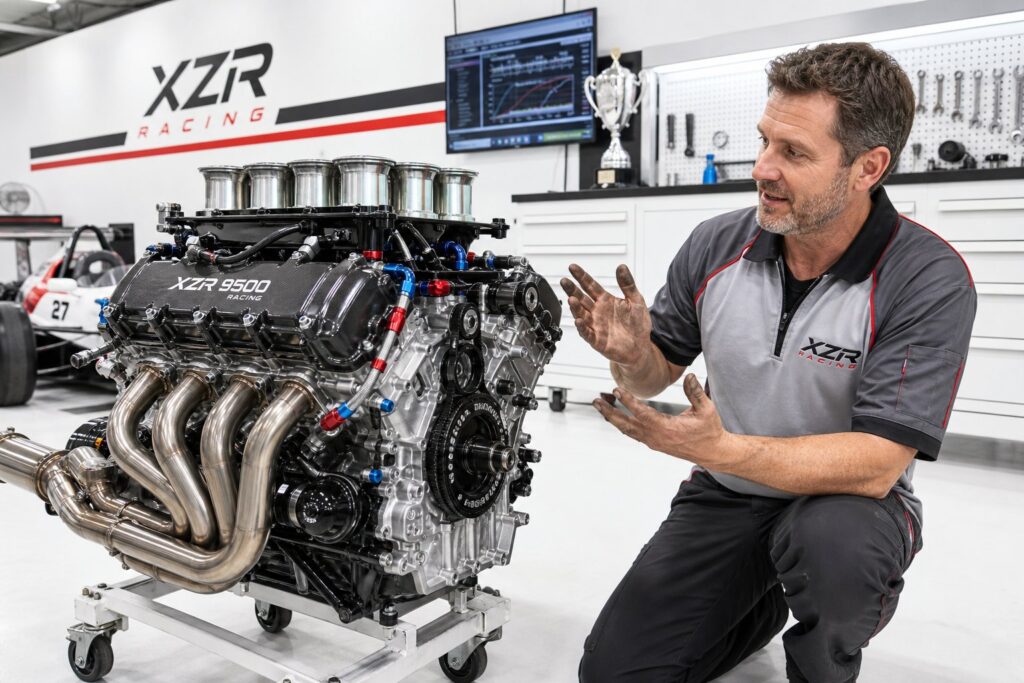
2. Think of an AI model as a racing engine
Imagine several companies trying to build the world’s best racing engine. The architecture of the engine tells you roughly how the machine is constructed. It tells you that there are cylinders, valves, a turbocharger and a fuel system. AI has an equivalent. Researchers publish architectures such as the Transformer and techniques such as mixture of experts and attention mechanisms, and anyone can read the papers.
But possessing the design of an engine does not mean you possess the engine. The really valuable object is the finished engine after thousands of engineering decisions, adjustments, tests and refinements have been made. The weights of an AI model are a little like all of those adjustments frozen into the finished machine. Technically, weights are enormous collections of numerical parameters learned during training. The Open Source Initiative describes an AI model as the combination of its architecture, its parameters (the weights) and the inference code needed to run it, and a modern frontier model may contain hundreds of billions or even trillions of these parameters.
Before training, those numbers are largely meaningless. During training they are adjusted again and again as the model processes enormous quantities of information, and what eventually emerges is the behaviour we recognise as the model. This distinction matters because the architecture itself is often not particularly secret. Two companies can understand broadly how one another’s engines work while still being unable to reproduce the finished engine without doing the enormously expensive engineering themselves. The weights are the clearest embodiment of that work, and a company handing them over is handing over an extraordinarily expensive product of its research, even though they are not the entire factory that produced it. The data pipeline, the training methodology, the post training process, the evaluation harnesses and the accumulated know-how behind all of it remain just as real, and just as valuable, whether or not the weights ship alongside them.
It is worth being a little more precise about what these numbers do. A weight is one of the values in the matrices that sit inside each layer of the network, and running the model, what people call a forward pass, is mostly repeated matrix multiplication against those numbers as the input works its way through the layers. Training sets them by trial and error at enormous scale. The model produces an output, that output is compared against what was wanted, and an algorithm called backpropagation works out how much each individual weight contributed to the error and nudges it slightly in the direction that would have made the answer better. That nudge happens for every weight, billions or trillions of times over, across the entire training run. Two details from earlier in this piece are worth carrying forward here. Moonshot’s Kimi K3 has 2.8 trillion parameters in total, but only 16 of its 896 experts activate for any given token, so the number of weights actually doing work on a single request, its active parameters, is closer to 104 billion. That gap between total and active parameters is one of the main reasons parameter count alone is a poor guide to how expensive a model is to run. It is also why the weights themselves come as enormous files, often hundreds of gigabytes, stored at a given numerical precision such as BF16 or FP8, and why quantising them down to a coarser precision such as MXFP4 is one of the first things the open community does with a new release, since it shrinks the file and speeds up inference at some cost to accuracy.
3. Closed models: you can drive the car, but the bonnet is welded shut
With a traditional proprietary model, you normally interact with it through somebody else’s service. You send a request to an API and receive an answer. You may be able to adjust prompts, tools and system instructions, but the model itself remains on the provider’s infrastructure. You cannot download the underlying weights, inspect them, or take the model home and run it on your own hardware. You cannot simply decide that from tomorrow your bank, hospital or government department will run the model inside its own data centre.
The easiest analogy is renting a racing car from its manufacturer. You can drive it incredibly quickly, but the bonnet is welded shut. This model has real advantages. The provider can continuously improve the system, operate enormous computing infrastructure and hide a great deal of complexity from the customer, which is exactly what many users want. The disadvantage is dependency. If the provider changes the price, changes the model, changes its policies, withdraws a feature or decides that a particular use case is no longer allowed, there may be very little the customer can do about it. Your intelligence layer belongs to somebody else.
4. Open weights: here are the keys and here is the engine
An open weight model changes that relationship entirely. Instead of merely allowing you to send requests to a model, the creator makes the trained weights available. Depending on the licence and the model, you can download those weights, operate the model on infrastructure you control, adapt it for a particular purpose, fine tune it, quantise it, distil it or build another system around it.
OpenAI released its gpt oss models in August 2025 under the Apache 2.0 licence, describing them on the model’s own documentation as open weight reasoning models that developers can customise and run on their own infrastructure, together with a usage policy governing acceptable deployment.[¹] DeepSeek has released the code and weights for its core models, including R1, under the MIT licence, while Alibaba’s Qwen family includes numerous models released under Apache 2.0, with the licence occasionally reverting to a more restrictive Qwen licence for some flagship releases. Mistral has followed a similar strategy with a mixture of commercial and open weight models, and Moonshot AI has pushed the idea remarkably far. Its Kimi K3 model, published on Hugging Face in July 2026, is a 2.8 trillion parameter mixture of experts model that activates only 16 of 896 experts per token, and Moonshot’s own model card describes it as the first open model at what it calls “3T class” scale, released under a dedicated Kimi K3 licence together with the full technical report.[²]
You are no longer merely renting the car. Someone has given you the engine.
5. Open weights does not necessarily mean open source
This is where the terminology becomes messy. People regularly describe models as open source simply because the weights can be downloaded, but those two things are not equivalent. You might have the finished engine without receiving every drawing, every test result, every manufacturing process or a record of every material that went into building it. AI can work the same way. A company may release the model weights while keeping some or all of the training data, training process and internal tooling private.
The Open Source Initiative published its Open Source AI Definition in October 2024, and by that definition a genuinely open source AI system must give users the freedom to use, study, modify and share it, which in practice requires sufficiently detailed information about the training data, the training and evaluation code, and the parameters, all made available under approved terms.[³] By this stricter test, most of the models people casually call open source, including Llama, Gemma and Qwen, are actually open weight rather than fully open. They give you the finished engine, not the factory that built it.
Licensing terms vary considerably across the field, and they are more fluid than they first appear. DeepSeek’s own licence FAQ explains that it applies the standard MIT licence to its code repositories, while its models have historically sat under a separate model licence. R1 was released under MIT for both code and weights from the start, but the original V3 release kept its Base and Chat models under a custom licence even though the surrounding code was MIT. That changed with the V3 0324 update in March 2025, when DeepSeek moved the model weights themselves to MIT as well, so the direction of travel has clearly been towards more permissive terms rather than less.[⁴] Qwen mostly uses Apache 2.0, though Alibaba retains a separate Qwen licence for some of its largest models. Meta describes Llama as open source, but Llama actually ships under Meta’s own community licence, which Meta’s own published terms show includes a threshold of 700 million monthly active users, above which a company must negotiate a separate commercial agreement, along with restrictions on how derivative models must be named.[⁵] So it is worth being precise. Open weights tells you that you can obtain the trained parameters. It does not automatically tell you everything about how the model was created, or everything you are legally permitted to do with it.
6. So why on earth would anyone give the weights away?
This is the genuinely interesting question. There is a tendency to assume companies release open models out of charity, and there is undoubtedly a real research culture behind some of these decisions, but there are also extremely powerful commercial reasons for doing it.
The first reason is brutally simple: sometimes the model is not the business. Meta is the clearest example. Meta makes its money primarily through the enormous advertising businesses surrounding Facebook, Instagram and its other products, so it does not need to charge every developer who runs Llama for that model to be strategically valuable to Meta. Mark Zuckerberg has been unusually explicit about this. In his 2024 essay accompanying the release of Llama 3.1, he compared the trajectory of open AI to the way Linux eventually overtook closed Unix systems, and argued that an open ecosystem prevents Meta from becoming dependent on a closed technology stack controlled by a competitor.[⁶] More recently, in August 2026, Meta has doubled down on this framing again, with Zuckerberg publishing a further essay and opinion piece arguing that American open models need to compete more aggressively against Chinese open models such as DeepSeek and Kimi, and positioning Meta’s continued commitment to openness as both a commercial strategy and a matter of national technology policy.[⁷]
There is a second, closely related motive that is easy to miss. Meta does not sell model tokens for a living, but several of its rivals do. If open weight models push the price of intelligence down across the board, that hurts any company whose business model depends on charging for API access to a model, while simultaneously making Meta’s own products cheaper to build. Giving away a model you do not monetise directly can be a way of commoditising a resource that your competitors do monetise. Sometimes you open something because you want it to become the standard. Sometimes you make your money somewhere adjacent to it. And sometimes you open something because you would quite like the thing your competitor sells to become a commodity. All three motives can sit comfortably inside the same decision.
7. Ecosystems, distribution and the researchers you do not employ
Technology becomes enormously powerful when an ecosystem forms around it. Developers optimise software for it, hardware manufacturers support it, cloud companies host it, researchers improve it, universities teach it and startups build products around it. Once that begins to happen, the model stops being merely a model and becomes a platform, and that platform effect is really two sides of the same network effect: ecosystem formation and distribution reinforce each other.
Meta has deliberately encouraged this around Llama, working with cloud providers, hardware companies and enterprise technology firms to make deployment, fine tuning and optimisation easier, with the explicit goal of making Llama the industry standard. A university can download a model. A startup can experiment with it. A government can deploy it internally. A bank can put it inside an environment where sensitive customer information never needs to leave its own infrastructure. OpenAI itself now highlights exactly this set of reasons, control, local deployment, data residency and customisation, as the justification for gpt oss.[⁸] Once a model is running in thousands of different places, replacing it becomes much harder, and giving the model away creates something selling API calls cannot create quite as easily, which is ubiquity. You do not always need to own the tollbooth if you can influence where the road gets built.
Alongside that sits a second, distinct effect: releasing weights recruits thousands of researchers you do not employ. The rest of the world starts experimenting with your model. Researchers discover better ways to quantise it. Developers make it run on cheaper hardware. Other researchers fine tune it for medicine, coding, mathematics or languages the original developers barely considered, and infrastructure companies optimise inference engines specifically around it. Suddenly an enormous distributed research and development organisation exists around your technology, and most of the people in it do not work for you. Mistral has argued publicly that open models allow systems to be adapted to specialised business problems in ways closed models cannot easily match. The original creator does not capture all of that value, but it may capture enough of it to make the trade worthwhile.
8. This is part of why the Chinese models matter so much
This is where DeepSeek, Qwen and Kimi become strategically important. The AI discussion in the West was initially dominated by a handful of American companies with closed models, with the implicit assumption that access to the most capable intelligence would increasingly be purchased through APIs operated by those companies. Open weight Chinese models challenge that assumption directly.
DeepSeek releases weights and technical reports for its major models and has moved steadily towards the permissive MIT licence for both code and weights. Qwen has released a broad family of models across different sizes, making it possible to choose something appropriate for anything from modest consumer hardware to a large data centre deployment. Moonshot AI has now put the full weights of Kimi K3, at 2.8 trillion parameters, on Hugging Face under its own Kimi K3 licence, pushing genuinely frontier scale intelligence further into the open model world than any Western lab has yet matched. Moonshot’s own published benchmarks are candid that K3 still trails the very best closed models from Anthropic and OpenAI overall, while leading on several coding and long horizon agentic tasks among open models.[⁹] Precise rankings among the fastest moving open models change from month to month and are worth checking against current, independently run benchmarks rather than any single snapshot, but the broader point does not depend on who holds the top spot this quarter.
What matters is that the competitive question has changed shape. It is no longer simply which company has the best chatbot. It increasingly becomes which model becomes the foundation everybody else builds on, and those are very different battles to win. A model that is five per cent worse but becomes infrastructure for a hundred thousand products can ultimately matter more than a technically superior model locked behind one company’s API.
9. Open models change the economics of AI
There is another consequence that may ultimately matter more than any of the above, and that is downward pressure on the price of intelligence. If only a handful of companies possess highly capable models, those companies have enormous pricing power. If a capable model can instead be downloaded and operated by Amazon, Microsoft, Google, a specialist inference provider or the customer itself, inference starts behaving more like a competitive computing workload rather than a scarce resource controlled by one seller.
The model creator may have spent an enormous amount developing the underlying intelligence, but once the weights are available, many companies can compete to operate it efficiently. That changes the economics substantially. Optimisation becomes valuable. GPUs compete with alternative accelerators. Quantisation improves. Smaller distilled versions appear. Inference software improves. Hardware utilisation improves. The cost of consuming intelligence begins to move away from whatever the original creator decides to charge and closer to the underlying cost of computing it, which is an important shift for anyone budgeting for AI at scale.
10. There is still a reason to keep models closed
None of this means every model will become open weight. There are powerful reasons to keep the very best models proprietary. A company that has spent billions developing a genuine capability advantage may decide that selling access to that advantage is far more valuable than distributing it. Keeping the weights private also gives the developer more control over safety mechanisms, usage, intellectual property and the way the model is operated in practice.
There is therefore likely to be a continuing tension between the two approaches. Some companies will monetise scarcity. Others will monetise the ecosystem surrounding abundance. Some, like Mistral, will try to do both at once, running a portfolio that mixes open weight models with commercial ones reserved for production use under separate licensing terms. That structure may prove to be fairly common as the field matures.
11. Weights make intelligence portable
This is probably the simplest way to explain why open weights matter. With a closed model, intelligence is a service. With an open weight model, intelligence starts becoming an asset you can actually possess. You can put it in your data centre. You can put it in your cloud account. You can optimise it for your hardware. You can modify it for your organisation. With sufficiently small models, you can even put it directly onto personal devices.
That difference is profound. We spent the first years of the generative AI wave becoming accustomed to the idea that intelligence lived behind somebody else’s API. Open weights challenge that assumption, and the 2026 push by Meta to reassert itself against Chinese open models, alongside DeepSeek, Qwen and Moonshot continuing to publish frontier scale weights, suggests the trend is accelerating rather than fading. Once you understand that, the decision to release a model’s weights no longer seems quite so strange. The company doing it is giving away an extraordinarily expensive product of its research, even if not the whole factory behind it, because what it really wants is for the entire world to start building around that product. In technology, owning the standard can sometimes be worth considerably more than owning the product.
Notes
[¹] OpenAI, gpt oss 120b & gpt oss 20b Model Card, and the OpenAI Help Center article “OpenAI open weight models (gpt-oss)”: https://openai.com/index/gpt-oss-model-card/ and https://help.openai.com/en/articles/11870455-openai-open-weight-models-gpt-oss
[²] Moonshot AI, Kimi K3 model card on Hugging Face: https://huggingface.co/moonshotai/Kimi-K3
[³] Open Source Initiative, The Open Source AI Definition 1.0, October 2024: https://opensource.org/ai/open-source-ai-definition
[⁴] DeepSeek, DeepSeek License FAQ: https://deepseeklicense.github.io/ ; DeepSeek-V3 repository licence notice: https://github.com/deepseek-ai/DeepSeek-V3/blob/main/README.md ; on the March 2025 move of V3-0324 to MIT for the weights themselves: https://simonwillison.net/2025/Mar/24/deepseek/
[⁵] Meta, Llama 4 Community License Agreement: https://www.llama.com/llama4/license/
[⁶] Mark Zuckerberg / Meta, “Open Source AI Is the Path Forward,” July 2024: https://about.fb.com/news/2024/07/open-source-ai-is-the-path-forward/
[⁷] Fortune, “Mark Zuckerberg makes his case for American open source AI over Chinese rivals,” August 2026: https://fortune.com/2026/08/10/meta-brandishes-open-source-ai-models-again-as-zuckerberg-media-blitz-emphasizes-battle-against-chinese-rivals/
[⁸] OpenAI Help Center, “OpenAI open weight models (gpt-oss)”: https://help.openai.com/en/articles/11870455-openai-open-weight-models-gpt-oss
[⁹] Moonshot AI, Kimi K3 model card and README, including benchmark comparisons against Claude and GPT models: https://huggingface.co/moonshotai/Kimi-K3