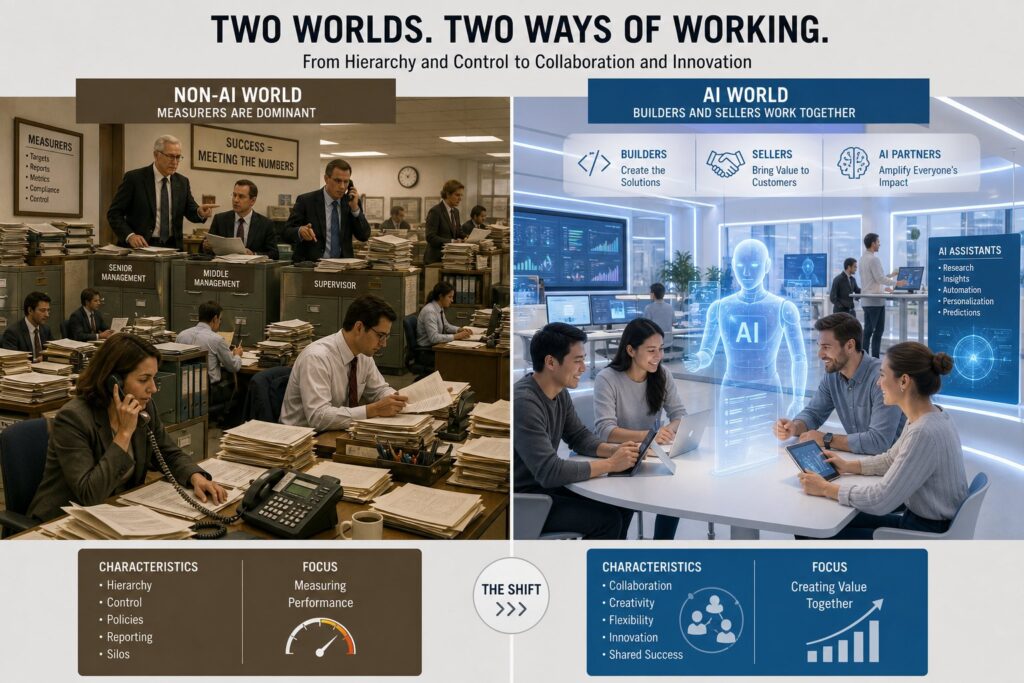
Builders, Sellers, Measurers: Why AI Is Restructuring Every Company Whether They Plan For It or Not

Artificial intelligence is fundamentally restructuring the assumptions organisations use to justify how they coordinate work, allocate decisions, and design hierarchies, rather than simply eliminating jobs. Just as electricity reshaped factory layouts and computers dismantled paper based bureaucracies, AI challenges why certain roles, layers, and processes exist at all, making organisational design the real frontier of disruption.
Builders, Sellers, Measurers: Why AI Is Restructuring Every Company Whether They Plan For It or NotAndrew Baker's Technology Blog Posts, 29/Jun/2026
https://andrewbaker.ninja/2026/06/29/builders-sellers-measurers-why-ai-is-restructuring-every-company-whether-they-plan-for-it-or-not/
AI is not eliminating work so much as changing what organisations optimise for. Companies that once grew by adding layers of management, reporting and coordination are beginning to grow by adding builders and customer facing experts instead, with AI quietly removing much of the organisational overhead that previously sat between them. The businesses that understand this first will look structurally very different from those still debating whether artificial intelligence is a threat or an opportunity.
The dominant narrative frames this as job displacement: a technology company restructures, a chief executive explains that AI has transformed productivity, and commentators immediately conclude that software developers, analysts or managers are becoming obsolete. That framing misses what may be the most significant economic shift underway. AI is not primarily changing who works; it is changing why organisations looked the way they did in the first place, and what it now costs to keep them looking that way. Every major technological revolution has reshaped organisations long before it reshaped labour markets. Steam power, electricity, computing and the internet each removed a fundamental economic constraint and forced businesses to reorganise around a new reality. Artificial intelligence appears to be removing a different constraint altogether, namely the cost of coordination, and that changes nearly everything about how large institutions justify their shape.
1. Every Technological Revolution Reduces the Cost of Something
The economist Ronald Coase argued in 1937 that firms exist because markets have transaction costs. It is sometimes cheaper to organise work internally than to contract for it externally, and the boundary of the firm sits at the point where internal coordination becomes more expensive than market exchange. Every major technological revolution can be understood as a reduction in some category of transaction cost, which is why each one forced organisations to reorganise rather than simply operate more efficiently.
Steam power reduced the transaction cost of physical production, making large scale manufacturing economical and displacing the cottage industries that had organised work around the constraints of distributed, small scale production. Electricity reduced the transaction cost of distributing mechanical power within a building, freeing factories from the tyranny of central drive shafts and allowing production lines to be organised around efficiency rather than proximity to a power source. Computers reduced the transaction cost of calculation, eliminating armies of clerks and allowing organisations to manage complexity that would previously have been administratively impossible. The internet reduced the transaction cost of distribution and communication across distance, while cloud computing reduced the transaction cost of building and scaling software infrastructure.
None of these revolutions simply improved existing organisations. Each changed what was expensive, which changed what organisations needed to exist, which changed what organisations looked like. The businesses that understood this distinction thrived while those that treated new technology as a faster version of the old way eventually found themselves structurally outcompeted by organisations that had rebuilt around the new cost reality. Artificial intelligence appears to be following exactly the same pattern, reducing the transaction cost of information coordination, and modern organisations, almost without exception, were built around the assumption that information coordination was expensive.
2. Modern Organisations Were Built Around Expensive Communication
Large organisations are often criticised for bureaucracy, endless meetings and layers of management, as though these structures developed because executives enjoyed process for its own sake. The reality is rather more practical. Bureaucracy exists because communication has historically been slow, fragmented and expensive, and the roles that constitute it did not appear because organisations were poorly run but because organisations had no alternative.
An executive responsible for twenty thousand employees cannot observe everything personally, which means information has to travel through the organisation before decisions can be made, and someone has to carry it. Managers collect status updates because systems cannot report their own state clearly. Programme offices exist because no single person can hold the dependencies of a large delivery portfolio in their head. Governance teams prepare committee packs because senior leaders cannot read raw operational data across dozens of systems before a board meeting. Finance teams reconcile accounts because the underlying platforms do not agree with each other automatically, and steering committees exist because alignment between functions requires a structured venue in which people with different information can reach shared understanding. None of these roles were invented frivolously. Each emerged to solve a real problem created by the cost and fragmentation of information, and the measurer category as a proportion of total headcount grew in direct proportion to organisational complexity because complexity created information gaps and information gaps required people to fill them.
Artificial intelligence challenges the assumption that this infrastructure must continue to exist in its current form. According to BCG research published in 2026, organisations that redesign their operating models around AI are achieving up to 60 percent cost reduction and 80 percent cycle time reduction, and the gap between those results and the outcomes of incremental adoption is not a matter of degree but a matter of structural choice. The reason those numbers are possible is that AI can now perform much of the information assembly, translation and distribution that entire departments previously existed to do manually.
3. The Hidden Coordination Tax
Every organisation pays what might be called a coordination tax. As companies grow, an increasing proportion of employees spend their time helping other people work rather than directly creating value for customers: some build products, some sell them, some support customers, and many others coordinate the work of everyone else through reporting, scheduling, governance, planning, documentation, approvals, portfolio management and communication. These activities have historically been valuable precisely because information was expensive to collect and distribute, but artificial intelligence is rapidly reducing those costs. An AI system connected to operational telemetry, engineering systems, customer support platforms, financial data and documentation repositories can answer questions that previously required days of manual effort, explaining why a deployment failed, identifying affected customers, summarising operational risks, analysing financial performance and retrieving institutional knowledge without requiring multiple people to prepare reports for multiple meetings. The information itself increasingly becomes available on demand, continuously and at negligible marginal cost, and if coordination becomes inexpensive then organisations built around expensive coordination begin to look structurally inefficient in ways that are difficult to ignore when a competitor has already reorganised itself around the new reality.
It is important to be precise about which coordination costs AI actually reduces, because the claim is stronger in some areas than others. AI dramatically reduces the cost of information coordination: gathering, assembling, translating and distributing data across organisational boundaries. It is considerably less effective at the coordination that involves politics, trust, negotiation, ambiguous incentives and conflicting human interests, which remain stubbornly expensive regardless of how capable the underlying models become. The implication is not that all coordination overhead disappears but that the information moving portion of it, which constitutes a substantial fraction of what most large organisations spend on management infrastructure, becomes dramatically cheaper. Research published in February 2026 under the title AI as Coordination Compressing Capital formalises this intuition, arguing that AI reduces coordination costs in ways that expand management spans of control and enable new task creation, and that firms adopting such tools are demonstrably flattening hierarchies as a result.
4. Cloudflare and the Builders, Sellers, Measurers Framework
When Cloudflare cut approximately 1,100 jobs in May 2026, the headline interpretation was straightforward: a technology company was replacing workers with AI. What followed complicated that reading considerably. According to BNP Paribas analysis of LinkedIn data, Cloudflare’s engineering headcount grew from 1,308 to 1,894 in the weeks after the cuts, a 45 percent increase in the function the company considers most central to its value creation even as total headcount shrank by roughly a fifth. CEO Matthew Prince confirmed the trend and offered a framework for understanding it, dividing almost every large organisation into three groups: builders who make the product, sellers who bring in revenue, and measurers who track, report and coordinate the work of the first two groups. The taxonomy is useful and memorable, but as the following sections argue, it quietly omits a fourth category that becomes critically important when you start removing the measurer layer: owners.
It is worth being precise about what a measurer is, because the word is easy to misread. A measurer is someone whose primary organisational value comes from observing, reporting, coordinating or validating work created by others rather than directly creating products or revenue. That definition removes ambiguity about where the boundary sits, because it is not a job title but a description of what someone’s output actually is. A finance analyst who produces dashboards summarising other people’s work is a measurer, while a quantitative trader whose models directly generate revenue is not. A programme manager who coordinates delivery across teams is a measurer, while an engineer who builds the delivery pipeline is not. The distinction is not about seniority or salary but about whether the work creates value or describes value that others have created. It is also worth noting that some apparently measurement heavy roles are builders in disguise: fraud detection, cyber monitoring, observability engineering and market surveillance are all measurement intensive disciplines that directly prevent loss or generate revenue, which means the people doing that work sit firmly in the builder category regardless of how data heavy their day looks.
The roles cut at Cloudflare fell overwhelmingly into the genuine measurer category: middle managers, operations staff, finance analysts and marketing coordinators whose primary function AI agents can increasingly approximate. Prince’s logic runs in the opposite direction from the dominant narrative: if his engineers become more productive with AI, he would hire more of them rather than fewer, because each additional engineer now generates greater returns. Cloudflare’s Q1 2026 revenue grew 34 percent year on year to $640 million, and the company added a record number of enterprise customers through the same period in which it shed those roles, making clear that the restructuring was not driven by financial weakness. GitLab followed a strikingly similar path in May 2026, announcing a seven percent workforce reduction alongside the removal of up to three management layers in certain functions and a reorganisation of its research and development division into roughly 60 smaller autonomous teams, framed explicitly as preparation for an agentic era in which internal reviews, approvals and handoffs would be automated by AI agents. The pattern repeating across two companies in the same month, with nearly identical logic and structural outcomes, is harder to dismiss as coincidence than a single data point would be.
5. AI Is Replacing Assumptions, Not Professions
Perhaps the biggest misunderstanding surrounding artificial intelligence is the belief that it replaces professions directly. Computers did not replace accountants, the internet did not replace retailers, and cloud computing did not replace IT departments. Instead, each technology replaced the assumptions about how those professions needed to operate, producing profound changes in what those professionals actually did for a living and in the organisational structures built to support them. Artificial intelligence appears to be replacing a different assumption. For decades businesses have accepted that moving information between people is expensive and have built organisational structures accordingly, with entire layers of administration emerging because somebody needed to gather information, summarise it, distribute it and ensure everyone shared the same understanding before a decision could be reached. If AI performs much of that information coordination continuously and at negligible cost, then many of those structural assumptions become unnecessary, which is an organisational economics transformation rather than a technological one, and explains why the phenomenon cannot be adequately described as job displacement alone.
This matters particularly in regulated industries. Banks, healthcare providers, aviation operators and government agencies cannot simply eliminate measurement functions because those functions are legally mandated, but what changes is the human role within them. AI increasingly performs the mechanical production of compliance output, risk reports and audit trails, while the humans who remain in those functions shift from being producers of measurement to reviewers and interpreters of it. Banking illustrates this clearly: entire departments exist to reconcile systems, prepare governance packs, aggregate operational metrics and coordinate information between technology, operations and risk functions, and much of this work exists not because it is intrinsically valuable but because today’s systems cannot continuously explain themselves in terms that decision makers can act on. As AI gains direct access to operational data, many of these coordination activities become automated rather than manual, the governance obligation remains, and the infrastructure required to discharge it changes substantially.
None of this means that management disappears or that leadership becomes less important. If anything, it becomes more important. Great organisations still need people who exercise judgment under uncertainty, set direction, resolve conflict and accept accountability for outcomes. What disappears is not management itself but the information moving infrastructure that surrounded it, and in doing so AI is making the quality of leadership more visible rather than less.
6. Why Builders Become More Valuable
One of the most persistent assumptions surrounding AI is that greater productivity inevitably leads to fewer employees, but that conclusion only follows if demand remains constant, and history suggests something rather different. When productive capacity increases, organisations frequently expand investment in the activities that generate value because each additional contributor now produces greater returns.
A useful way to think about this is what might be called the value creation ratio: the proportion of an organisation’s total headcount that is directly involved in creating or converting value for customers, as opposed to supporting, coordinating and reporting on that creation. Builders create value, sellers convert it into revenue, and everyone else exists to support those two groups. As AI makes that support function dramatically more efficient the ratio shifts, and the companies that benefit most from AI are therefore not necessarily those that reduce total headcount but those that continuously increase the proportion of employees directly involved in creating or selling something customers pay for, which is a profoundly different optimisation target from the one most large organisations have historically pursued.
Prince’s stated reasoning at Cloudflare makes this explicit: AI amplifies the output of people who build and sell, which means hiring more builders becomes more attractive rather than less as AI capability grows, and the return on investment of the builder category improves precisely because coordination and reporting consume less of their time. TrueUp, a platform that tracks technology hiring, reports that open technology roles were up fourteen percent in 2026 compared with the previous year, with hardware engineering positions growing at more than fifty percent. The gains are concentrated in technical and product roles while openings in operations, human resources and general management have declined, and companies are hiring more people who build things and fewer people who manage the people who build things.
7. The Sequence Problem
The structural argument for AI replacing coordination roles is compelling, but there is an important counterexample that deserves equal weight. Ford Motor Company spent several years reducing its reliance on experienced engineers, replacing human quality inspection with AI driven automated systems. The results were damaging: Ford’s VP of vehicle hardware engineering acknowledged publicly in June 2026 that the company had mistakenly believed it could introduce AI, ingest existing design requirements and thereby produce a high quality product. The fundamental problem was not that the AI was technically broken but that experienced engineers had left before they could transfer their institutional knowledge into the systems intended to replace them, and without decades of engineering judgment encoded in training data, Ford’s automated tools amplified weak inputs rather than catching design flaws. The company subsequently hired, rehired or promoted 350 veteran engineers to mentor younger staff and rebuild the data pipelines feeding AI training, and following that investment it reached the top of JD Power’s initial quality ranking among mainstream brands for the first time in sixteen years.
The lesson is that sequence matters enormously. Institutional knowledge must be transferred before it can be encoded, and encoding it requires the people who hold it to be present and engaged. Organisations that remove experienced practitioners before their knowledge has been adequately captured will find themselves with AI systems of limited use and a pipeline of junior talent that has never had the opportunity to develop the judgment those systems were supposed to replicate.
8. The Apprenticeship Problem
Every profession depends upon apprentices, with junior engineers becoming experienced architects by solving thousands of relatively small problems over many years, lawyers becoming trusted advisers by handling routine cases before tackling complex litigation, and accountants developing expertise by mastering everyday financial work before taking responsibility for strategic decisions. The routine work that feels most automatable is also, in most professions, the substrate on which expertise is built, and artificial intelligence increasingly performs much of that routine work.
The instinctive organisational response has been to reduce junior hiring and concentrate AI tooling in the hands of experienced practitioners, and the logic is understandable because AI does not just amplify good judgment. It amplifies whatever judgment is present, which means a junior engineer in a poorly bounded system with AI assistance and no structural constraints can cause damage at a speed and scale that was previously impossible. But that framing quietly assumes something that no well-run engineering organisation would accept: that the junior engineer is working alone. Apprentices do not operate in a vacuum. They work inside teams with code review, pair programming, automated test gates, staging environments, user testing, business sign-off and staff pilots. Nobody is clicking a button and shipping directly to production. The judgment that forms through struggle forms precisely because the apprentice is embedded in a team that catches mistakes, explains them and routes them back as learning. AI does not remove that structure. Within a well-constructed team environment, AI access actually accelerates judgment formation because the apprentice gets more iterations, more feedback cycles and more exposure to real problems per unit of time, all still inside the review and testing infrastructure that makes mistakes survivable and instructive rather than catastrophic.
The real risk is therefore not juniors with AI access but juniors without the team structure, process gates and architectural boundaries that make learning safe and productive. And that risk exists with or without AI. Research published in June 2026 in the Journal of Higher Education Theory and Practice argues that the informal post degree apprenticeship system that historically completed graduate formation no longer reliably exists. ADP payroll data analysed by Brynjolfsson, Chandar and Chen found a thirteen percent relative decline in employment for workers aged twenty two to twenty five in AI exposed occupations since late 2022. Hosseini and Lichtinger, analysing sixty two million resumes across 285,000 American firms, found that AI adopting companies reduced junior hiring by nine to ten percent within six quarters, driven entirely by reduced hiring rather than increased departures, with senior hiring unaffected. The career ladder is not collapsing from the top down but being eroded from the bottom up, and the cause is not AI access granted too freely but the decision to stop hiring the juniors who would have developed inside those teams in the first place.
The correct diagnosis is therefore an environment problem rather than a people problem. If the blast radius of a mistake is catastrophically large, the solution is to reduce the blast radius rather than stop hiring the people most likely to learn from making mistakes, which means better guard rails, better automated testing, better standards, better mentorship structures, and crucially better architectural boundaries that limit how far a mistake can travel before it is caught. An organisation operating on a large shared monolithic database, where a poorly written query or a poorly considered migration can affect dozens of teams simultaneously, is not a safe environment for any junior work regardless of AI involvement. The monolith is not just technical debt but a cap on how aggressively the organisation can distribute AI tooling and how fast it can develop new engineers into productive autonomy. Each domain boundary that gets properly established creates a bounded environment where junior engineers can operate with AI tooling, make mistakes, learn from them and be mentored by seniors without the consequences propagating across the organisation. Domain decomposition and junior talent development are not independent workstreams but the same investment viewed from different angles, and the organisations that understand this sequencing will build sustainable engineering capability while those that do not will find themselves a decade from now facing the same problem Ford discovered the hard way.
9. Decision Latency as a Competitive Advantage
Reducing coordination costs is the first order effect of AI on organisational design. There is a second order effect that receives considerably less attention but may ultimately matter more: AI dramatically reduces the time between observation and action.
In a traditional organisation, a customer facing problem travels a considerable distance before it produces a decision. A support team identifies an issue, escalates it to a manager, who routes it to a programme office, which schedules it for an architecture review, which produces a recommendation for a governance committee, which eventually reaches an executive capable of authorising a response. Each handoff exists because the next person in the chain lacks either the information or the authority to act alone, and the total elapsed time between the original observation and the resulting decision can be measured in days or weeks even when the underlying technical fix would take hours. AI compresses this chain by making information available to the person closest to the problem rather than requiring it to travel upward through layers of aggregation before it becomes intelligible to a decision maker. An engineer with AI access to operational telemetry, customer impact data, deployment history and risk context can assess and act on a situation that would previously have required four meetings and a committee pack.
The competitive implication is significant. Organisations that compress decision latency gain a structural advantage that compounds over time because faster decisions mean faster learning, faster learning means faster iteration, and faster iteration means products that improve more quickly than those produced by organisations still routing observations through legacy coordination infrastructure. This is not merely a cost argument but a capability argument. The organisations that win over the next decade will not just be those that spend less on coordination but those that act on what they observe faster than any competitor running the old model can.
There is, however, a risk embedded in the compression that most organisations fail to anticipate. The measurer layer was not only moving information. It was also, however imperfectly, the structure where accountability appeared to live. The steering committee that slowed a decision down was also, implicitly, the body that could be held responsible when the decision turned out to be wrong. Committees are poor accountability mechanisms precisely because collective agreement diffuses individual ownership. When the committee approved the call, nobody truly owned the outcome, but they were at least a named point in the process where the question of who authorised this could be asked and answered. When you remove the committee and compress the decision chain, you get an engineer with full context and the authority to act, which is exactly what you want. But if you have not deliberately reattached ownership to that engineer at the moment of decision, you get something rather more dangerous: a faster organisation where consequential choices happen and nobody is accountable for them at all.
This suggests that the builders, sellers, measurers taxonomy, useful as it is, omits a fourth category that becomes indispensable as the measurer layer shrinks: owners. An owner is someone who holds explicit, named accountability for an outcome: not the committee that approved the direction, not the governance process that signed off the risk, but the individual who can be identified before the decision is made as the person responsible for what happens next. The Ford sequencing lesson applies here as directly as it does to institutional knowledge: transfer the accountability model before you remove the layer that was implicitly carrying it, or you will discover, in the aftermath of the first significant failure, that it was never as explicit as you assumed. Compressing decision latency without deliberately distributing ownership does not produce a faster organisation. It produces a faster way of making decisions that nobody has to answer for.
10. The Lag Problem
There is a transition cost that most commentary on AI organisational design ignores entirely. Almost every large organisation will not respond to AI by immediately dismantling its measurement infrastructure but will instead add AI tooling to existing structures, keeping every reporting layer, retaining every approval committee and maintaining every governance process, with the result that at least initially there is more bureaucracy rather than less. Coordinators acquire AI assisted dashboards, programme offices generate automated status reports, and governance committees receive AI summarised risk assessments, but none of the underlying structure changes. It simply runs faster and produces more output, most of which nobody needed in the first place.
This creates a temporary period during which AI makes organisations slower and more expensive before the structural pressure eventually becomes impossible to ignore. The coordination layer now has powerful tools and institutional legitimacy, which makes removing it politically harder rather than easier because the people within it can point to measurable productivity gains. The organisations that move fastest through this transition are those whose leadership understands from the outset that the goal is not to make the existing structure more efficient but to ask whether the existing structure would have been built at all if AI had existed when the company was founded, which is a considerably more uncomfortable question to answer honestly, but the right one.
11. Separating Transformation from Storytelling
There is also a reason for caution whenever companies attribute restructuring entirely to artificial intelligence. Some organisations undoubtedly are redesigning their operating models around AI, but others are responding to slower growth, previous overhiring or changing market conditions while recognising that AI narratives are currently rewarded by investors and generate more favourable coverage than conventional cost reduction, a phenomenon Sam Altman has himself described as AI washing. The coming years will require separating businesses that are fundamentally redesigning how they operate from those simply using AI as a convenient explanation for headcount reduction, because only the first group is likely to enjoy lasting competitive advantages, while the second will find itself having reduced coordination capacity without having built the builder capacity to replace it.
12. Final Thoughts
Every industrial revolution reduced the cost of something that organisations had previously treated as fixed. Steam reduced the cost of physical production, computing reduced the cost of calculation, and the internet reduced the cost of distribution. Artificial intelligence is reducing the cost of information coordination, and that changes everything about how large institutions justify their shape, because modern organisations were built almost entirely around the assumption that information coordination was expensive.
Twenty years ago companies competed by scaling headcount. Today they compete by scaling decision quality, and the organisations that win over the next decade will employ a much higher proportion of people who directly create value for customers, supported by AI systems that handle the information assembly, reporting and coordination that previously required entire layers of management to perform manually. Companies built primarily around measuring themselves will find that shape increasingly difficult to defend as the transaction costs that justified those measurement layers continue to fall. Companies built around building, selling and owning outcomes at the edge will find they can grow faster, develop talent more sustainably and deploy capital more effectively than competitors still routing decisions through legacy coordination infrastructure. The headlines asking whether AI will take your job are asking the wrong question. The right question is whether the assumptions your organisation was built on are still true, and what you are going to do now that many of them are not.
References
Primary sources
Stan, A.M. (2026, June 27). Cloudflare cut 1,100 jobs and then grew its engineering team by 45 percent, and its CEO says the pattern will repeat everywhere. The Next Web.
Staples, B. (2026, May 11). GitLab Act 2. GitLab Blog.
Poon, C., quoted in multiple sources (2026, June 25–28). Ford VP of Vehicle Hardware Engineering statements on AI quality failures and engineer rehiring. Bloomberg, TechCrunch, The Verge.
Bloomberg (2026, June 25). Ford has been rehiring quality inspectors after AI fell short.
Research and academic sources
Coase, R.H. (1937). The nature of the firm. Economica, 4(16), 386–405. Foundational source for transaction cost theory.
Farach, A. (2026, February). AI as coordination-compressing capital: Task reallocation, organisational redesign, and the regime fork. arXiv preprint arXiv:2602.16078.
Crescentis, A.D. and Baker, B. (2026). Apprenticeship after AI: Bridging gaps in early-career knowledge-work roles. Journal of Higher Education Theory and Practice, 26(3).
Brynjolfsson, E., Chandar, P. and Chen, S. (2025). Generative AI and employment by age: Evidence from ADP payroll records. Quarterly Journal of Economics. Referenced in Farach (2026).
Hosseini, S.M. and Lichtinger, G. (2025). Generative AI as seniority-biased technological change. Cited in Farach (2026) and in The Broken Job Ladder working paper.
Ewens, M. and Giroud, X. (2025). Firms, hierarchies and AI adoption. Referenced in Farach (2026).
Conway, M. (1968). How do committees invent? Datamation, April 1968.
Industry and analyst sources
BCG (2026). AI organisational redesign research: Operating model transformation metrics. Referenced in Hymalaia (2026).
Digital Watch Observatory (2025, December). How AI in 2026 will transform management roles and organisational design.
IMD Business School (2026). 2026 AI trends: What leaders need to know to stay competitive.
TrueUp (2026). Technology hiring trends: Open roles up 14 percent year on year, hardware engineering up 52 percent. Referenced in The Next Web (2026).
American Recruiting and Consulting Group (2026, June). AI is breaking the apprenticeship model: Why CEOs need to protect the leadership bench.
Rezi (2026, January). The crisis of entry-level labour in the age of AI: 2024–2026 report.
Contextual and analytical sources
The Next Web (2026, May 19). GitLab cuts 7% of workforce and flattens management in sweeping agentic era restructuring.
The Next Web (2026, June 27). Ford had to rehire 350 engineers after its AI got vehicle quality wrong.
TechCrunch (2026, June 28). Ford rehires gray beard engineers after AI falls short.
Fowler, M. Conway’s Law. martinfowler.com.
The comparison with electricity changing factory layouts is a useful lens, the gains came from redesigning the floor rather than swapping the motor. Framing AI as removing coordination layers rather than individual jobs explains a lot of what teams are actually seeing.