The Agentic Rollout Gap: Why AI Products Still Need Armies of Consultants
Despite impressive demos, agentic AI products still require consultant armies because vendors optimize for capability showcases rather than deployment readiness. Configuration complexity, organizational context, and irreversible decision guardrails cannot be automated away they require human judgment. Until vendors ship opinionated defaults, rollback mechanisms, and genuinely constrained autonomy, implementation gaps will keep consulting firms profitably employed regardless of how autonomous the underlying system claims to be.
The Agentic Rollout Gap: Why AI Products Still Need Armies of ConsultantsAndrew Baker's Technology Blog Posts, 09/Jun/2026
https://andrewbaker.ninja/2026/06/09/the-agentic-rollout-gap-why-ai-products-still-need-armies-of-consultants/
Agentic systems should not remove humans from deployment. They should remove irreversible decisions, and that distinction is the entire argument.
Every SaaS vendor suddenly has an AI story: AI powered workflows, AI assisted operations, autonomous recommendations, self healing infrastructure, intelligent observability, agent driven decisions. The pitch deck is confident, the demo is smooth, and then you buy the product.
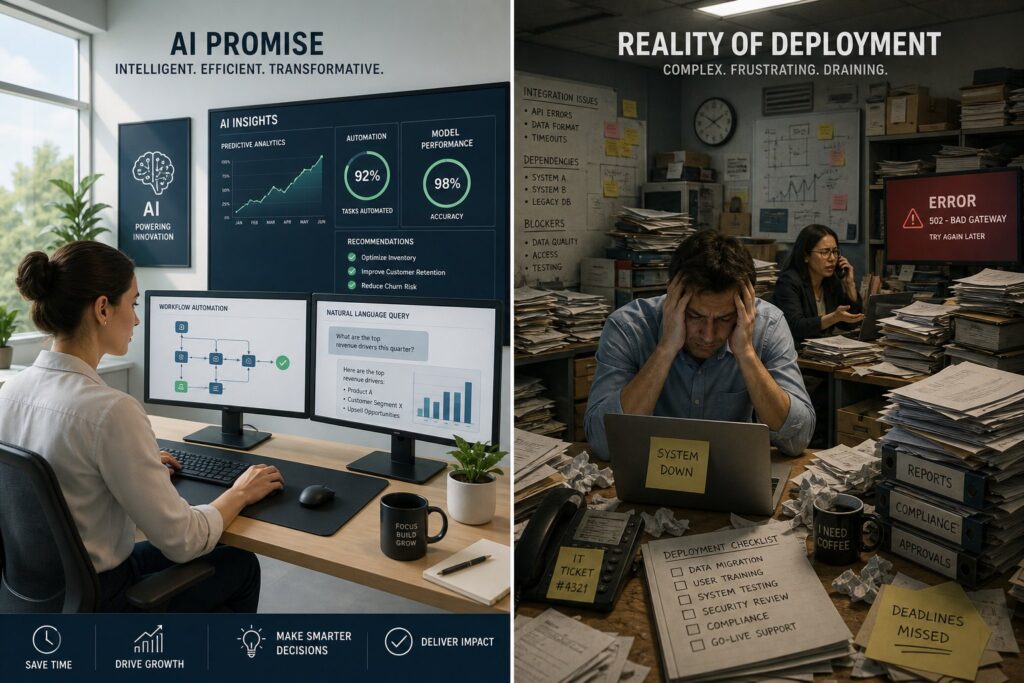
Three months later you have a steering committee, a project manager, six workshops, a consulting team billing $250,000, a configuration spreadsheet with four thousand rows, a Slack war room, and a support portal full of tickets asking why production exploded. Apparently the product is agentic. The rollout definitely is not.
1. The person doing this work today
Before arguing what should change, it is worth being honest about what currently exists, because the industry has normalised a situation that, described plainly, is indefensible.
A human being is sitting somewhere right now trying to deploy enterprise software they have never seen before into a production environment they know only partially. They are reading documentation written by engineers who understood the product deeply but have never seen this customer’s environment. They are translating policies that exist in one system into a configuration model they are still learning. They are making decisions about blast radius with no simulation capability, no dry run, and no meaningful rollback path once the change goes live. They are raising support tickets to a vendor team in a different timezone who respond by asking for log file access, which requires a separate approval, which takes three days, by which point the context is stale and the thread has twenty replies and nobody is sure what the original question was anymore.
And this is before the environment itself fights back. Dependencies that nobody documented surface mid-deployment. Traffic patterns that nobody anticipated break rules that looked correct in staging. Exceptions that lived in one engineer’s head for six years have no representation in any configuration system. Policies have drifted from what the documentation describes, and the rollback path, if it exists at all, was defined by the same person who defined the deployment, under the same constraints, with the same incomplete information.
Deployments do not fail because of configuration errors or insufficient training. They fail because nobody has enough information at deployment time and the tools available to the person doing the work were never designed to close that gap. The vendor’s answer to this problem is more workshops, more discovery sessions, and more consultants who have seen similar environments and can guess at what this one probably contains.
This is not a process that has been optimised poorly. It is a process that has never been optimised at all. It persists because both sides of the transaction have learned to absorb the cost rather than eliminate it. The vendor wraps it in methodology and calls it professional services, and the customer wraps it in governance and calls it change management. Underneath both wrappers is a person working with poor visibility, limited product knowledge, and tools that were not built for the task they are being asked to perform. The most important thing AI can do in enterprise software is not generate a dashboard insight. It is replace that person’s worst day with something that actually works.
2. The least intelligent part of modern software is deployment
The place where customers experience the highest operational uncertainty is not daily operations, and yet that is exactly where vendors stop applying intelligence. Migration, onboarding, deployment, configuration, rule creation, policy definition, identity integration, cutover, and rollback carry the most operational risk in the entire product lifecycle, and AI is almost entirely absent from all of them. Most vendors apply AI only after implementation is complete, which is precisely backwards.
They expect humans to discover dependencies, learn the vendor model, translate policies, build configurations, define rules, predict blast radius, decide rollout sequence, test outcomes, interpret failures, and raise support tickets, and once all of that is done the vendor says: enable AI mode. That is not intelligence. That is outsourcing deployment risk to the customer while calling it a feature.
Some vendors are beginning to move in the right direction, but nobody has fully crossed the gap yet. Netskope’s learning agent observes traffic behaviour before it enforces anything, building a picture of normal from actual usage rather than asking administrators to define policy from memory. Rubrik has moved backup scheduling away from fixed time windows toward load adaptive scheduling that learns when the environment is genuinely quiet, and their DLP capability infers data classification from observed patterns rather than requiring a team to author an exhaustive ruleset before any protection is active. These are meaningful steps toward observation driven deployment, but they are not yet the complete model. The gap between what these products do today and what a fully agentic deployment looks like is where the real opportunity sits.
3. The hidden tax of fake AI products
Enterprise software has developed a peculiar economic model that most buyers accept without questioning it. Advertise fast value, sell software, attach professional services, make implementation mandatory, and blame configuration when outcomes fail. Customers end up funding uncertainty twice: first through licence cost and then through implementation cost. The implementation cost is not incidental, it is structural, and it is baked into the go to market motion of almost every enterprise vendor with an AI badge on the website. A traditional rollout runs between six and twenty-four weeks and carries professional services costs that typically land between one hundred thousand and five hundred thousand dollars before the first user is in production. The risk is front loaded, the rule creation is manual, and the rollback, if it exists, is a human operation performed under pressure.
The absurdity becomes obvious when you compare it to consumer technology. Nobody buys a new phone and pays consultants to configure notifications, migrate contacts, classify apps, optimise battery policies, and manually recreate settings. The device learns from what is already there. Enterprise software somehow went backwards, dressing up a consulting engagement as a deployment methodology and charging for both.
4. The project is the problem
The deepest issue is not that implementation takes too long. It is that deployment is treated as a one time translation event rather than a continuous adaptation process.
The project model assumes risk can be transferred in a single bounded moment, where you are either on the old system or the new one, the cutover is the moment, everything before it is preparation, and everything after it is somebody else’s problem. That assumption was always fragile, and in environments with undocumented dependencies, policy drift, and fifteen years of accumulated exceptions, it is indefensible. A big bang cutover bets the organisation’s operational risk on a moment in time and then hands the result to a support team. The alternative is not a longer project. It is no project at all.
5. Agentic learning and human controlled risk transfer
What agentic deployment actually looks like is not faster implementation. It is a fundamentally different model: continuous learning, gradual exposure, and human controlled risk transfer at every stage.
Day zero begins with read only credentials. The system inventories users, policies, rules, configurations, usage patterns, traffic, incidents, integrations, and historical behaviour without asking you to describe your environment. It reads it. Within hours the agent has built a proposed target architecture, a dependency graph, a migration sequence, a risk model, and a confidence score for each decision it is about to make. Then it presents choices, not tasks. Low confidence decisions stay with the human, high confidence decisions are proposed for approval, and nothing is applied without a clear explanation of what changes, what the rollback path is, and what the agent does not yet know. There are no one way doors. Every action is reversible until the operator explicitly closes the option, and the system moves at the pace of human confidence, not at the pace of the project plan. The human is always in the position of expanding trust, never of recovering from a mistake the vendor made on their behalf.
Traffic shadows before it routes. Rules observe before they enforce. Policies flag before they block. The agent surfaces anomalies in real time and adjusts its own confidence thresholds accordingly, and if something unexpected appears the system narrows its own scope rather than proceeding.
The obvious sceptical question is what happens when the agent gets it wrong, but it is the wrong question because it assumes the risk model is comparable to a traditional deployment. It is not. What the agentic model actually delivers is a complete risk instrumentation suite in the hands of the operator: simulations that model the impact of a proposed change before it touches production, dry runs that execute the logic against real data without applying outcomes, controlled switchovers that move a precisely defined slice of load across while everything else continues running, and switchbacks that reverse any transition cleanly if the operator decides they do not like what they see. None of this requires a change request, a CAB approval, or a war room. It requires a decision.
The result is inch perfect deployment control of a kind that traditional project methodology never came close to offering. A conventional go live transfers risk in bulk at a fixed moment and then manages the consequences, whereas an agentic deployment keeps risk granular, measured, and reversible at every point. The operator always knows exactly what is live, what is shadowing, what has been proven, and what remains to be validated. The footprint expands only when outcomes justify it, and a misconfigured manual rollout has no equivalent constraint. It goes live at full scale on day one and the discovery process is called an incident. Time to safe production means not speed, but the elimination of forced risk accumulation, so that the customer never has to absorb a large irreversible change to move forward.
6. No configuration fees, no customisation tax
When an enterprise software vendor charges for configuration, what they are really charging for is the gap between what the product learned and what the customer’s environment actually contains. The configuration fee is an admission that the product did not learn, and it is billing the customer for the vendor’s failure to observe. A system that reads your existing policies, reconstructs your existing controls, identifies the differences, and asks you to confirm does not require a configuration workshop. It requires a review, and those are not the same thing and should not carry the same price tag. When a DLP agent surfaces data classifications inferred from observed behaviour and asks a human to confirm the risk grade, the human is making a judgement call rather than doing data entry, and that shift in cognitive load is where the configuration fee disappears.
The vendors who survive the next cycle will not offer configuration as a professional service. They will treat the absence of configuration work as proof that their system actually learned something, and the ones still billing day rates for rule entry in 2027 will have a difficult conversation to have with their renewal pipeline.
7. Why this has not happened yet
There is an uncomfortable possibility worth naming directly: maybe implementation is not difficult, and maybe implementation is profitable. Long deployments create services revenue, partner ecosystems, certification programmes, deep lock in, and renewal dependency, and agentic onboarding threatens all of it. If rollout compresses from six months to one day, entire business models compress alongside it, which may explain why so much AI appears inside product dashboards but disappears the moment implementation begins. The AI is real. The incentive to apply it at deployment is not.
There is also resistance on the customer side that rarely gets named. Enterprise IT teams have built genuine professional identity around implementation work, and solution architects, change managers, and deployment leads have spent careers mastering the complexity of getting software from contract to production. Agentic deployment does not just threaten vendor services revenue. It threatens the internal headcount and organisational structures that exist specifically because the current process is hard, and that resistance is quieter than vendor incentives but at least as significant. Buyers should expect it to show up in their own organisations when they try to move faster.
The vendors most likely to break this pattern are not the incumbents. They are the challengers who have nothing to protect and a reason to make the incumbent’s implementation complexity look like what it actually is: a cost the customer carries on behalf of business models that do not serve them.
8. So why is nobody building this?
If faster deployment, lower risk, and greater customer control are genuinely better outcomes, the obvious question is why no vendor has made day one agentic deployment their primary market position. The answer is uncomfortable and operates on several levels simultaneously.
The first is structural. In most enterprise software companies, the sales motion and the implementation motion are owned by different teams running different P&L lines, and professional services is not a cost of delivery but a revenue centre. The CRO who owns the licence number has no organisational incentive to eliminate the services number that sits next to it, and the product team that could build agentic deployment has to make a business case to leadership that explicitly cannibalises an existing high margin revenue stream. The result is that the people with the budget to solve the problem are the same people who benefit financially from its persistence.
The second layer is engineering confidence. Day one agentic deployment requires a vendor to trust their own product’s ability to observe, interpret, and propose changes in an environment they have never seen before, which is a substantially harder problem than building features for customers who are already live and generating feedback. Most product roadmaps are shaped by the existing customer base, which has already survived implementation and wants incremental improvements, and the voice of the person suffering through onboarding rarely reaches the roadmap with enough force to change it.
The third layer is that enterprise buyers have been trained to misread complexity as quality. A product that deploys in a day reads as lightweight, while a product that requires twelve weeks of professional services, a dedicated solution architect, and a formal change programme reads as enterprise grade. That heuristic is irrational but persistent, and vendors have learned to perform complexity rather than eliminate it because the market has historically rewarded the performance. Simplicity gets you into the mid-market. Complexity gets you into the boardroom.
The fourth and perhaps most honest layer is that nobody has been seriously punished for the status quo yet. Buyers absorb implementation costs, attribute project failures to their own environments, and renew licences anyway, and the feedback loop that would force vendors to change has been broken by a procurement culture that separates the buying decision from the deployment experience by months. The person who signed the contract is rarely the person debugging the configuration spreadsheet at midnight.
The disruption will not come from incumbents choosing to cannibalise their own services revenue. It will come from a challenger entering an established category with a credible day one deployment claim, taking enough deals to force a response, and making the incumbent’s twelve week onboarding look like what it actually is. When that comparison becomes visible in competitive evaluations, the conversation will change very quickly, and the incumbents will discover that agentic deployment was technically possible all along. It simply was not commercially convenient.
9. The future benchmark: Time to Safe Production
Today the industry measures features, model accuracy, cost per seat, and uptime, and none of those metrics captures the operational risk a customer carries from contract signature to live production. The metric that should replace implementation length is Time to Safe Production, defined as the elapsed time from signed contract to full production operation with acceptable risk, no dedicated implementation team, and no irreversible configuration decisions made under uncertainty. Any deployment requiring consultants, PMO governance, manual rule writing, configuration workshops, or cross company ticket queues is not agentic. It is software pretending to be labour.
Vendors who can credibly quote this number and back it with a deployment model that never forces a one way door will eventually own the market. Vendors who cannot will continue attaching services revenue to hide the gap, right up until a challenger makes the comparison impossible to ignore.
10. The question buyers should start asking
The next time a vendor says their platform uses AI, ask one question: show me the deployment. Can it discover your environment without you describing it? Can it learn your policies without you encoding them? Can it simulate changes before they touch production, run dry before it runs live, switchover a controlled slice and switchback cleanly if you do not like what you see? Can it deploy gradually, observe in real time, and narrow its own scope when confidence drops? Can it reach safe production without a project, a PM, a consulting team, a log file request, or a configuration fee?
If your AI product still requires humans to discover, translate, configure, test, cut over, debug, and explain it, then the most intelligent component in the system is still the customer. That should concern vendors more than customers. The customers have been managing it for years. They are just tired of being charged for the privilege.